 +1 302-235-9792
 SIGN IN
 CONTACT US


- News
- Antibody Discovery Technologies: How To Build A Smarter Gold Standard for Research
share


Antibody Discovery Technologies: How To Build A Smarter Gold Standard for Research
Content Menu
● Why Antibody Discovery Requires More Than One Technology
● The Four Core Antibody Discovery Technologies
>> Hybridoma Technology: Mature Immune Responses and Stable Monoclonal Sources
>> Single B-Cell Screening: Direct Access to Individual Antibody Repertoires
>> Phage Display: Library Scale, Controlled Selection, and Engineering Flexibility
>> Computational Antibody Engineering: Better Decisions, Not a Substitute for Data
● Comparing Hybridoma, Single B-Cell, Phage Display, and Computational Approaches
● A Practical Framework for Selecting an Antibody Discovery Strategy
>> Start With the Intended Research Application
>> Design Antigens Around Biological Relevance
>> Build Validation Into the Discovery Workflow
● Diversity Is an Asset, Not a Failure of Selection
● From DNA to Antibody: An Integrated Research Workflow
● Why Research Teams Need Transparent Deliverables
● Partner With Gene Universal for Antibody Discovery and Engineering
● Frequently Asked Questions
>> 1. What is the best antibody discovery technology?
>> 2. When should researchers choose hybridoma technology?
>> 3. What is the advantage of single B-cell antibody discovery?
>> 4. Why is phage display useful for difficult targets?
>> 5. Can computational tools replace laboratory antibody screening?
>> 6. What characterization data should be collected for research-use antibodies?
>> 7. Does Gene Universal provide GMP, CDMO, or IND-submission support?
● References
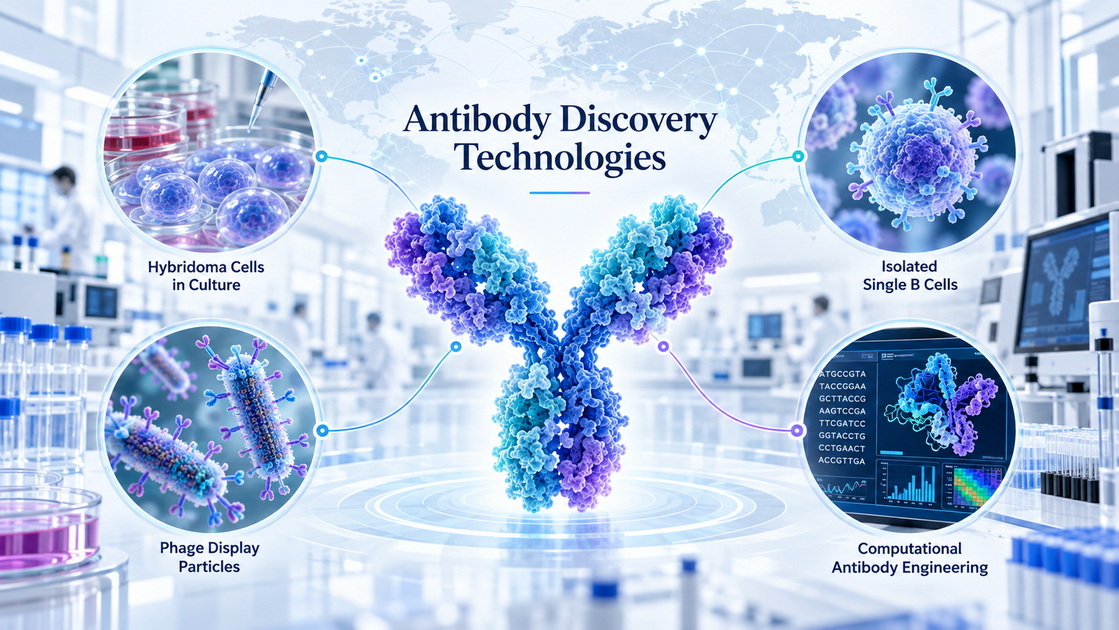
Antibody discovery technologies are most effective when researchers select and combine methods according to the biology of the target, the intended assay, and the evidence needed for early discovery and characterization. Rather than treating hybridoma, single B-cell screening, phage display, and computational antibody engineering as competing choices, experienced teams use each platform's strengths to reduce blind spots and create a more informed candidate-selection process.
For global research teams working on difficult proteins, novel disease mechanisms, infectious agents, cell-surface targets, or assay development, the real objective is not simply to identify a binder. It is to generate well-documented, sequence-confirmed, fit-for-purpose research-grade antibody candidates that can be compared with confidence across affinity, specificity, epitope behavior, expression, and basic biophysical properties.
Gene Universal supports this work through end-to-end research solutions spanning DNA/RNA, recombinant protein, antibody discovery, antibody engineering, expression, purification, and characterization. We serve researchers in more than 100 countries and help connect molecular design decisions with the laboratory evidence needed to move a project forward. Our services are intended for research and preclinical research support; we do not provide GMP, CDMO, or IND-submission support.
Why Antibody Discovery Requires More Than One Technology
Antibodies are highly adaptable recognition molecules. Their ability to bind a target with selectivity makes them central to basic research, biomarker work, infectious-disease studies, cell biology, diagnostics research, and therapeutic discovery programs.
However, antibody discovery is not a single test or a single platform. A project can fail to produce useful research candidates even when the target is biologically relevant. Common causes include:
- The antigen does not present the relevant native conformation
- The screening format favors a narrow subset of binders
- The resulting clone recognizes a tag, carrier, linker, or denatured target rather than the intended antigen
- Heavy- and light-chain combinations do not retain desirable performance after reformatting
- Binding data are collected without enough orthogonal evidence for specificity
- A high-affinity clone is selected before its expression, aggregation tendency, or cross-reactivity profile is understood
A practical discovery strategy therefore starts with a different question:
The Four Core Antibody Discovery Technologies
Hybridoma Technology: Mature Immune Responses and Stable Monoclonal Sources
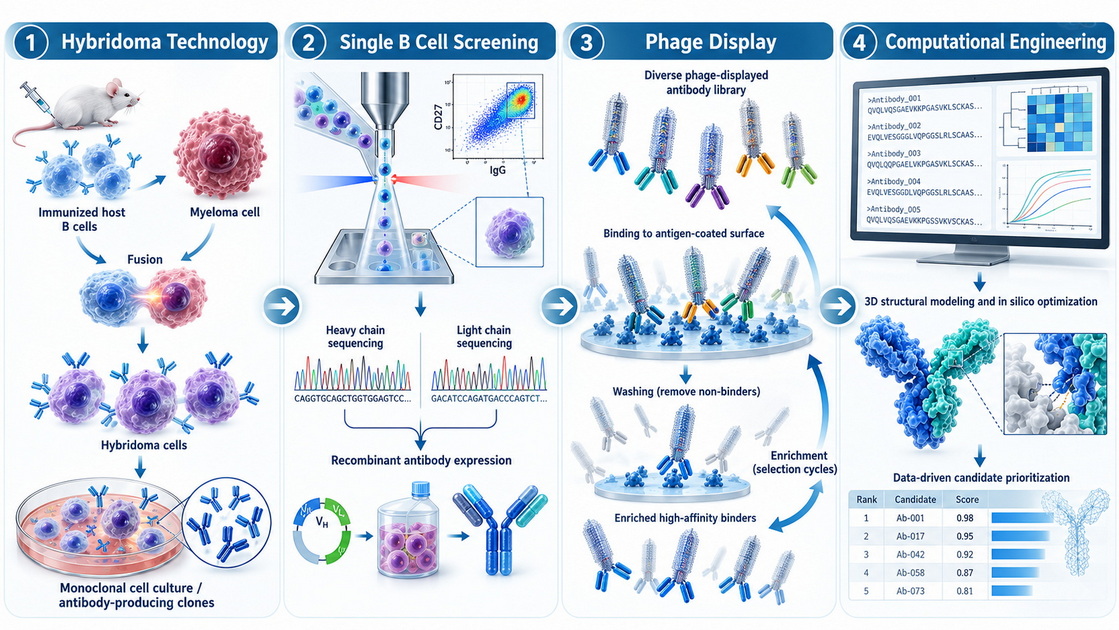
Hybridoma technology remains one of the most established approaches for generating monoclonal antibodies. The workflow typically begins with immunization using a selected antigen. Antibody-producing B cells are then isolated and fused with myeloma cells to create hybridomas, which can be expanded and screened for antigen recognition.
The scientific value of hybridoma technology comes from the natural immune processes that occur before screening. In an immunized host, B-cell populations undergo selection and affinity maturation. This can enrich the repertoire for antibodies that recognize the immunogen and retain naturally paired heavy and light chains.
Hybridoma campaigns can be especially useful when researchers need:
- A conventional route to monoclonal antibody generation
- Antibodies against purified proteins, peptides, or carefully designed immunogens
- Stable monoclonal cell lines for ongoing research use
- Initial panels of binders for assay development
- Antibodies from established host species and immunization workflows
At the same time, hybridoma discovery has practical limitations. Cell fusion can be inefficient, and some potentially valuable B-cell clones may not survive or expand after fusion. The immune response may also focus heavily on immunodominant epitopes, reducing the diversity of the resulting antibody panel.
A productive hybridoma campaign therefore depends heavily on antigen design, immunization planning, screening strategy, and clone selection criteria. Generating many hybridoma wells is not the same as generating many useful antibody candidates.
Single B-Cell Screening: Direct Access to Individual Antibody Repertoires
Single B-cell antibody discovery addresses several limitations of hybridoma workflows. Instead of requiring B-cell fusion and prolonged hybridoma culture, researchers can isolate individual antigen-reactive B cells, recover immunoglobulin sequences, clone matched variable regions, and express recombinant antibodies for evaluation.
One major advantage is preservation of the original heavy- and light-chain pairing from a selected B cell. This matters because antibody performance depends on the combined architecture of both chains, not only on one variable domain in isolation.
A typical single B-cell workflow may include:
1. Preparing antigen-specific probes or cell-based screening reagents
2. Enriching and sorting relevant B-cell populations
3. Isolating individual cells using flow cytometry or microfluidic systems
4. Recovering paired heavy- and light-chain sequences
5. Cloning and recombinant expression of selected antibodies
6. Screening purified candidates using binding and functional assays
7. Sequencing, ranking, and selecting diverse lead families
Single B-cell screening can be particularly valuable when a research team wants to explore a naturally matured immune response while avoiding the fusion step required for hybridoma generation. It can also support rapid sequence recovery and early comparison of multiple antibody lineages.
For infectious-disease research, single-cell methods have become especially important because antigen-specific B cells from exposed, vaccinated, or immunized sources may contain antibodies that recognize biologically meaningful epitopes. Reviews of antibody discovery in infectious diseases describe how B-cell isolation, recombinant cloning, display technologies, and related platforms have expanded the available routes for monoclonal antibody generation.
Phage Display: Library Scale, Controlled Selection, and Engineering Flexibility
Phage display is an in vitro antibody discovery technology that links an antibody fragment's genotype with its binding phenotype. Antibody fragments such as scFv, Fab, or VHH can be displayed on bacteriophage particles, creating libraries that are screened against a target through iterative binding and enrichment steps.
The major advantage of phage display is experimental control. Researchers can define library architecture, select sequence diversity, adjust screening pressure, and change the target presentation across successive rounds.
Phage display may be an effective choice when a project requires:
- Large and defined antibody library diversity
- Discovery against difficult, toxic, weakly immunogenic, or non-immunogenic targets
- Human-framework or synthetic libraries
- Flexible selection conditions
- Target-focused enrichment strategies
- Fragment formats such as scFv, Fab, or VHH
- Iterative affinity maturation or sequence optimization
In a typical biopanning workflow, a library is exposed to an immobilized antigen, target-expressing cells, or another relevant selection format. Non-binding phage are washed away, while retained phage are recovered and amplified. Repeated rounds enrich potential binders, which are then sequenced, reformatted, expressed, and tested.
However, a large library does not automatically solve a discovery challenge. Library size alone cannot correct a poorly designed antigen, irrelevant target presentation, overly harsh washing conditions, or inadequate counter-screening.
The most useful phage display campaigns deliberately include negative selection and orthogonal confirmation. For example, when selecting an antibody against a membrane protein, researchers may use target-negative cells to remove non-specific binders and then confirm hits against target-positive cells. This reduces the risk of advancing clones that recognize shared cell-surface features instead of the intended target.
Computational Antibody Engineering: Better Decisions, Not a Substitute for Data
Computational tools, structural modeling, machine learning, and sequence-based analysis can improve antibody discovery by helping researchers prioritize variants, interpret sequence families, identify potential liabilities, and design focused engineering campaigns.
These approaches are increasingly useful because antibody programs generate large amounts of data. A campaign may produce hundreds or thousands of sequences, multiple binding measurements, expression data, epitope competition results, and functional readouts. Without a structured decision framework, promising diversity can be lost too early.
Computational analysis can help teams:
- Cluster related antibody sequences into families
- Identify sequence diversity across candidate panels
- Support CDR and framework analysis
- Prioritize variants for recombinant expression
- Evaluate potential sequence liabilities
- Guide humanization and back-mutation planning
- Support structural hypotheses for antigen recognition
- Design focused mutagenesis libraries
- Combine experimental data across multiple screening stages
The essential principle is simple: predictions should guide experiments, not replace them. Computational models can help rank hypotheses, but experimental evidence remains necessary to confirm binding, specificity, expression, stability, and intended assay performance.
Comparing Hybridoma, Single B-Cell, Phage Display, and Computational Approaches
| Discovery approach | Core strength | Common research use | Important consideration |
|---|---|---|---|
| Hybridoma technology | Uses an in vivo immune response and naturally paired chains | Monoclonal antibody generation against designed immunogens | Fusion efficiency and immune-response bias can limit accessible diversity |
| Single B-cell screening | Direct recovery of paired antibody sequences from individual B cells | Rapid repertoire interrogation and recombinant antibody generation | Requires effective cell sorting, sequencing, and data handling |
| Phage display | Large, controllable in vitro libraries and flexible selection design | Difficult targets, synthetic libraries, antibody fragments, affinity maturation | Chain pairing and display-based selection bias require careful follow-up |
| Computational engineering | Supports data-driven candidate ranking and focused design | Sequence analysis, humanization planning, variant prioritization | Predictions require experimental confirmation |
There is no universal "best" platform. The best approach depends on the antigen, target biology, intended assay, source material, project timeline, and the type of diversity the research team needs.
A membrane receptor with complex extracellular structure may require cell-based screening and careful counter-selection. A soluble recombinant protein may be well suited to hybridoma or phage display workflows. A viral antigen may benefit from a combination of immunization, single B-cell recovery, recombinant expression, and epitope binning.
A Practical Framework for Selecting an Antibody Discovery Strategy
Start With the Intended Research Application
Before choosing a discovery platform, define how the antibody will be used.
Ask the following questions:
- Will the antibody be used for ELISA, Western blot, flow cytometry, immunofluorescence, immunohistochemistry, immunoprecipitation, or a cell-based assay?
- Must it recognize a native, denatured, fixed, soluble, or membrane-associated form of the target?
- Is the desired epitope linear, conformational, extracellular, intracellular, or unknown?
- Is species cross-reactivity required?
- Are blocking, agonistic, antagonistic, or internalization-related properties relevant to the research question?
- Is the desired output a polyclonal reagent, monoclonal antibody, recombinant IgG, Fab, scFv, or VHH?
- What negative targets, homologs, tags, or cell lines should be included in counter-screening?
This planning stage prevents a frequent mistake: discovering antibodies against the easiest form of an antigen rather than the form that matters in the final assay.
Design Antigens Around Biological Relevance
Antigen quality is often the hidden determinant of discovery success. A highly pure recombinant protein can still be a poor immunogen or screening target if it lacks the relevant conformation, post-translational features, oligomeric state, or domain exposure.
A strong antigen strategy may include:
- Recombinant proteins with validated purity and identity
- Domain-specific constructs
- Peptide antigens for linear epitope objectives
- Cell-based antigen presentation for membrane proteins
- Orthogonal antigen formats for confirmation
- Tag-free proteins for confirmation screening
- Homologous proteins for selectivity assessment
- Negative-control cells or proteins to remove irrelevant binders
For example, a research team studying a cell-surface receptor may use purified extracellular domain protein for initial enrichment, then confirm antibody binding on target-expressing cells. A clone that binds the purified protein but not the cell-surface receptor may still be useful for one application, but it should not be misclassified as a native-cell binder.
Build Validation Into the Discovery Workflow
The goal is not to accumulate positive assay signals. The goal is to assemble a convincing evidence package for each candidate.
A fit-for-purpose characterization plan may include:
- Sequence confirmation: Verify heavy- and light-chain sequences and identify clone families
- Binding confirmation: Use ELISA, biolayer interferometry, surface plasmon resonance, or comparable methods as appropriate
- Specificity assessment: Test antigen-negative controls, related proteins, tags, and relevant cell lines
- Orthogonal assay confirmation: Confirm results using a second assay format
- Epitope binning: Group antibodies by competitive or non-competitive binding behavior
- Expression evaluation: Compare recombinant expression levels across clones
- Purity assessment: Use methods such as SDS-PAGE and SEC-HPLC where appropriate
- Functional research assays: Assess blocking, activation, internalization, neutralization, or other target-relevant activity when scientifically justified
For research-use antibodies, a well-characterized panel is often more valuable than a single "top" clone selected only by one affinity measurement.
Diversity Is an Asset, Not a Failure of Selection
In many discovery programs, teams narrow candidate pools too early. They select only the strongest apparent binders, then later discover that those clones share the same epitope, sequence lineage, or assay limitation.
A better approach is to maintain purposeful diversity during early ranking.
Instead of selecting ten nearly identical sequences, consider retaining candidates that differ across:
- Sequence family
- Epitope bin
- Binding format
- Species cross-reactivity
- Expression behavior
- Functional activity
- Target-domain recognition
- Assay compatibility
This strategy creates options. A candidate that is not the highest-affinity binder may prove more useful in a sandwich assay, competitive assay, cell staining experiment, or mechanistic research study.
The same principle applies to antibody engineering. When modifying a sequence, researchers should avoid optimizing one metric in isolation. Increasing affinity may alter specificity. Improving expression may change binding. A deliberate, data-driven panel provides a stronger basis for selecting research-use candidates.
From DNA to Antibody: An Integrated Research Workflow
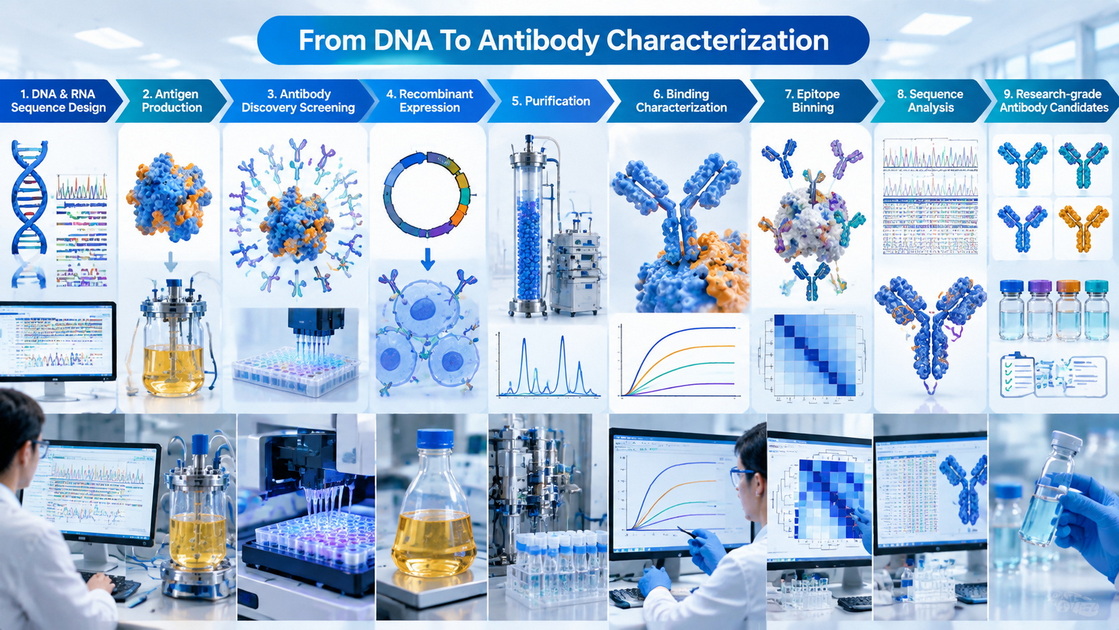
Gene Universal can support interconnected antibody research workflows from early molecular design through recombinant expression and characterization. Bringing these stages into a coordinated research plan can reduce handoffs, shorten iteration cycles, and make it easier to connect sequence information with protein performance.
A typical research workflow may include:
1. Target and antigen planning
Define the target region, antigen format, desired assay, controls, and screening logic.
2. DNA synthesis and molecular construction
Prepare codon-optimized genes, antibody variable-region constructs, expression vectors, or mutagenesis libraries.
3. Recombinant protein production
Produce antigens, antibody fragments, recombinant IgG molecules, or target proteins for screening and confirmation.
4. Antibody discovery and screening
Select a hybridoma, single B-cell, phage display, or combined discovery strategy based on the scientific objective.
5. Recombinant antibody expression
Reformat selected sequences into the required antibody format and generate material for comparative testing.
6. Characterization and candidate ranking
Evaluate binding, specificity, sequence diversity, purity, expression, and relevant functional research readouts.
7. Engineering and re-testing
Conduct humanization, affinity maturation, format conversion, or targeted sequence optimization, followed by repeat characterization.
This integrated model helps research teams avoid treating antibody discovery as an isolated event. It is an iterative process in which antigen quality, sequence design, expression, and assay evidence continuously inform one another.
Why Research Teams Need Transparent Deliverables
A useful antibody discovery project should end with more than a vial of antibody material. It should provide organized scientific information that enables researchers to make their next decision.
Depending on the project scope, transparent deliverables may include:
- Antibody sequence information
- Clone identifiers and sequence-family analysis
- Expression and purification summaries
- Binding-screen results
- Specificity and counter-screen findings
- Epitope binning or competition data
- Basic purity and integrity data
- Recommended next-stage research options
- Retained clone panels for future comparison
Clear documentation matters because antibody behavior is context dependent. A clone may perform well in one assay and poorly in another. Researchers need enough information to understand what was tested, which controls were used, and what conclusions are justified by the available data.
The EMA notes that monoclonal antibodies should be thoroughly characterized, including physicochemical and immunochemical properties, biological activity, purity, impurities, and quantity. Although Gene Universal's work is focused on research and early discovery rather than GMP, the underlying scientific lesson is still valuable: the quality of a decision depends on the quality and relevance of the characterization evidence.
Partner With Gene Universal for Antibody Discovery and Engineering
A strong antibody discovery program starts with a clear scientific question and ends with evidence that helps the research team choose its next experiment.
Gene Universal supports global researchers with integrated solutions across DNA/RNA, recombinant protein, custom antibody development, antibody engineering, expression, purification, and research characterization. Whether your project requires a focused monoclonal antibody panel, recombinant antibody reformatting, humanization support, custom antigen production, or developability-oriented assessment, our team can help design a research workflow aligned with your target biology and intended assay.
Discuss your antibody discovery project with Gene Universal to define the right antigen, platform, screening strategy, and characterization plan for your research goals.
Frequently Asked Questions
1. What is the best antibody discovery technology?
There is no single best technology for every project. Hybridoma technology, single B-cell screening, phage display, and computational antibody engineering each offer different advantages. The right choice depends on the target, antigen format, desired antibody type, intended application, timeline, and validation requirements.
2. When should researchers choose hybridoma technology?
Hybridoma technology can be appropriate when researchers want to generate monoclonal antibodies through an established immunization-based approach. It is often used for soluble proteins, peptides, and designed immunogens. Success depends strongly on antigen design, host response, screening depth, and clone selection.
3. What is the advantage of single B-cell antibody discovery?
Single B-cell screening enables direct isolation and sequencing of individual B cells while preserving matched heavy- and light-chain pairs. It can avoid the cell-fusion step required in hybridoma workflows and can support efficient generation of recombinant antibodies for comparative research screening.
4. Why is phage display useful for difficult targets?
Phage display enables large in vitro antibody libraries and controlled selection conditions. It can be valuable for targets that are toxic, weakly immunogenic, non-immunogenic, or difficult to access through conventional immunization. Careful counter-selection and orthogonal validation are essential to confirm target-specific binders.
5. Can computational tools replace laboratory antibody screening?
No. Computational tools can help prioritize sequences, analyze antibody families, identify potential liabilities, and guide focused engineering. However, experimental testing remains necessary to confirm actual binding, specificity, expression, purity, and performance in the intended research assay.
6. What characterization data should be collected for research-use antibodies?
The appropriate data package depends on the intended use. Common elements include antibody sequence confirmation, binding data, specificity controls, purity assessment, expression information, epitope binning, and relevant functional research assays. Orthogonal validation is especially useful when a candidate will be used in complex biological systems.
7. Does Gene Universal provide GMP, CDMO, or IND-submission support?
No. Gene Universal provides research-focused services for antibody discovery, engineering, recombinant expression, and characterization. Our scope supports early discovery and preclinical research support and does not include GMP manufacturing, CDMO services, or IND-submission support.
References
1. [Twist Bioscience. "The Alchemy of Antibody Discovery: Creating a New Gold Standard."]
2. [National Center for Biotechnology Information. "Hybridoma Technology: Is It Still Useful?"]