 +1 302-235-9792
 SIGN IN
 CONTACT US


- News
- Co-Expression of Molecular Chaperones Vs Low-Temperature Induction: Maximizing Active Protein Yields in High-Density Bacterial Fermentation
share


Co-Expression of Molecular Chaperones Vs Low-Temperature Induction: Maximizing Active Protein Yields in High-Density Bacterial Fermentation
Content Menu
● Why Active Protein Yield Matters More Than Total Expression
● Understanding Molecular Chaperone Co-Expression
>> What Molecular Chaperones Do in E. coli
>> Evidence: How Chaperone Co-Expression Boosts Active Yield
>> Practical Implementation in High-Density Fermentation
● Understanding Low-Temperature Induction
>> How Low-Temperature Induction Changes the Folding Landscape
>> Low-Temperature Induction and Active Yield
>> Practical Design of Temperature-Shift Protocols
● Direct Comparison: Chaperone Co-Expression vs Low-Temperature Induction
>> Core Trade-Offs in High-Density E. coli Fermentation
● Design Patterns for Research-Use Candidates
● Example Workflow from a Service-Provider Perspective
● Operational Best Practices to Maximize Active Protein Yield
● Where Gene Universal Fits in Your Expression Strategy
● Frequently Asked Questions
>> 1. When should I prioritize chaperone co-expression over low-temperature induction?
>> 2. Can I combine multiple chaperone systems without overloading the cell?
>> 3. How low can I go in temperature before productivity collapses?
>> 4. Are inclusion bodies always undesirable for research-use candidates?
>> 5. How can a service provider like Gene Universal help my lab decide between these strategies?
As someone who has spent years optimizing recombinant protein and antibody expression in E. coli for global research labs, I've seen the same bottleneck repeat across projects: high volumetric titers, but low specific activity due to misfolding and inclusion body formation in high‑density cultures. The two most powerful levers my teams consistently return to are co‑expression of molecular chaperones and low‑temperature induction, each reshaping the folding landscape in a different way.
Gene Universal supports scientists worldwide with end‑to‑end solutions from DNA/RNA design through research‑grade protein and antibody expression, focusing on fit‑for‑purpose materials for early discovery and characterization rather than GMP manufacturing or IND‑oriented services. That gives us the freedom to aggressively experiment with expression strategies and help clients select the most productive combination for their target.
Why Active Protein Yield Matters More Than Total Expression
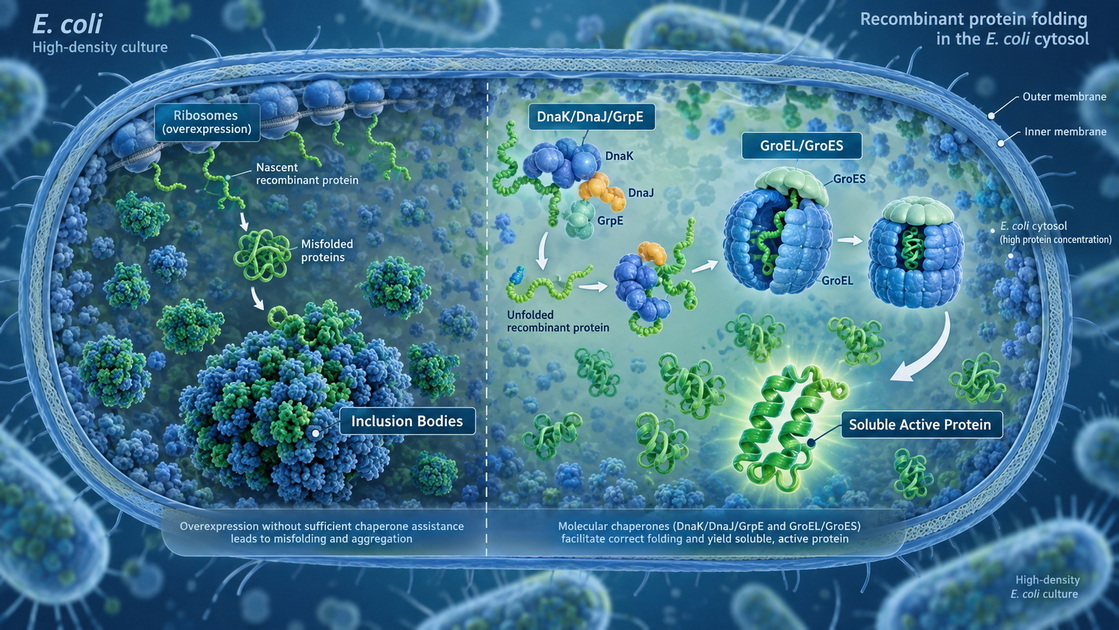
In high‑density fed‑batch fermentation, it is straightforward to push *E. coli* into producing grams per liter of recombinant protein, but much of this material can be misfolded and sequestered in inclusion bodies. For research‑use candidates, the real success metric is active, correctly folded protein per liter, not just total expression.
- Overexpression at standard temperatures often saturates the native chaperone machinery, driving aggregation.
- Inclusion bodies can be refolded, but refolding workflows add cost, complexity, and batch‑to‑batch variability.
- Low‑temperature induction and chaperone co‑expression both aim to shift the balance toward in‑cell folding, reducing downstream refolding burdens.
From a service‑provider perspective, we routinely see projects where a modest reduction in total expression—but a large increase in soluble, active fraction—delivers better assay performance and more robust early discovery data than brute‑force high expression at 37 °C.
Understanding Molecular Chaperone Co-Expression
What Molecular Chaperones Do in E. coli
Molecular chaperones are ATP‑dependent protein quality‑control machines that bind non‑native polypeptides, prevent aggregation, and guide them toward productive folding pathways. Major bacterial systems include:
- GroEL/GroES (Hsp60‑type chaperonin): encapsulates substrates in a central cavity, providing an isolated environment for folding.
- DnaK/DnaJ/GrpE (Hsp70 system): binds exposed hydrophobic segments on nascent chains, cycles them through binding and release for folding.
- Trigger Factor (TF): ribosome‑associated chaperone that acts on very early nascent chains.
Under strong recombinant expression and high cell densities, these systems are easily overwhelmed, leading to misfolding and aggregation.
Evidence: How Chaperone Co-Expression Boosts Active Yield
Multiple studies have shown that co‑expressing chaperones with the target protein increases the fraction of correctly folded, active material:
- In E. coli BL21(DE3), co‑expression of GroEL/GroES increased yields of active enzymes up to 4.9‑fold for certain dehydrogenases, while DnaK/DnaJ/GrpE or TF had substrate‑dependent benefits.
- A systematic study of different chaperone "teams" demonstrated that helix‑rich proteins preferentially benefited from GroEL/GroES or TF, whereas other structural classes responded better to DnaK/DnaJ/GrpE.
- Co‑expression of heterologous chaperones from extremophiles improved folding of aggregation‑prone GFP, increasing soluble fluorescence signal compared with native E. coli chaperones alone.
For clients, this translates into higher active recovery in the soluble fraction, often without radically changing the fermentation platform.
Practical Implementation in High-Density Fermentation
In practice, we design chaperone co‑expression strategies around three axes:
1. Vector architecture
- Separate plasmids for chaperones and the target allow independent tuning of induction levels.
- Well‑established plasmid sets enable overexpression of GroEL/GroES, DnaK/DnaJ/GrpE, TF, or combinations thereof.
2. Induction timing and strength
- Inducing chaperones slightly before or at lower levels than the target helps prevent saturation and competition for expression resources.
- Using tunable promoters (e.g., arabinose‑regulated systems) lets us match chaperone load to target complexity.
3. Substrate‑specific optimization
- For large, multidomain proteins or antibody fragments, we prioritize GroEL/GroES, often combined with TF.
- For enzymes with more flexible or less helical structures, DnaK/DnaJ/GrpE can be more effective.
From an operational standpoint, chaperone co‑expression is a high‑impact lever when the client's main constraint is poor activity or solubility at otherwise acceptable expression levels.
Understanding Low-Temperature Induction
How Low-Temperature Induction Changes the Folding Landscape
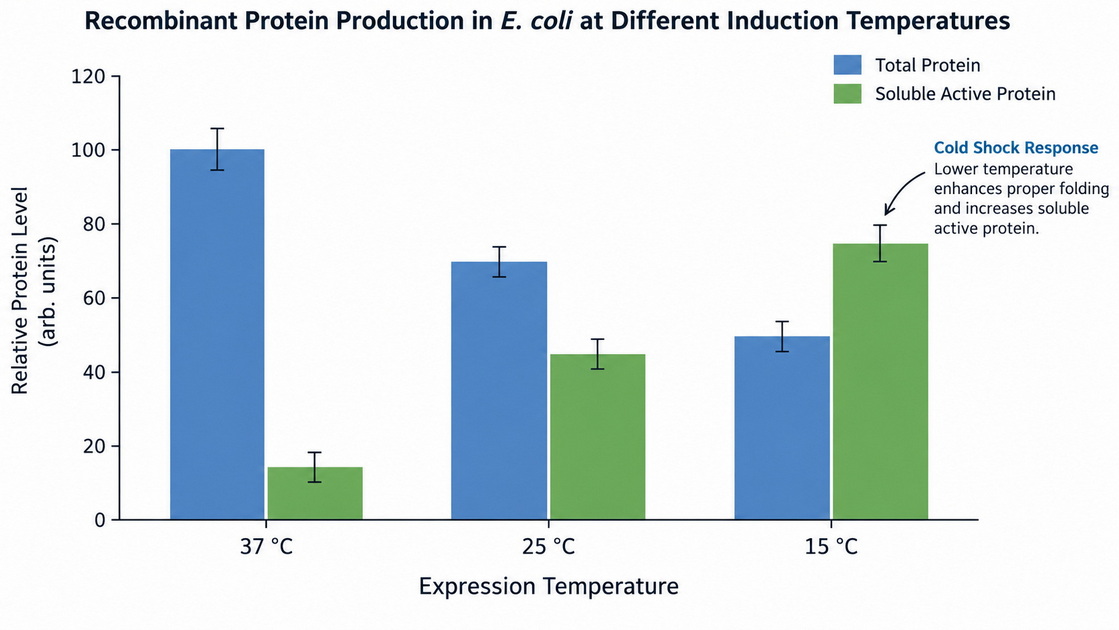
Lowering the expression temperature slows transcription, translation, and overall cell metabolism, reducing the risk of misfolding and aggregation in crowded cytosol. In *E. coli*, temperature downshift triggers a cold shock response, including induction of the CspA cold shock protein and related factors that support translation at low temperatures.
Key mechanistic effects:
- Slower synthesis gives chaperones more time to act on nascent chains.
- Reduced protease activity decreases degradation of partially folded intermediates.
- Cold‑shock promoters such as cspA can drive strong expression at 10–25 °C without chemical inducers.
Low-Temperature Induction and Active Yield
Representative data from the literature show clear gains in active protein yield at lower induction temperatures:
- Inducing expression in early log‑phase cultures at 4 °C yielded roughly three‑fold higher soluble protein compared with mid‑log induction at 37 °C for certain eukaryotic proteins.
- GFP and other aggregation‑prone proteins exhibited five‑fold higher fluorescence in soluble fractions at 16 °C versus 37 °C, indicating improved folding quality.
- Cold‑shock‑driven expression systems using cspA promoters achieved three‑ to five‑fold increases in reporter activity after downshift to 15–25 °C compared with standard 37 °C expression.
- An engineered low‑temperature inducible system in *E. coli* Nissle 1917 achieved >5‑fold and up to ~158‑fold induction rates for GFP and a trehalose synthase using staged temperature shifts, demonstrating strong scalability.
In our client work, low‑temperature induction often turns previously "unexpressible" research‑use proteins into routine production targets, especially for multidomain eukaryotic proteins and antibody fragments.
Practical Design of Temperature-Shift Protocols
When we build protocols for Gene Universal customers, typical patterns include:
- Growth at 37 °C to mid‑log phase (OD\(_{600}\) ~0.5–0.8), then induction and expression at 15–20 °C for 16–20 hours.
- Use of cspA‑based vectors or modified T7 systems combined with temperature control rather than relying solely on IPTG.
- Balancing longer expression time against lower metabolic stress to maintain high cell density with improved folding quality.
Direct Comparison: Chaperone Co-Expression vs Low-Temperature Induction
Core Trade-Offs in High-Density E. coli Fermentation
The table below summarizes the main differences and synergies from a process‑development perspective.
| Aspect | Chaperone Co-Expression | Low-Temperature Induction |
|---|---|---|
| Primary mechanism | Increases folding capacity via additional GroEL/GroES, DnaK/DnaJ/GrpE, TF systems. | Reduces aggregation and misfolding by slowing synthesis and activating cold shock machinery. |
| Impact on active yield | Often multi‑fold increase in active enzymes, substrate‑dependent. | Typically 2–5‑fold increase in soluble, functional protein; sometimes higher. |
| Impact on volumetric productivity | May maintain or increase volumetric yield if metabolic load is managed.pubmed. | May reduce growth rate and total expression but improves specific activity per mg protein. |
| Strain/vector requirements | Requires additional plasmids and antibiotic selection; more complex cloning. | Can use specialized cold‑shock vectors or temperature‑inducible promoters; simpler genetic load. |
| Metabolic burden | Extra ATP cost for chaperone cycles; risk of resource competition at extreme expression. | Lower metabolic stress at reduced temperature but slower biomass accumulation. |
| Optimization complexity | Needs substrate‑specific tuning of chaperone sets and induction levels. | Mainly tuning temperature, induction time, and promoter strength. |
| Best suited for | Targets with high misfolding despite reasonable expression at 30–37 °C; enzyme panels. | Highly aggregation‑prone or complex multidomain proteins; difficult eukaryotic targets. |
In practice, we rarely choose strictly one or the other. Instead, we map the target's properties and the client's constraints (timeline, budget, downstream assays) to a combination of both levers.
Design Patterns for Research-Use Candidates
Several studies have explored cold‑adapted chaperonins co‑expressed under low‑temperature regimes, showing improved host growth and recombinant protein solubility at 4–12 °C. This combination aligns well with what many Gene Universal clients need: highly active, research‑grade materials for early discovery and characterization, rather than maximum volumetric output at all costs.
A robust design pattern we often recommend:
1. Adopt a low‑temperature expression system (e.g., cspA promoter or engineered LT inducible strain) targeting 15–20 °C induction.
2. Co‑express a minimal chaperone set tuned to the target (e.g., GroEL/GroES ± TF for complex antibody fragments).
3. Screen a small matrix of temperatures (12–25 °C) and chaperone stoichiometries using micro‑scale high‑density cultures to identify the sweet spot for activity.
This kind of matrix approach allows us to deliver developability‑oriented assessment for clients before they invest in larger runs, while staying within research‑grade, non‑GMP frameworks.
Example Workflow from a Service-Provider Perspective
To illustrate how this looks in a real project, consider a hypothetical antibody fragment intended for preclinical research support:
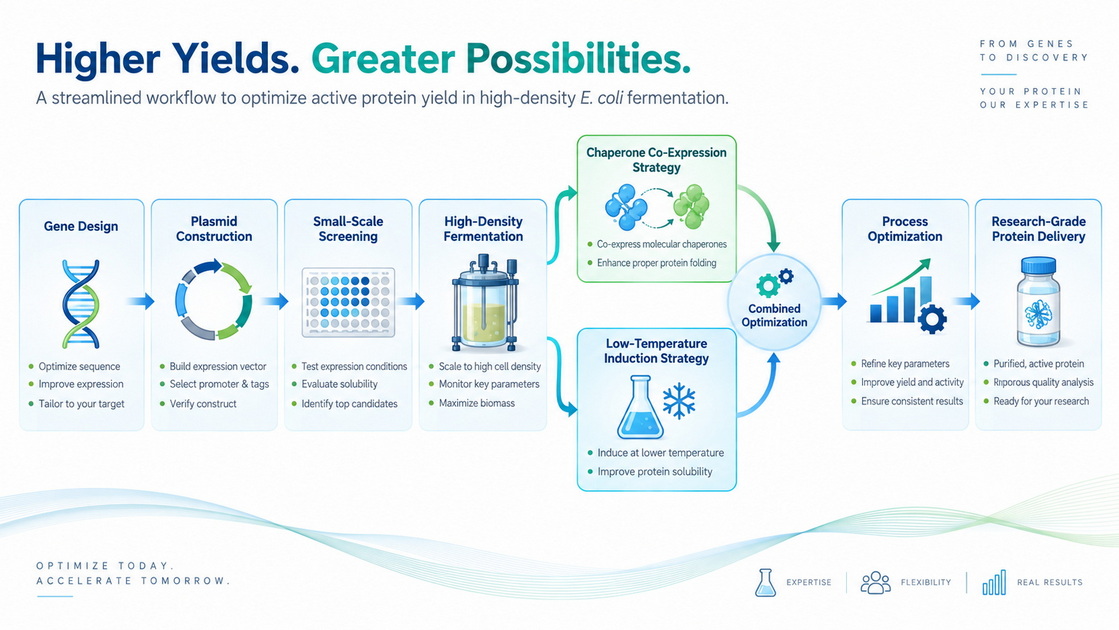
1. Sequence and construct design
- Codon optimization for *E. coli* BL21(DE3) and choice of periplasmic vs cytosolic expression based on disulfide requirements.
- Parallel cloning into a standard T7 vector and a cspA‑based cold‑shock vector.
2. Screening phase
- Small‑scale high‑density cultures grown to OD\(_{600}\) ~0.6–0.8 at 37 °C, then induced at 18 °C or 15 °C with or without co‑expressed GroEL/GroES and DnaK/DnaJ/GrpE.
- Measurement of soluble vs insoluble fractions and binding activity to the antigen.
3. Process optimization
- Selection of the temperature–chaperone combination giving the highest active yield per liter, even if total expression is slightly lower.
- Refinement of feed strategy and oxygen transfer (e.g., shaking speed, baffled flasks, fed‑batch regime) to maintain high cell density without compromising folding.
4. Scale‑up for fit‑for‑purpose materials
- Transition into larger bioreactors under the optimized regime to supply research‑grade antibody fragments for early discovery assays, structural studies, or developability screens.
Through this process, the client gains a data‑driven understanding of which lever—chaperones, temperature, or both—is most effective for their molecule.
Operational Best Practices to Maximize Active Protein Yield
From repeated campaigns across enzymes, cytokines, and antibody fragments, several practical rules stand out:
- Start from lower induction temperatures by default (e.g., 15–20 °C) for new, aggregation‑prone targets; escalate only if activity is acceptable at higher temperatures.
- Use design‑of‑experiments to jointly optimize inducer concentration, temperature, induction time, and chaperone load, rather than adjusting one factor at a time.
- Monitor inclusion bodies as a resource, not just a problem—a growing body of work shows that inclusion bodies can retain native‑like structure and activity, which may be leveraged for certain applications.
- Select strains and vectors that support tunable expression, such as Lemo21(DE3), Tuner(DE3), or araBAD‑controlled systems, to avoid overwhelming folding capacity.
These steps align strongly with Gene Universal's role in method development and optimization for clients who need reliable, reproducible research‑grade materials.
Where Gene Universal Fits in Your Expression Strategy
Gene Universal is positioned as a global partner for DNA/RNA design, plasmid construction, and research‑grade protein and antibody expression, serving labs in more than 100 countries. Our focus is on:
- Designing expression constructs and screening strategies that integrate chaperone co‑expression and low‑temperature induction intelligently.
- Delivering fit‑for‑purpose materials for early discovery campaigns, mechanistic studies, and developability‑oriented assessment, rather than GMP or CDMO‑style manufacturing.
- Providing consultative support to help your team interpret activity, solubility, and yield profiles and decide when to scale a chosen process.
By combining literature‑grounded best practices with iterative lab work, we help you move from "it expresses, but it doesn't work" to high‑confidence, active protein production suitable for demanding research workflows.
If your team is facing low activity, aggregation, or inconsistent yields in high‑density *E. coli* fermentation, we can help you systematically evaluate chaperone co‑expression and low‑temperature induction for your specific target. Reach out to Gene Universal to discuss your expression bottlenecks, share current data, and design a targeted optimization plan that delivers fit‑for‑purpose research‑grade proteins and antibodies for your next round of discovery.
Frequently Asked Questions
1. When should I prioritize chaperone co-expression over low-temperature induction?
Prioritize chaperone co‑expression when your protein reaches reasonable expression levels at 30–37 °C but shows poor activity or solubility, especially for enzyme panels or smaller domains that respond well to GroEL/GroES or DnaK/DnaJ/GrpE. Low‑temperature induction is preferable as a first step for large, multidomain proteins or antibody fragments that aggregate heavily at standard temperatures.
2. Can I combine multiple chaperone systems without overloading the cell?
Yes, but you need to manage metabolic load carefully using separate, tunable promoters and stepwise induction. We typically start with a minimal combination (e.g., GroEL/GroES plus TF) and then expand only if activity gains justify additional ATP expenditure and plasmid burden.
3. How low can I go in temperature before productivity collapses?
Below about 10–15 °C, *E. coli* growth slows dramatically and high‑density fermentation becomes challenging, even though folding quality may improve. Most industrial and service‑lab workflows find a practical balance around 15–20 °C, where soluble active yield increases significantly but biomass accumulation remains manageable.
4. Are inclusion bodies always undesirable for research-use candidates?
Not necessarily. Modern studies show that inclusion bodies can retain native‑like secondary structure and even biological activity, which can be useful for certain delivery or refolding‑based applications. For routine biochemical assays, however, maximizing soluble active protein remains the preferred path to reduce complexity in purification and refolding.
5. How can a service provider like Gene Universal help my lab decide between these strategies?
We can design and execute a small but informative screening campaign that tests temperature ranges, chaperone sets, and induction regimes in parallel. Based on measured activity, solubility, and yield, we then recommend a fit‑for‑purpose process and provide research‑grade materials along with data and process parameters that your lab can replicate or scale.