 +1 302-235-9792
 SIGN IN
 CONTACT US


- News
- Comprehensive Guide to Plasmid Vectors: Functional Characterization and Basic Components for Modern Molecular Biology.
share


Comprehensive Guide to Plasmid Vectors: Functional Characterization and Basic Components for Modern Molecular Biology.
Content Menu
● Role of Plasmid Vectors in Molecular Biology
● Functional Characterization of Plasmid Vectors
>> Copy Number and Replication Dynamics
>> Selectability and Marker Function
>> Expression Performance and Regulatory Sequences
● Basic Components of a Plasmid Vector
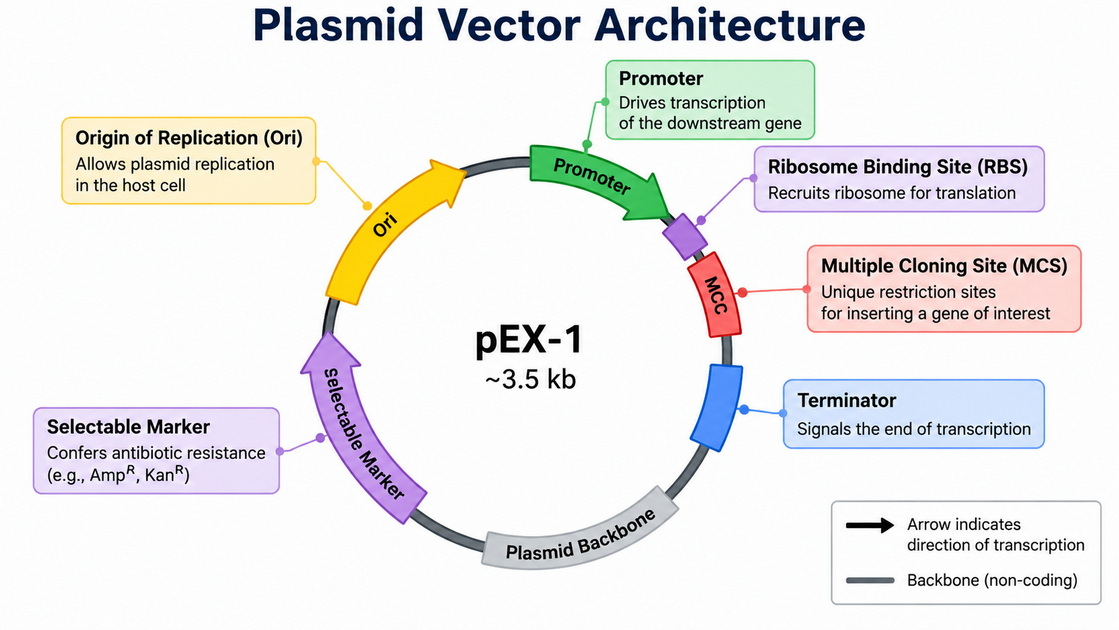
>> Origin of Replication (Ori)
>> Selectable Marker Gene
>> Multiple Cloning Site (MCS)
>> Promoter and Enhancer Elements
>> Ribosome Binding Site (RBS)
>> Transcription Terminator and Poly(A) Signals
>> Optional Elements: Primer Binding Sites, Tags, and Reporters
● From Design to Functional Characterization
● Expert Tips for Choosing and Optimizing Plasmid Vectors
● Supporting Global Plasmid-Based Research at Gene Universal
● Emerging Trends in Plasmid Vector Engineering
● Core Plasmid Components and Design Considerations
● Frequently Asked Questions (FAQ)
● References
As a molecular biology specialist working with researchers across more than one hundred countries, I rely on plasmid vectors every day to turn ideas into actionable experiments, from DNA and RNA constructs through to proteins and antibodies. When these vectors are well designed and carefully characterized, they become the backbone of reproducible cloning, expression, and early discovery work in the lab.

Role of Plasmid Vectors in Molecular Biology
Plasmid vectors are small, circular DNA molecules that carry foreign genetic sequences into host cells, typically bacteria but also yeast and mammalian systems via specialized backbones. They combine a replication origin, selection markers, and expression cassettes to enable cloning, expression, and functional analysis in a controlled environment.
Because they replicate independently from the host chromosome, plasmid vectors allow researchers to rapidly amplify a construct, test variants in parallel, and iterate through multiple design cycles without rebuilding the host strain each time. This flexibility makes them central to work in gene cloning, protein production, vaccine research, and synthetic biology.
Key roles of plasmid vectors:
- Gene cloning and subcloning for sequence validation and downstream expression.
- Transient and stable expression of proteins and non-coding RNAs in prokaryotic and eukaryotic systems.
- Reporter assays using fluorescent or enzymatic readouts to probe promoters, enhancers, and regulatory elements.
Functional Characterization of Plasmid Vectors
Functional characterization is the process of confirming that a plasmid vector behaves exactly as intended under experimental conditions. It goes beyond sequence confirmation to address copy number, stability, expression level, and host compatibility.
Copy Number and Replication Dynamics
Every plasmid backbone includes an origin of replication (Ori) that determines how many copies of the plasmid are maintained per cell and in which host species it can replicate. High-copy origins (often derived from ColE1-type replicons) can reach dozens of copies per cell, providing strong DNA yield and high expression at the cost of increased metabolic burden.
Low-copy origins are favored when cloning large inserts, toxic genes, or complex libraries, because they reduce stress on the host and improve long-term stability. Thoughtful selection of Ori is one of the most important design decisions for robust plasmid-based workflows.
Selectability and Marker Function
Functional plasmid vectors must allow unambiguous selection of successfully transformed cells. Most designs rely on antibiotic resistance genes such as ampicillin, kanamycin, chloramphenicol, or hygromycin, which are well characterized in bacterial and plant systems.
Markers are evaluated not only for their selection strength but also for compatibility with downstream assays, biosafety requirements, and local institutional guidelines. In some advanced systems, dual markers or recyclable resistance cassettes are used to support multi-vector experiments in the same host strain.
Expression Performance and Regulatory Sequences
For expression vectors, functional characterization focuses on the promoter, ribosome binding site (RBS), and terminator that drive transcription and translation of the inserted gene. Researchers measure:
- Basal and induced expression levels under defined culture conditions.
- Leakiness of regulated promoters and the dynamic range between "off" and "on" states.
- Protein solubility and folding, sometimes aided by tags and chaperone co-expression.
At Gene Universal, we routinely help teams design and test vectors in a way that aligns expression strength with assay sensitivity, avoiding both under-expression and unnecessary overload on the host system.
Basic Components of a Plasmid Vector
Although plasmid vectors can be highly specialized, most share a common set of core components that define their behavior. Understanding these elements is essential for both troubleshooting and rational design.
Origin of Replication (Ori)
The Ori is the sequence where plasmid replication initiates, recruiting host replication proteins and determining copy number and host range. Many origins are AT-rich, which facilitates local DNA melting and assembly of the replication machinery.
- High-copy origins: Ideal for routine cloning and high-yield plasmid prep.
- Low-copy origins: Preferred for large inserts, pathways, or potentially toxic genes.
Some vectors include dual origins, enabling shuttle behavior between bacteria and eukaryotic cells, which is particularly useful in synthetic biology and gene delivery studies.
Selectable Marker Gene
Selectable markers provide a clear phenotype to identify cells that carry the plasmid. The most common approach is an antibiotic resistance gene, but markers can also encode herbicide resistance or other traits in plant and specialized systems.
Effective marker design considers:
- Compatibility with the host strain and medium.
- Regulatory and biosafety guidance from institutional committees and international agencies.
- Avoidance of unnecessary resistance genes when they do not add experimental value.
Multiple Cloning Site (MCS)
The MCS is a compact region containing many unique restriction sites, serving as the primary insertion point for foreign genes. A well-designed MCS:
- Offers flexibility in cloning strategies (single-cut, double-cut, or ligation-independent).
- Sits in a position that preserves promoter function and terminator efficiency.
- Avoids repetitive or palindromic motifs that might promote recombination.
Promoter and Enhancer Elements
Promoters drive transcription of the gene of interest, while enhancers and operator sequences fine-tune the level and timing of expression. They are typically classified as:
- Constitutive promoters for steady, continuous expression.
- Inducible promoters responsive to small molecules, temperature, or stress.
- Tissue- or cell-type-specific promoters for work in more complex organisms.
The choice of promoter strongly influences protein yield, toxicity, and experimental reproducibility.
Ribosome Binding Site (RBS)
The RBS sits upstream of the start codon and ensures that ribosomes can bind and initiate translation efficiently. In bacteria, this often corresponds to a Shine–Dalgarno sequence, while in eukaryotes translation initiation depends on the 5' cap structure and, in some cases, internal ribosome entry sites (IRES).
Careful RBS design can significantly improve expression, especially when combined with codon optimization and folding-friendly tags.
Transcription Terminator and Poly(A) Signals
Terminators are non-coding sequences downstream of the gene that ensure proper transcription termination and mRNA processing.
In many bacterial systems, terminators rely on GC-rich inverted repeats that form hairpin structures in the nascent RNA, causing RNA polymerase to disengage. In mammalian expression plasmids, terminators often include conserved poly(A) motifs (e.g., AAUAAA) that promote polyadenylation and signal termination.
Robust terminators reduce read-through, stabilize expression, and improve plasmid integrity during large-scale preparation.
Optional Elements: Primer Binding Sites, Tags, and Reporters
Many modern plasmid vectors also include:
- Primer binding sites to simplify sequencing and PCR-based verification.
- Epitope tags or fluorescence reporters (such as His-tags or GFP) for purification and detection.
- Origins of transfer (oriT) and recombination sites for integration into chromosomes or modular assembly workflows.
These elements expand the versatility of the vector while keeping the core architecture intact.
From Design to Functional Characterization
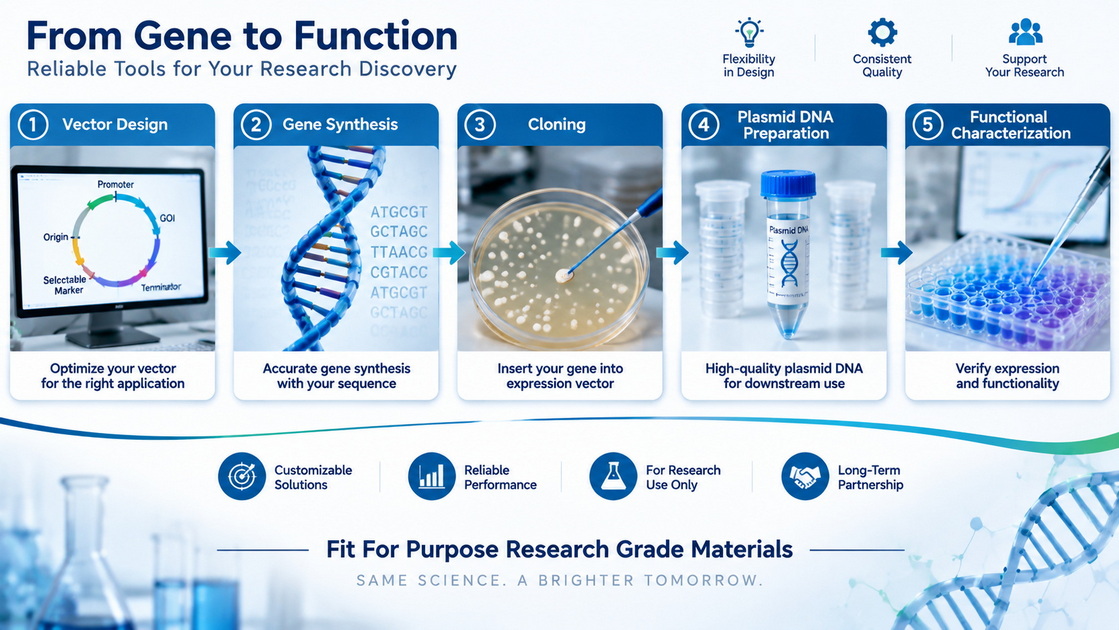
From a practical, project-level perspective, designing and validating a plasmid vector typically follows a structured, repeatable workflow. At Gene Universal, we apply this process to support early discovery and characterization projects using fit-for-purpose research-grade materials.
A typical workflow:
1. Define the research objective.
Clarify host system, expression level, duration, and downstream assays.
2. Select backbone and Ori.
Match copy number and host range to insert size and experimental constraints.
3. Choose promoter, RBS, and terminator.
Align expression strength and regulation with protein behavior and assay sensitivity.
4. Plan the MCS strategy.
Decide on restriction enzymes or recombination systems, minimizing internal sites in the insert.
5. Introduce and verify the insert.
Use sequencing, restriction analysis, and functional assays to confirm construct integrity.
6. Characterize expression and stability.
Measure protein levels, host growth, and plasmid maintenance over multiple passages.
7. Refine design as needed.
Adjust promoter strength, RBS composition, or copy number to optimize fit-for-purpose performance.
Expert Tips for Choosing and Optimizing Plasmid Vectors
Drawing on experience from supporting thousands of constructs across diverse applications, several practical principles consistently improve outcomes.
Match vector complexity to project stage.
Early screening and feasibility work often benefits from simple, robust backbones with strong promoters and standard markers. Later optimization can introduce more nuanced regulation and modular assemblies.
Limit metabolic burden on the host.
Overly strong promoters combined with high-copy origins can slow growth and promote instability, especially for membrane or secreted proteins. A balanced design often yields more reproducible data than aggressive overexpression.
Design for verification and troubleshooting.
Include primer binding sites and diagnostic restriction patterns that make it easy to verify constructs quickly. When projects scale to dozens or hundreds of variants, this upfront planning saves substantial time.
Consider long-term storage and reuse.
Stable backbones and clearly documented maps enable future teams to reuse constructs, re-open projects, or build derivative libraries efficiently. As a global service provider, we've seen how good documentation and thoughtful vector architecture directly improve collaboration.
Supporting Global Plasmid-Based Research at Gene Universal
From our base in the United States, Gene Universal collaborates with laboratories worldwide on projects ranging from simple cloning to complex pathway assembly. Our support covers the full experimental continuum from DNA and RNA constructs through proteins and antibodies, always focusing on research-use candidates and developability-oriented assessment rather than regulated manufacturing.
In practice, this means helping teams:
- Select appropriate plasmid vectors for cloning, expression, and functional assays.
- Optimize regulatory sequences to increase signal quality in early discovery studies.
- Build and manage modular libraries that can be screened for fit-for-purpose biological activity.
By combining local expertise with a global delivery footprint, we aim to make advanced plasmid vector design accessible to researchers in more than one hundred countries.
Emerging Trends in Plasmid Vector Engineering
Recent literature highlights several important trends in plasmid vector engineering that directly influence everyday molecular biology work.
Modular and integrative architectures.
Synthetic biology has driven the development of modular vectors with interchangeable origins, markers, and expression cassettes that can be integrated into host chromosomes when needed. This modularity reduces redundancy and enables more systematic exploration of design spaces.
Safer and more efficient backbones.
Research on DNA vaccine plasmids and nonviral gene delivery has spurred backbones that balance high yield with improved structural stability and reduced unwanted sequences. While these designs are often developed for advanced applications, many of their principles—such as origin orientation and terminator placement—translate well to routine expression work.
Rational optimization of expression control.
Combining promoter engineering, codon optimization, and synthetic RBS design allows fine-grained tuning of protein levels, enabling more precise mechanistic studies and better-quality data for downstream decision-making. For service providers like Gene Universal, these advances expand the toolkit available to clients working in complex pathways or challenging targets.
Core Plasmid Components and Design Considerations
| Component | Primary role | Practical design considerations |
|---|---|---|
| Origin of replication (Ori) | Controls copy number and host rangepmc.ncbi.nlm.nih+1 | Balance yield vs. burden; select host-compatible origins. |
| Selectable marker | Enables identification of transformed cellspmc.ncbi.nlm.nih+1 | Choose markers aligned with host, medium, and biosafety needs. |
| MCS | Provides insertion sites for foreign DNAsynbio-tech+1 | Ensure unique sites, avoid internal cut sites in the insert. |
| Promoter / enhancer | Drives transcription of the gene of interestpmc.ncbi.nlm.nih+1 | Match strength and regulation to assay requirements. |
| RBS / initiation elements | Initiates translation of mRNA into proteinsynbio-tech+1 | Tune for expression efficiency and folding quality. |
| Terminator / poly(A) | Ensures proper transcript terminationsynbio-tech+1 | Reduce read-through; stabilize expression and plasmid integrity. |
If you are planning a new plasmid-based project—from basic cloning to complex expression studies—and want end-to-end support across DNA, RNA, protein, and antibody workflows, Gene Universal can help you design and implement a fit-for-purpose vector strategy tailored to your host system and research objectives. Reach out to our team to discuss your requirements and explore scalable, research-focused solutions for your next experiment.
Frequently Asked Questions (FAQ)
1. What is the most important feature to consider when choosing a plasmid vector for a new project?
The most critical feature is usually the origin of replication, because it determines copy number, host range, and overall plasmid behavior. Once Ori is chosen, you can tune promoters, markers, and MCS to fit the experimental goal.
2. How do I decide between a high-copy and low-copy plasmid?
High-copy plasmids are ideal when you need large amounts of DNA or strong expression of relatively benign proteins. Low-copy plasmids are better for large constructs, multi-gene pathways, or proteins that stress the host, as they help maintain stability and healthier growth.
3. Why does my expression drop after several passages, even though my construct is correct?
Loss of expression over time often reflects plasmid instability or selective pressure against high expression. Reviewing promoter strength, copy number, and culture conditions—and confirming that the selection marker is maintained—can usually identify the underlying issue.
4. Can one plasmid backbone work in both bacterial and mammalian cells?
Yes, shuttle vectors combining bacterial and eukaryotic origins, markers, and expression cassettes are widely used. However, they must be carefully designed so that each module functions correctly in its respective host.
5. How does Gene Universal support plasmid vector projects without providing GMP or regulatory services?
We focus on research-use candidates, helping teams design, build, and characterize plasmid vectors for discovery and preclinical studies. Our role is to deliver fit-for-purpose research-grade materials and technical guidance, leaving regulated manufacturing and submission work to specialized partners.
6. What are common mistakes that reduce cloning efficiency in plasmid work?
Frequent issues include internal restriction sites in the insert, poorly chosen MCS strategies, and inadequate verification of sequence and orientation. Careful planning of cloning sites and diagnostic checks greatly reduces these problems.
References
1. Designing plasmid vectors. *Hum Gene Ther.* PubMed.
[https://pubmed.ncbi.nlm.nih.gov/19565899/]
2. The art of vector engineering: towards the construction of next-generation genetic tools. *Microb Biotechnol.* PubMed Central.
[https://www.ncbi.nlm.nih.gov/pmc/articles/PMC6302727/]
3. Plasmid DNA vaccine vector design: impact on efficacy, safety and stability. *Expert Rev Vaccines.* PubMed Central.
[https://www.ncbi.nlm.nih.gov/pmc/articles/PMC2693335/]
4. T-DNA binary vectors and systems. *Methods Mol Biol.* PubMed Central.
[https://www.ncbi.nlm.nih.gov/pmc/articles/PMC2245830/]
5. Modular and integrative vectors for synthetic biology applications in *Streptomyces* spp. *ACS Synth Biol.* PubMed Central.
[https://www.ncbi.nlm.nih.gov/pmc/articles/PMC6677859/]
6. Plasmid vectors: components, markers, examples, applications. Microbe Notes (summary aligned with NCBI-based concepts).