 +1 302-235-9792
 SIGN IN
 CONTACT US


- News
- CRISPR Screening sgRNA Libraries Made Easy: A Practical Guide to Custom Library Design
share


CRISPR Screening sgRNA Libraries Made Easy: A Practical Guide to Custom Library Design
Content Menu
● What Is a CRISPR Screening sgRNA Library?
● Choose the Right CRISPR Screen Before Designing Guides
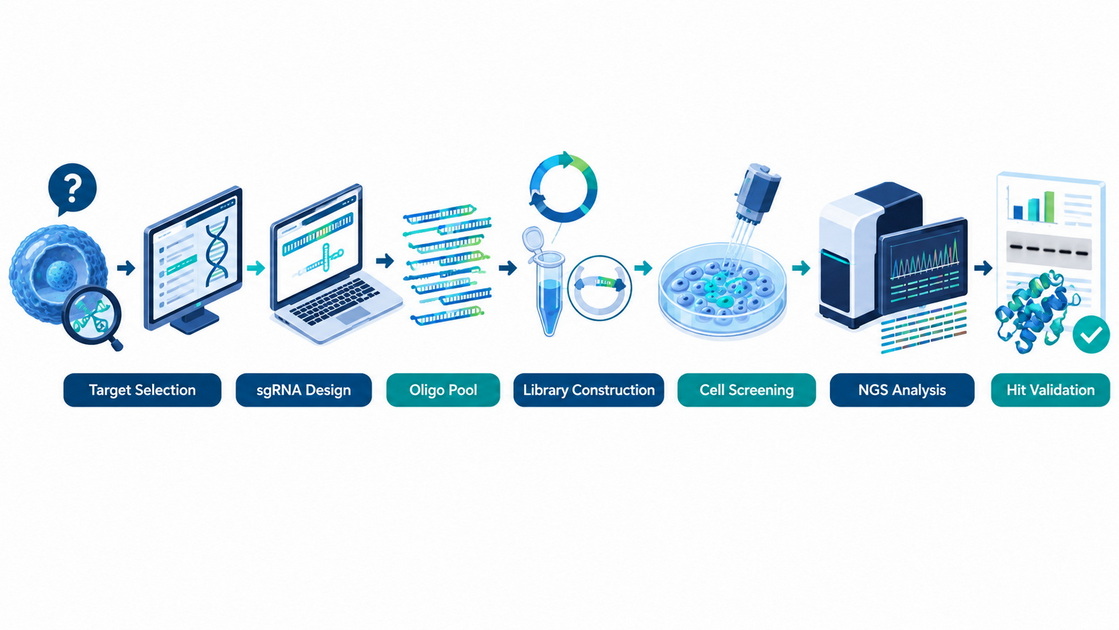
● How to Design a Custom sgRNA Library
>> 1. Define the Phenotype and Readout
>> 2. Rank Guides by More Than One Score
>> 3. Design for Biological Redundancy
>> 4. Add Cloning-Ready Sequence Architecture
● Oligo Pool Synthesis and Representation
● A Stage-Gated Workflow That Reduces Rework
● Calculate Coverage as a Chain, Not One Number
● Common Failure Modes and Corrective Actions
● Expert Checklist Before Ordering an Oligo Pool
● How Gene Universal Supports CRISPR Research
● Frequently Asked Questions
>> 1. How Many sgRNAs Should Target Each Gene?
>> 2. Should a Lab Choose a Genome-Wide or Focused CRISPR Library?
>> 3. Why Is sgRNA Library Representation Important?
>> 4. What Controls Belong in a Pooled CRISPR Screen?
>> 5. How Should Off-Target Risk Be Handled During Library Design?
>> 6. When Should the Plasmid sgRNA Library Be Sequenced?
● References
A reliable CRISPR screening sgRNA library begins long before cells are transduced. It begins with a clearly defined biological question, a guide-selection strategy matched to the perturbation mode, and an oligo pool engineered to preserve representation through cloning and screening. When those decisions are aligned, a custom sgRNA library can make pooled CRISPR screening more efficient, interpretable, and easier to validate.
Gene Universal supports research teams in more than 100 countries with integrated services spanning DNA/RNA, proteins, and antibodies. For CRISPR workflows, that support can include custom oligo synthesis and research-focused molecular biology services. These offerings are intended for research use and early discovery. Gene Universal does not provide GMP manufacturing, CDMO services, or IND submission support.

What Is a CRISPR Screening sgRNA Library?
A CRISPR screening library is a defined collection of single-guide RNA sequences designed to direct a Cas protein or Cas-derived effector to many genomic targets in parallel. In a pooled screen, each cell ideally receives a limited number of perturbations. Researchers then connect changes in guide abundance—or guide identity in individual cells—to a measurable phenotype.
The library is therefore more than a sequence list. It is an experimental system whose performance depends on four connected layers:
- Biological design: the hypothesis, model, phenotype, and perturbation mechanism.
- Guide design: on-target activity, specificity, target location, and sequence constraints.
- Physical library quality: oligo accuracy, cloning efficiency, and guide representation.
- Screen execution: delivery conditions, coverage, sampling, sequencing, and analysis.
Weakness in any one layer can reduce the value of the entire screen. A sophisticated analysis pipeline cannot fully rescue guides that were poorly selected or lost during library construction.
Choose the Right CRISPR Screen Before Designing Guides
The best library architecture follows the biological question. Selecting a familiar nuclease first and forcing the experiment around it often creates unnecessary compromises.
| Screening mode | Typical purpose | Preferred target region | Important design concern |
|---|---|---|---|
| CRISPR knockout | Disrupt protein-coding genes | Constitutive coding exons or critical protein domains | Frameshift probability, exon usage, copy-number effects |
| CRISPR interference | Repress transcription without cutting both DNA strands | Around the transcription start site | Cell-specific transcript annotation and chromatin accessibility |
| CRISPR activation | Increase endogenous gene expression | Promoter-proximal regulatory regions | Distance and orientation relative to the transcription start site |
| Tiling screen | Map functional regions | Dense guides across a locus, enhancer, or protein domain | Guide spacing, local sequence availability, and statistical resolution |
| Focused pathway screen | Test a defined gene set | Depends on the perturbation mode | More guides per gene, controls, and pathway coverage |
For CRISPRi and CRISPRa libraries, transcription start site selection is especially important. A guide can have an excellent sequence score and still underperform if it targets the wrong promoter for the chosen cell type. For knockout screens, guides aimed at shared coding exons or essential protein domains can create clearer loss-of-function phenotypes than guides placed without regard to isoforms.
How to Design a Custom sgRNA Library
1. Define the Phenotype and Readout
Start with the endpoint, not the oligo. Decide whether the experiment measures survival, drug response, reporter intensity, surface-marker abundance, morphology, or a transcriptomic state. The readout determines whether the screen should be pooled or arrayed and whether the library must be genome-wide, pathway-focused, or locus-specific.
A practical design brief should record:
- Species, genome build, and cell model.
- Cas system, PAM requirement, and perturbation mode.
- Gene list, transcript set, or genomic intervals.
- Positive, negative, and safe-targeting controls.
- Intended delivery vector and cloning overhangs.
- Number of guides per target and acceptable library size.
- Planned biological replicates, cell coverage, and sequencing depth.
2. Rank Guides by More Than One Score
On-target prediction and off-target filtering must be considered together. Activity models help rank guides that are more likely to produce the desired perturbation. Specificity models identify close genomic matches that could create confounding effects. Neither score should be treated as an experimental guarantee.
Sequence review should also flag extreme GC content, long homopolymers, restriction sites incompatible with cloning, problematic motifs for the selected promoter, common variants within the target, and sequences that map ambiguously. For cell models with known genomic variation, checking the actual target sequence can prevent a seemingly strong guide from failing because its binding site differs from the reference genome.
3. Design for Biological Redundancy
Multiple independent guides per gene help separate a real gene-level effect from an unusual guide-level result. The ideal number depends on screen scale, cell availability, expected effect size, and the strength of the phenotype. Compact libraries reduce the number of cells and sequencing reads required, while additional guides can improve resilience when individual guides are inactive.
Controls deserve the same attention as target guides. Non-targeting controls estimate background behavior, while safe-targeting controls can better model the consequences of DNA cutting in some knockout experiments. Positive controls should match the assay: essential genes for dropout screens, established pathway regulators for reporter assays, or markers expected to shift during selection.
4. Add Cloning-Ready Sequence Architecture
The synthesized oligo usually contains more than the variable spacer. Constant flanking regions may support PCR amplification, Golden Gate assembly, vector compatibility, barcode capture, or sequencing. These elements must be checked as a complete construct because an acceptable spacer can become problematic when combined with adapters or cloning sites.
Freeze the final sequence file before synthesis. Assign a unique identifier to every oligo, remove exact duplicates, confirm orientation, verify length, and document every control. This version should remain the reference for cloning, sequencing, and downstream analysis.
Oligo Pool Synthesis and Representation
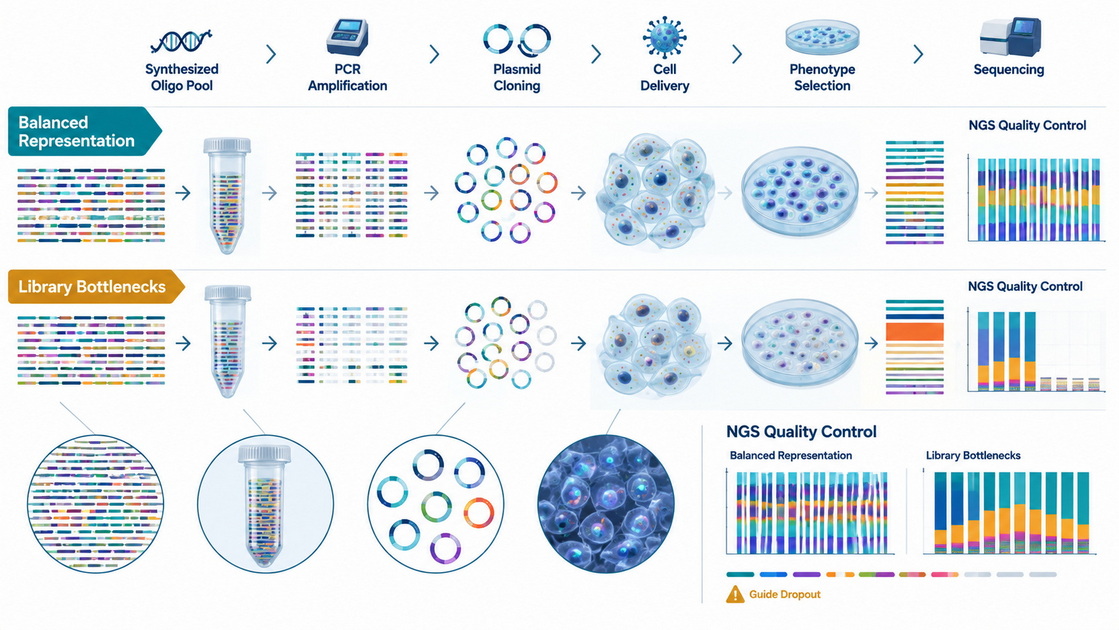
A pooled CRISPR screen depends on representation, meaning that designed guides remain present at reasonably balanced abundance. Representation can narrow at several stages: synthesis, PCR amplification, assembly, bacterial transformation, viral packaging, cell transduction, selection, DNA extraction, and sequencing.
Array-synthesized oligo pools provide a practical route to thousands of custom sequences, but pooled synthesis can include truncated products and sequence errors. Library construction can add further skew when amplification favors certain templates or transformation yields too few independent colonies. For this reason, the useful question is not simply, "Was the pool synthesized?" It is, "Did the finished plasmid library preserve the intended sequence diversity?"
A strong quality-control plan evaluates:
- Library completeness: the proportion of designed guides detected.
- Read distribution: whether a small group of guides dominates the pool.
- Low-abundance or missing guides: sequences at risk of dropout.
- Sequence identity: whether spacer and flanking regions match the design.
- Cloning background: the presence of empty or incorrect constructs.
- Replicate consistency: agreement across independent preparations or sequencing runs.
A Stage-Gated Workflow That Reduces Rework
A useful way to simplify sgRNA library projects is to create decision gates. Each gate answers a specific question before more time and material are committed.
1. Design gate: Do all guides meet the chosen activity, specificity, annotation, and cloning rules?
2. Pilot gate: Does the selected cell model express the required machinery and produce the expected perturbation with test guides?
3. Plasmid-library gate: Does sequencing confirm acceptable guide detection and abundance distribution?
4. Delivery gate: Do pilot data establish workable transduction, selection, and cell-recovery conditions?
5. Screen gate: Can every sample maintain the planned representation through treatment and collection?
6. Hit gate: Are candidate effects supported by multiple guides and reproducible across biological replicates?
7. Validation gate: Do individually tested guides reproduce the phenotype using an orthogonal assay or rescue strategy?
This framework prevents a common failure pattern: scaling an unverified construct directly into a large screen. A small pilot cannot predict every outcome, but it can expose basic problems with guide activity, promoter choice, vector compatibility, selection pressure, and assay dynamic range.
Calculate Coverage as a Chain, Not One Number
Researchers often discuss coverage as cells per guide, but representation must be protected across the complete workflow. A library with 50,000 guides at 500-fold coverage requires 25 million successfully represented cells at that stage. If only a fraction of exposed cells receives the desired construct, the starting population must be larger.
Plan backward from the smallest sample collected. Account for cell loss during selection, sorting, treatment, passaging, and DNA preparation. Also calculate bacterial transformation coverage for the plasmid library and molecular sampling during PCR and sequencing. The correct target is experiment-specific; rare-cell models, strong negative selection, and multi-step sorting often need more conservative planning than robust cell lines with simple endpoint collection.
A coverage worksheet should include:
- Library size and planned guides per gene.
- Desired representation at each major stage.
- Delivery efficiency and multiplicity-of-infection strategy.
- Expected survival after selection or treatment.
- Number of replicates and experimental arms.
- Maximum feasible culture scale.
- Sequencing reads allocated per sample.
Common Failure Modes and Corrective Actions
| Warning sign | Likely cause | Corrective action |
|---|---|---|
| Many guides are absent before screening | Insufficient transformation, cloning bias, or synthesis loss | Increase transformation scale; review assembly and amplification; resequence the plasmid pool |
| Guide abundance is highly skewed | Excess PCR cycling or sequence-dependent amplification | Use multiple parallel reactions, limit cycles, and pool replicates |
| Replicates separate unexpectedly | Inconsistent coverage, handling, or selection | Standardize passage history and sampling; inspect guide-count distributions |
| Essential-gene signal is weak | Low perturbation activity or insufficient assay duration | Validate Cas activity, guide performance, and endpoint timing |
| Hits cluster in amplified genomic regions | DNA-cutting toxicity related to copy number | Apply appropriate correction and confirm with independent strategies |
| Only one guide supports a hit | Guide-specific artifact or weak gene-level evidence | Retest with independent guides and orthogonal validation |
Copy-number amplification is particularly important in cancer cell lines. Multiple DNA breaks in amplified regions can reduce cell fitness independently of the targeted gene's biological function. This effect can generate convincing but misleading depletion signals unless the analysis accounts for genomic context.
Expert Checklist Before Ordering an Oligo Pool
Before releasing a custom sgRNA library for synthesis, confirm that:
- The screen type matches the biological question.
- Genome build, transcripts, and target regions are documented.
- Every guide passes sequence and cloning checks.
- On-target and off-target criteria are explicit.
- Control classes reflect the assay and nuclease effects.
- The total library size fits the available cell scale.
- Coverage is calculated through every bottleneck.
- The final oligo file has unique IDs and a frozen version.
- Plasmid-library sequencing is planned before screening.
- Hit confirmation uses independent guides and an orthogonal readout.
How Gene Universal Supports CRISPR Research
Gene Universal helps research teams move from sequence concepts to custom research-use oligonucleotides within broader DNA/RNA, protein, and antibody workflows. For a CRISPR screening project, early discussion of pool size, sequence architecture, purification expectations, downstream cloning, and quality-control needs can reduce avoidable redesign.
The most useful project request includes the complete sequence file, rather than spacer sequences alone, plus the vector strategy and intended application. Clear specifications allow technical teams to identify length conflicts, incompatible motifs, orientation errors, and adapter issues before synthesis.
Planning a custom sgRNA library? Contact Gene Universal to discuss your target list, oligo architecture, pool scale, and research workflow. Gene Universal provides fit-for-purpose research-grade materials and early discovery support; it does not offer GMP manufacturing, CDMO programs, or IND submission services.
Frequently Asked Questions
1. How Many sgRNAs Should Target Each Gene?
There is no universal number. More guides can strengthen gene-level confidence, while fewer high-performing guides reduce library size, cell demand, and sequencing cost. Choose the number using expected effect size, guide-ranking confidence, model constraints, and validation strategy.
2. Should a Lab Choose a Genome-Wide or Focused CRISPR Library?
Use a genome-wide library for unbiased discovery when cell numbers, budget, and assay robustness support the required scale. Use a focused library when the hypothesis centers on defined pathways, the cell model is limited, or deeper guide coverage is more valuable than broad genomic scope.
3. Why Is sgRNA Library Representation Important?
Uneven representation changes statistical power across guides. A guide that starts at very low abundance can disappear by chance, while an overrepresented guide can consume sequencing reads. Measuring the plasmid library before screening establishes a baseline for interpreting later enrichment or depletion.
4. What Controls Belong in a Pooled CRISPR Screen?
Include negative controls, suitable positive controls, and controls that account for the perturbation mechanism. Depending on the assay, these may include non-targeting guides, safe-targeting guides, essential-gene guides, and guides against established pathway regulators.
5. How Should Off-Target Risk Be Handled During Library Design?
Rank candidate guides using both predicted activity and specificity, remove problematic genomic matches, and consider variants or unusual genome structure in the model. Prediction narrows risk but does not eliminate it, so important hits should be confirmed with independent guides and orthogonal experiments.
6. When Should the Plasmid sgRNA Library Be Sequenced?
Sequence it before investing in the full screen. Pre-screen sequencing can reveal missing guides, extreme abundance skew, cloning background, or sequence errors while the workflow can still be corrected. ://pubmed.ncbi.nlm.nih.gov/27250066/)
References
1. [Doench JG, et al. Optimized sgRNA design to maximize activity and minimize off-target effects of CRISPR-Cas9. *Nature Biotechnology*. 2016.] [pubmed.ncbi.nlm.nih]
2. [Sanson KR, et al. Optimized libraries for CRISPR-Cas9 genetic screens with multiple modalities. *Nature Communications*. 2018.] [pubmed.ncbi.nlm.nih]
3. [Horlbeck MA, et al. Compact and highly active next-generation libraries for CRISPR-mediated gene repression and activation. *eLife*. 2016.] [pubmed.ncbi.nlm.nih]
4. [Haeussler M, et al. Integrated design, execution, and analysis of arrayed and pooled CRISPR genome-editing experiments. *Nature Protocols*. 2018.] [pubmed.ncbi.nlm.nih]
5. [Meyers RM, et al. Computational correction of copy-number effect improves specificity of CRISPR-Cas9 essentiality screens in cancer cells. *Nature Genetics*. 2017.] [pubmed.ncbi.nlm.nih]
6. [Morgens DW, et al. Genome-scale measurement of off-target activity using Cas9 toxicity in high-throughput screens. *Nature Communications*. 2017.] [pubmed.ncbi.nlm.nih]
7. [Joung J, et al. Genome-scale CRISPR-Cas9 knockout and transcriptional activation screening. *Nature Protocols*. 2017.] [pubmed.ncbi.nlm.nih]
8. [Liu X, et al. Improved design and analysis of CRISPR knockout screens. *Bioinformatics*. 2019.] [pubmed.ncbi.nlm.nih]