 +1 302-235-9792
 SIGN IN
 CONTACT US


- News
- Fully Human vs. Humanized Monoclonal Antibodies: Key Differences for Antibody Development
share


Fully Human vs. Humanized Monoclonal Antibodies: Key Differences for Antibody Development
Content Menu
● Fully Human vs. Humanized Antibodies at a Glance
● What Is a Fully Human Monoclonal Antibody?
>> Human B-Cell Isolation
>> Human Antibody Display Libraries
>> Transgenic Animal Platforms
● What Is a Humanized Monoclonal Antibody?
● A Practical Antibody Humanization Workflow
>> 1. Confirm the Parental Sequence
>> 2. Map Sequence and Structure
>> 3. Select Multiple Human Frameworks
>> 4. Design a Focused Variant Panel
>> 5. Express and Purify Side by Side
>> 6. Compare Binding and Function
>> 7. Assess Molecular Behavior
● Why Fully Human Does Not Mean Non-Immunogenic
● Evaluate More Than Antibody Affinity
>> Recommended Early Screening Panel
● How to Choose the Right Antibody Route
>> Choose Antibody Humanization When
>> Choose Fully Human Antibody Discovery When
>> Consider Parallel Routes When
● An Illustrative Humanization Scenario
● Production Choices for Research Antibodies
● How Gene Universal Supports Antibody Research
● Start Your Antibody Project
● Frequently Asked Questions
>> 1. Are Fully Human Antibodies Always Less Immunogenic Than Humanized Antibodies?
>> 2. Can Humanization Reduce Antibody Affinity?
>> 3. What Is the Difference Between a Chimeric and a Humanized Antibody?
>> 4. How Are Fully Human Monoclonal Antibodies Discovered?
>> 5. Which Assays Should Be Used After Antibody Humanization?
>> 6. Can the Same Expression System Produce Fully Human and Humanized Antibodies?
>> 7. When Should Affinity Maturation Follow Humanization?
● References
Fully human and humanized monoclonal antibodies differ primarily in sequence origin and how their variable regions are obtained or engineered. That distinction matters, but it does not by itself determine affinity, specificity, stability, expression, or immunogenicity.
For research teams planning custom antibody development and engineering, the stronger decision comes from evaluating the starting asset, target biology, desired mechanism, project timeline, and experimental behavior of each molecule.
From an antibody engineer's perspective, labels are useful starting points—not quality verdicts. A well-designed humanized antibody can outperform a fully human clone in a specific assay. Meanwhile, a fully human sequence can still display aggregation, nonspecific binding, chemical liabilities, or an unwanted immune response.
The most reliable strategy is therefore to compare sequence origin with functional and biophysical evidence.
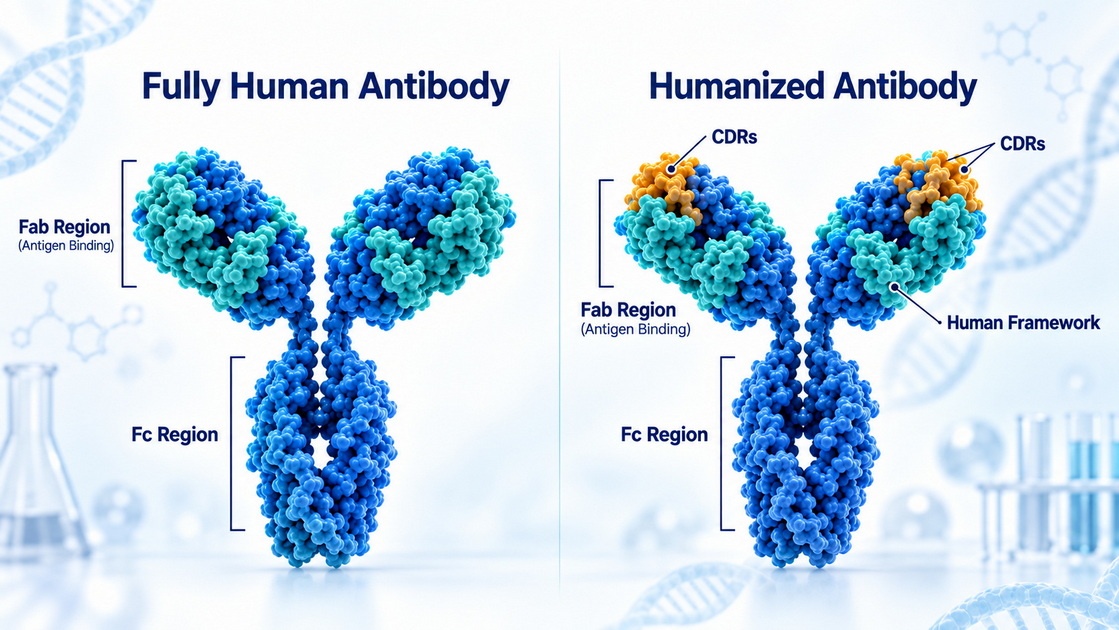
Fully Human vs. Humanized Antibodies at a Glance
| Feature | Fully Human Antibodies | Humanized Antibodies |
|---|---|---|
| Sequence origin | Human-derived variable and constant regions | Mainly human sequence, with selected non-human antigen-binding residues retained |
| Typical starting point | Human B cells, human antibody libraries, or transgenic animals carrying human immunoglobulin loci | A validated mouse, rat, rabbit, or other non-human antibody |
| Core workflow | Discovery, screening, sequence recovery, recombinant expression, and characterization | Framework selection, CDR grafting or related redesign, back-mutation assessment, expression, and comparison |
| Main advantage | Introduces human-sequence diversity from the beginning | Preserves access to a known binder, epitope, and functional profile |
| Main technical risk | Discovery output may still contain poor biophysical or specificity traits | Grafting can alter CDR geometry, affinity, expression, or stability |
| Immunogenicity consideration | Potentially reduced, but never guaranteed to be absent | Potentially reduced compared with the parental non-human antibody, but never guaranteed to be absent |
| Best research fit | New discovery programs seeking broad human-sequence panels | Programs with a valuable non-human lead worth preserving |
Another distinction is essential: sequence source and expression host are separate decisions.
A fully human or humanized antibody sequence may be recombinantly expressed in mammalian cells such as CHO or HEK293. The host cell does not determine whether the antibody is classified as fully human or humanized.
What Is a Fully Human Monoclonal Antibody?
A fully human monoclonal antibody has variable and constant regions derived from human antibody sequences.
However, "fully human" does not mean every residue must be identical to an unmutated human germline template. Normal V(D)J recombination, junctional diversity, and somatic hypermutation can generate substantial sequence diversity during an immune response.
Fully human antibodies can be obtained through several discovery routes.
Human B-Cell Isolation
Antigen-specific B cells can be obtained from suitable human samples. Researchers then screen individual cells, recover paired heavy- and light-chain sequences, and recombinantly express the selected antibodies.
This route can provide antibodies shaped by a natural human immune response. However, the resulting repertoire depends on donor history, antigen exposure, sample quality, and the sensitivity of the screening platform.
Human Antibody Display Libraries
Human Fab, scFv, or other antibody fragments can be displayed on phage, yeast, or compatible selection platforms.
The library is exposed to the target antigen through one or more selection rounds. Enriched clones are subsequently sequenced, expressed, and tested.
Display-based discovery allows researchers to adjust selection pressure, antigen presentation, counterselection conditions, and screening stringency. Its effectiveness depends heavily on library diversity, sequence quality, target preparation, and selection design.
Transgenic Animal Platforms
Transgenic animals carrying human immunoglobulin loci can be immunized with the selected antigen.
The animals generate human antibody sequences through an immune response that includes diversification and selection. Antibody-producing cells or sequence information can then be recovered for recombinant expression.
Each discovery route samples a different repertoire. None removes the need to confirm epitope, specificity, function, expression, purity, and biophysical behavior.
What Is a Humanized Monoclonal Antibody?
A humanized monoclonal antibody usually begins with a non-human antibody whose binding or function has already been demonstrated.
Its complementarity-determining regions, or carefully selected antigen-contacting residues, are transferred into human framework sequences. A human constant region is also selected according to the intended research format and functional requirements.
Humanization is commonly associated with CDR grafting, but the engineering process is more complex than simply moving six loops from one sequence to another.
The antibody framework is not passive structural filler. Framework and Vernier-zone residues may influence:
- CDR conformation
- Heavy-chain and light-chain orientation
- Variable-domain packing
- Paratope structure
- Antigen contact
- Expression and folding
- Thermal stability
- Aggregation tendency
Replacing important framework residues without structural review can weaken binding or destabilize the antibody.
For this reason, humanization should be treated as a panel-design and experimental comparison process, not a one-sequence conversion.
Several human frameworks and rational back-mutation combinations can be designed, expressed, and evaluated. This approach preserves options and creates the evidence needed to select an appropriate balance of humanness, binding, function, and molecular behavior.
A Practical Antibody Humanization Workflow
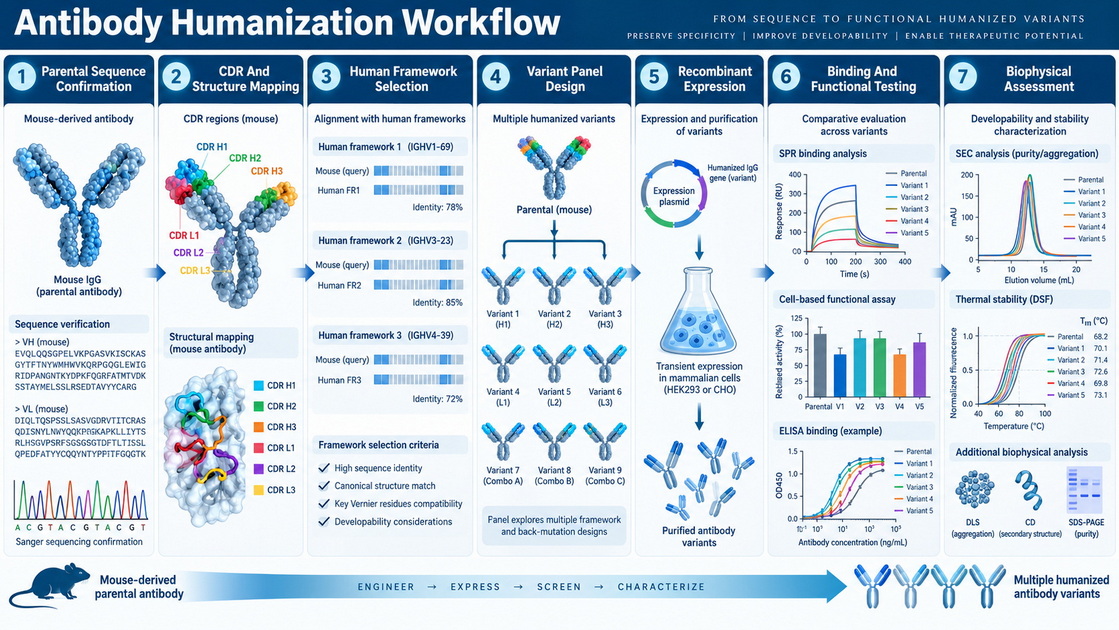
An effective antibody humanization workflow moves through a series of connected design and testing stages.
1. Confirm the Parental Sequence
Recover paired heavy- and light-chain variable-region sequences from the parental antibody.
Ambiguous positions should be resolved before humanization begins. If the antibody originates from a hybridoma, recombinant re-expression of the recovered sequence is especially important.
The re-expressed parental antibody should reproduce the expected binding and functional behavior. Otherwise, the humanization program may be built around an incorrect or incomplete sequence.
2. Map Sequence and Structure
Assign CDRs using a consistent antibody numbering system.
Researchers should identify closely related human germline frameworks, model the variable domains, and examine residues surrounding the paratope. Particular attention should be paid to positions that could influence CDR conformation or heavy-chain and light-chain packing.
Potential sequence liabilities can also be reviewed at this stage, including:
- Unpaired cysteines
- Potential deamidation sites
- Potential isomerization sites
- Oxidation-sensitive residues
- Unwanted glycosylation motifs
- Hydrophobic surface patches
- Charge clusters
Not every theoretical liability requires modification. Changes should be prioritized according to structural context, experimental relevance, and possible effects on antigen binding.
3. Select Multiple Human Frameworks
Framework selection should not rely on sequence identity alone.
A suitable framework should support the geometry of the parental CDRs while maintaining favorable folding and expression characteristics. Important considerations include:
- Overall sequence similarity
- CDR canonical structure compatibility
- VH–VL interface compatibility
- Vernier-zone residues
- Structural fit
- Predicted stability
- Potential chemical liabilities
Using multiple frameworks creates alternatives if the highest-identity framework does not preserve the parental antibody's performance.
4. Design a Focused Variant Panel
The initial panel may include straightforward grafted designs and additional variants containing selected back-mutations.
Back-mutations restore individual parental residues that are likely to support:
- CDR positioning
- Antigen contact
- Framework packing
- VH–VL orientation
- Structural stability
The goal is not to restore large portions of the non-human framework without discrimination. Instead, each retained residue should have a rational structural or functional justification.
5. Express and Purify Side by Side
Humanized variants should be expressed under matched conditions.
Using the same expression system, construct design, culture scale, purification method, and analytical workflow makes the comparison more meaningful. Otherwise, production differences may be mistaken for sequence-dependent effects.
Matched expression also helps reveal whether a variant has:
- Lower productivity
- Poorer assembly
- Increased fragmentation
- Greater aggregation
- Reduced recovery after purification
6. Compare Binding and Function
Binding should be assessed using an assay appropriate for the target.
SPR or BLI can provide kinetic information, including association rate, dissociation rate, and calculated affinity. However, binding kinetics should not be interpreted in isolation.
Humanized variants should also be compared in a mechanism-relevant functional assay whenever one is available.
Depending on the target and research purpose, this may include:
- Ligand-blocking assays
- Receptor activation assays
- Cell-signaling assays
- Internalization assays
- Neutralization assays
- Enzyme-inhibition assays
- Fc-mediated functional assays
A variant with affinity similar to the parental antibody may still behave differently in a cellular system if its epitope, geometry, avidity, or Fc configuration has changed.
7. Assess Molecular Behavior
Candidate selection should include more than antigen binding.
Researchers should review:
- Monomer content
- Expression level
- Purity
- Thermal stability
- Nonspecific binding
- Self-association
- Chemical hotspots
- Stress sensitivity
- Reproducibility between preparations
Do not advance a construct on affinity alone while overlooking weak expression or self-association.
A slightly weaker binder with cleaner molecular behavior may provide a better engineering foundation. If the functional data support the molecule, affinity maturation can be considered later.
Why Fully Human Does Not Mean Non-Immunogenic
Both fully human and humanized antibodies can provoke anti-drug antibodies in people.
Human sequence content is only one contributor to immunogenicity. An immune response may also be influenced by:
- Aggregation
- Product-related impurities
- Process-related impurities
- Post-translational modifications
- Novel sequence epitopes
- Antibody structure
- Target biology
- Dose
- Route of administration
- Treatment schedule
- Disease state
- Concomitant therapies
- Patient-specific immune factors
This distinction prevents a common interpretation error: an antibody sequence label is not an immunogenicity result.
Computational T-cell epitope or MHC-II binding assessments may help flag sequences for additional review. However, computational predictions do not reproduce the full complexity of a human immune response.
They should therefore be treated as risk-identification tools rather than definitive evidence that a sequence will or will not generate an immune response.
During early discovery and characterization, the practical objective is risk reduction. Researchers can compare human-likeness, remove avoidable sequence liabilities when function permits, limit aggregation, and maintain well-characterized research materials.
All claims should remain proportional to the evidence generated.
Evaluate More Than Antibody Affinity
Affinity is important, but it should not dominate candidate selection.
A useful antibody must also retain specificity, functional activity, structural integrity, and reproducible expression. Early developability-oriented assessment can expose weaknesses before they become embedded in a larger research program.
Recommended Early Screening Panel
| Research Question | Practical Assessment | Why It Matters |
|---|---|---|
| Does the antibody bind the intended target? | ELISA, flow cytometry, SPR, or BLI | Confirms binding in a relevant target presentation and can quantify kinetics |
| Does it preserve the desired epitope? | Competition assay or epitope binning | Distinguishes variants with similar affinity but different binding sites |
| Does it produce the intended effect? | Cell-based or biochemical functional assay | Connects antigen binding with the proposed research mechanism |
| Is it predominantly monomeric? | SEC-HPLC or an orthogonal size-based method | Flags aggregation and self-association |
| Is it intact and sufficiently pure? | SDS-PAGE, CE-SDS, and mass analysis as needed | Detects fragments, incorrect assembly, and unexpected species |
| Does it tolerate stress? | Thermal and short-term stress studies | Reveals instability that may not be visible immediately after purification |
| Does it bind nonspecifically? | Polyspecificity or cross-reactivity screens | Helps identify unwanted off-target behavior |
| Can it be expressed reproducibly? | Matched small-scale expression studies | Supports realistic comparison and future research supply |
Assays should be selected according to the target and intended experiment.
For example, a soluble-protein ELISA may be insufficient for a membrane receptor whose native conformation depends on the cell surface. Similarly, a single-concentration endpoint should not replace kinetic or functional comparisons when researchers are ranking closely related variants.
How to Choose the Right Antibody Route
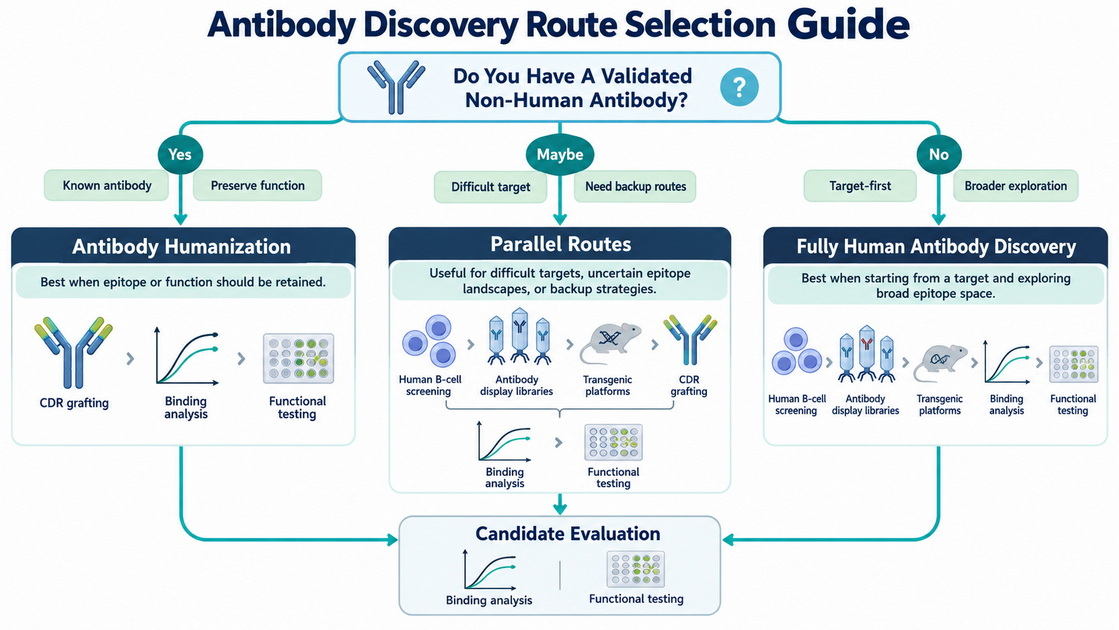
The choice between fully human antibody discovery and antibody humanization becomes clearer when it is framed around the evidence already available.
Choose Antibody Humanization When
- A non-human antibody already has compelling specificity, epitope, or functional data.
- Preserving the parental mechanism is more valuable than reopening discovery.
- The team can create and test several framework and back-mutation designs.
- Recombinant re-expression confirms that the recovered parental sequence reproduces the original behavior.
- The existing antibody provides a useful benchmark for comparative assays.
Choose Fully Human Antibody Discovery When
- The project starts with a target rather than a validated antibody.
- Broad epitope exploration is a priority.
- Access to human B cells, display libraries, or transgenic platforms is practical.
- The team wants to screen human-sequence diversity from the outset.
- The existing non-human leads do not provide a suitable binding or functional profile.
Consider Parallel Routes When
- The target is technically difficult.
- The epitope landscape is uncertain.
- The existing non-human lead has mixed properties.
- A backup sequence lineage would reduce project risk.
- Different paratopes may produce different functional outcomes.
A parallel strategy can establish a useful benchmark. The humanized lineage preserves known target biology, while fully human clones test whether alternative paratopes offer cleaner specificity, stronger function, or more favorable molecular behavior.
An Illustrative Humanization Scenario
Consider a research team that has a mouse antibody capable of blocking a receptor in a cell-based assay.
The team creates an initial CDR-grafted version, but the humanized antibody loses much of its binding activity. Abandoning humanization immediately would be premature because the loss may reflect altered loop support rather than an unsuitable parental antibody.
A stronger response is to create a compact experimental panel containing:
- Different human framework combinations
- Selected parental back-mutations
- Alternative heavy-chain and light-chain pairings, when scientifically justified
- Variants addressing residues near the CDRs
- Variants addressing the VH–VL interface
The resulting antibodies should be expressed under matched conditions and ranked using binding kinetics, the original cell assay, SEC-HPLC, expression data, and thermal assessment.
This comparison can determine whether activity is recoverable without retaining unnecessary non-human framework residues.
If no variant achieves a useful balance of binding, function, and molecular behavior, a fully human discovery campaign becomes a rational alternative. The decision is then based on comparative evidence rather than terminology.
Production Choices for Research Antibodies
After a sequence has been selected, recombinant in vitro production provides a controlled route to sequence-defined material.
Mammalian transient expression commonly suits full-length antibodies. However, the optimal expression system for antibody fragments depends on several factors:
- Folding requirements
- Disulfide-bond formation
- Glycosylation requirements
- Antibody format
- Required scale
- Purity expectations
- Intended assay
- Project timeline
For hybridoma-derived antibodies, in vitro culture is generally preferred for final production when reasonable and practical.
In vitro production can reduce animal use and avoid many contaminants associated with ascites fluid. However, the selected method should still be qualified for the required yield, purity, activity, and consistency because individual hybridoma lines can behave differently under culture conditions.
How Gene Universal Supports Antibody Research
Gene Universal supports global research teams through an integrated workflow spanning:
- DNA and RNA design and synthesis
- Antigen design
- Recombinant protein production
- Custom antibody discovery
- Antibody sequencing
- Antibody humanization
- Affinity maturation
- Antibody engineering
- Recombinant antibody expression
- Protein and antibody purification
- Selected analytical characterization
The objective is to provide fit-for-purpose research-grade materials for early discovery and characterization.
For a humanization project, support can begin with parental sequence review and framework design. The workflow can then continue through variant construction, transient expression, purification, affinity ranking, and selected quality assessments.
For fully human sequences supplied by a client or obtained through a compatible discovery route, the same gene-to-antibody workflow can support matched expression and comparative testing.
This integrated approach helps reduce transfers between separate service providers and makes it easier to maintain sequence traceability throughout the research workflow.
Service scope note: Gene Universal does not provide GMP manufacturing, CDMO services, or IND submission support. Project plans should separate research-focused antibody generation and characterization from any later activities requiring those capabilities.
Start Your Antibody Project
Ready to compare fully human and humanized antibody strategies?
Contact Gene Universal to discuss your:
- Target antigen
- Parental antibody sequence
- Available functional data
- Desired antibody format
- Assay requirements
- Material quantity
- Characterization needs
- Candidate-selection criteria
A clearly defined study plan can transform sequence options into comparable experimental evidence and help researchers identify suitable antibodies for subsequent discovery work.
Frequently Asked Questions
1. Are Fully Human Antibodies Always Less Immunogenic Than Humanized Antibodies?
No. Fully human sequences may reduce one source of immune recognition, but immunogenicity is multifactorial.
Aggregation, impurities, post-translational modifications, target biology, administration conditions, treatment context, and patient-specific factors can also affect the immune response. Neither "fully human" nor "humanized" supports a zero-risk claim.
2. Can Humanization Reduce Antibody Affinity?
Yes. CDR grafting can alter loop geometry, variable-domain packing, or residues that indirectly support antigen binding.
Testing multiple human frameworks and rational back-mutations can help recover binding while limiting unnecessary non-human sequence.
3. What Is the Difference Between a Chimeric and a Humanized Antibody?
A chimeric antibody commonly combines non-human variable regions with human constant regions.
A humanized antibody usually retains mainly the non-human CDRs or selected antigen-binding residues within largely human variable frameworks and human constant regions. As a result, a humanized antibody generally contains less non-human sequence than a conventional chimeric antibody.
4. How Are Fully Human Monoclonal Antibodies Discovered?
Common methods include screening human B cells, selecting binders from human display libraries, and immunizing transgenic animals carrying human immunoglobulin loci.
Recovered sequences must subsequently be expressed and characterized for binding, specificity, function, and molecular behavior.
5. Which Assays Should Be Used After Antibody Humanization?
A fit-for-purpose assessment panel often includes:
- Binding kinetics
- Specificity testing
- Epitope analysis
- A mechanism-relevant functional assay
- SEC-HPLC
- Purity assessment
- Expression comparison
- Thermal stability
- Selected nonspecific-binding tests
- Short-term stress studies
The final assay panel should reflect the target, antibody format, intended research application, and stage of the project.
6. Can the Same Expression System Produce Fully Human and Humanized Antibodies?
Yes. Antibody classification depends on sequence origin and engineering history, not the production host.
Both fully human and humanized antibodies can be expressed in systems such as CHO or HEK293 when those hosts fit the antibody format and research objective.
7. When Should Affinity Maturation Follow Humanization?
Affinity maturation is most useful after researchers confirm that a humanized variant retains the intended epitope and functional mechanism but still requires stronger binding.
Increasing affinity before confirming specificity, function, and molecular behavior may optimize the wrong property or preserve an undesirable binding profile.
References
5. [U.S. Food and Drug Administration. Immunogenicity Assessment for Therapeutic Protein Products.]
11. [The Antibody Society. Antibody Therapeutics Product Data.]