 +1 302-235-9792
 SIGN IN
 CONTACT US


- News
- How Llama Antibodies May Help Us Fight Coronavirus: VHH Discovery and Antibody Engineering
share


How Llama Antibodies May Help Us Fight Coronavirus: VHH Discovery and Antibody Engineering
Content Menu
● What Makes Llama Antibodies Different?
>> Heavy-Chain Antibodies Provide a Compact Binding Domain
>> Small Size Creates Opportunities, Not Automatic Advantages
● How Can VHH Antibodies Block Coronavirus Infection?
● What the Original Llama Antibody Study Actually Demonstrated
● Later Research: Multivalency and Variant Coverage
>> A Quantitative Example of Engineered Nanobody Neutralization
>> Animal Findings Require Careful Interpretation
● Choosing a VHH Engineering Format for Research
● A Practical Workflow for Custom VHH Antibody Development
>> 1. Define the Research Question and Antigen Panel
>> 2. Select a Discovery Strategy
>> 3. Confirm Sequences and Compare Constructs
>> 4. Produce and Purify Research-Grade Materials
>> 5. Connect Binding Data with Functional Evidence
>> 6. Evaluate Developability Before Expanding the Study
● How to Compare Research Partners and Experimental Deliverables
● Research Support from Gene Universal
● Frequently Asked Questions
>> Are Llama Antibodies and Nanobodies the Same Thing?
>> Can Nanobodies Cure COVID-19?
>> Must Every VHH Discovery Project Immunize a Llama?
>> Does Strong Spike Binding Guarantee Neutralization?
>> Why Combine Several VHH Domains?
>> What Should I Prepare Before Requesting a VHH Project?
● Supporting Research
Llama antibodies may help researchers fight coronavirus by providing compact, adaptable molecules that recognize viral proteins and, in selected experiments, block infection. These single-domain antibodies, commonly called VHH antibodies or nanobodies, offer a useful starting point for custom antibody development and engineering. However, promising laboratory results do not establish that a particular molecule prevents or treats COVID-19 in people.
For research teams, the important question is not simply whether llama antibodies bind coronavirus. It is whether the right sequence, molecular format, and experimental evidence can support a defined discovery objective. That distinction connects an intriguing biological story with practical decisions about screening, recombinant production, and characterization.
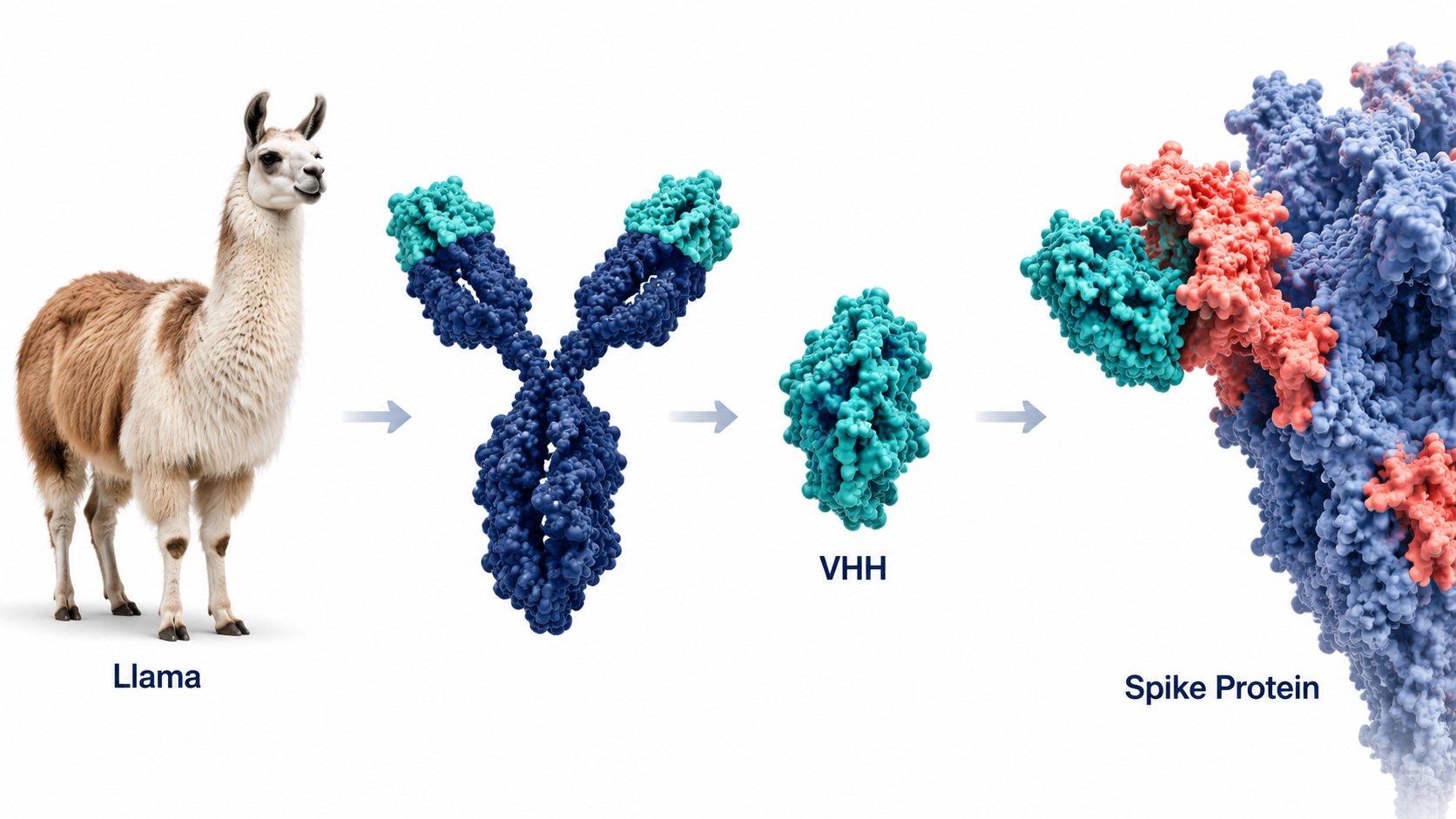
What Makes Llama Antibodies Different?
Heavy-Chain Antibodies Provide a Compact Binding Domain
Llamas and other camelids produce conventional antibodies and an additional class of heavy-chain-only antibodies. Conventional IgG antibodies contain two heavy chains and two light chains. Their antigen-binding sites depend on paired variable domains.
Camelid heavy-chain-only antibodies lack light chains. Their antigen-binding variable domain, called VHH, can function independently when isolated and expressed as a recombinant protein.
An isolated VHH typically weighs approximately 12–15 kDa, compared with roughly 150 kDa for a conventional IgG. Importantly, the VHH fragment is not the entire naturally occurring heavy-chain antibody.
This compact architecture gives researchers a modular building block. A VHH can be studied alone, linked to another VHH, or incorporated into a larger fusion construct.
Small Size Creates Opportunities, Not Automatic Advantages
Some VHHs recognize recessed or otherwise difficult-to-access epitopes. Many also exhibit useful solubility and stability. Nevertheless, these properties vary with sequence and experimental conditions.
A small molecule can also face limitations, including rapid renal clearance and the absence of an Fc region in its standalone format. Researchers should therefore evaluate each construct rather than assume that every nanobody is stable, broadly neutralizing, or suitable for respiratory delivery.
How Can VHH Antibodies Block Coronavirus Infection?
SARS-CoV-2 uses its spike protein to engage cellular receptors and support entry into host cells. The spike receptor-binding domain, or RBD, interacts with angiotensin-converting enzyme 2, commonly abbreviated ACE2.
Some anti-spike VHHs interfere with this interaction. Others recognize different spike regions and may inhibit entry through alternative mechanisms. The outcome depends on the epitope, spike conformation, antibody format, and assay system.
From a discovery perspective, three questions should remain separate:
- Binding: Does the VHH recognize the intended antigen?
- Competition: Does it interfere with a relevant molecular interaction?
- Neutralization: Does it reduce viral entry or infection in a functional assay?
A positive binding result does not answer the other two questions. Likewise, receptor competition alone does not establish protection in an animal or benefit in a person.
What the Original Llama Antibody Study Actually Demonstrated
The landmark 2020 study isolated VHHs from a llama immunized with prefusion-stabilized coronavirus spike proteins. Researchers identified antibodies that neutralized MERS-CoV or SARS-CoV-1 spike-pseudotyped viruses and used structural analysis to explain their interactions.
One SARS-CoV-1-directed VHH also cross-reacted with SARS-CoV-2 spike. When incorporated into a bivalent human IgG Fc-fusion format, this VHH neutralized SARS-CoV-2 spike-pseudotyped viruses.
The distinction matters: the SARS-CoV-2 result involved an engineered format and a pseudovirus assay, not proof of effective treatment in humans.
The broader lesson is highly relevant to antibody engineering. A useful binding sequence may require a different architecture to achieve the desired functional behavior. Discovery and format optimization are connected activities, not interchangeable milestones.
Later Research: Multivalency and Variant Coverage
A Quantitative Example of Engineered Nanobody Neutralization
A 2024 study identified nine nanobodies targeting the SARS-CoV-2 RBD. Five showed cross-neutralizing activity against the original strain and Omicron subvariants BA.1 and BA.4/5.
Researchers subsequently engineered multivalent constructs. The trivalent B13-B13-B13 construct neutralized all pseudoviruses tested in that study, with a geometric mean half-maximal inhibitory concentration of 20.83 ng/mL.
This figure describes performance across that particular experimental panel. It is not a universal potency benchmark, and it does not establish activity against variants outside the study.
For project planning, the useful insight is that repeating or combining binding domains can change functional activity. Linker design and domain arrangement therefore deserve direct testing rather than selection by intuition alone.
Animal Findings Require Careful Interpretation
Another 2024 study reported llama-derived nanobodies against multiple spike domains. Some neutralized several variants in pseudovirus assays, and cocktails performed better than individual nanobodies against two tested Omicron variants.
The researchers also investigated intranasal administration in a transgenic mouse model, reporting protection alongside reductions in viral replication or tissue viral load.
These findings support further investigation. They do not demonstrate that an inhaled or intranasal nanobody product is effective in humans. Delivery performance, local exposure, tolerability, and formulation behavior remain separate questions.
Choosing a VHH Engineering Format for Research
The best format depends on the experiment, not on a general ranking of antibody types.
| Format | Research purpose | Important tradeoff |
|---|---|---|
| Single VHH | Study a binding domain with minimal architectural complexity | Standalone behavior may differ from larger formats |
| Linked identical VHHs | Investigate multivalency and potential avidity effects | Linker geometry can affect accessibility |
| Linked distinct VHHs | Explore complementary epitopes or broader recognition | Simultaneous binding must be demonstrated |
| VHH Fc fusion | Compare bivalent presentation and Fc-associated properties | Added size and Fc effects change interpretation |
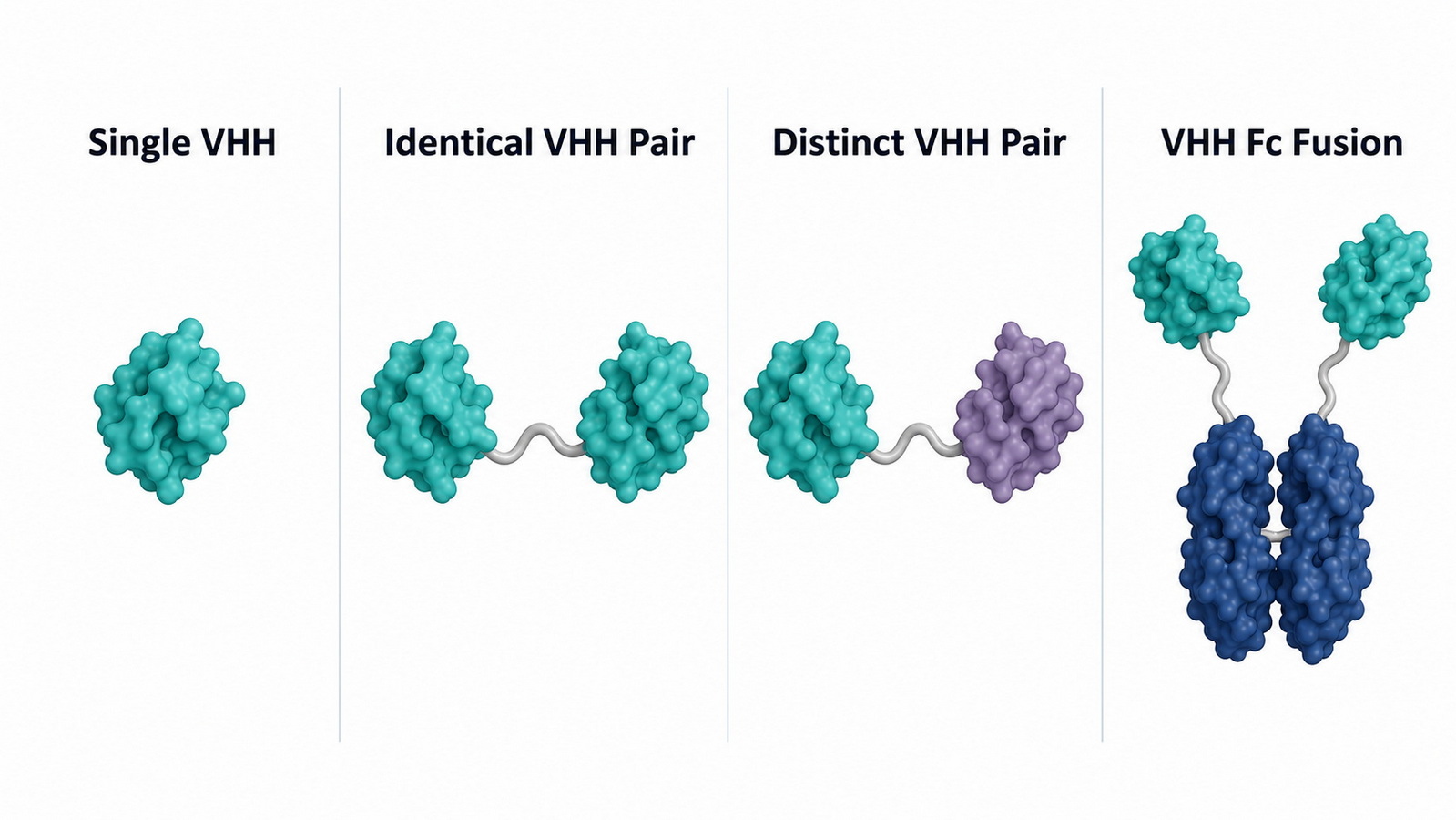
Avidity describes the combined binding effect of multiple interactions. It differs from the affinity of an individual binding site. A stronger multivalent assay signal does not necessarily mean that the underlying single-domain affinity improved.
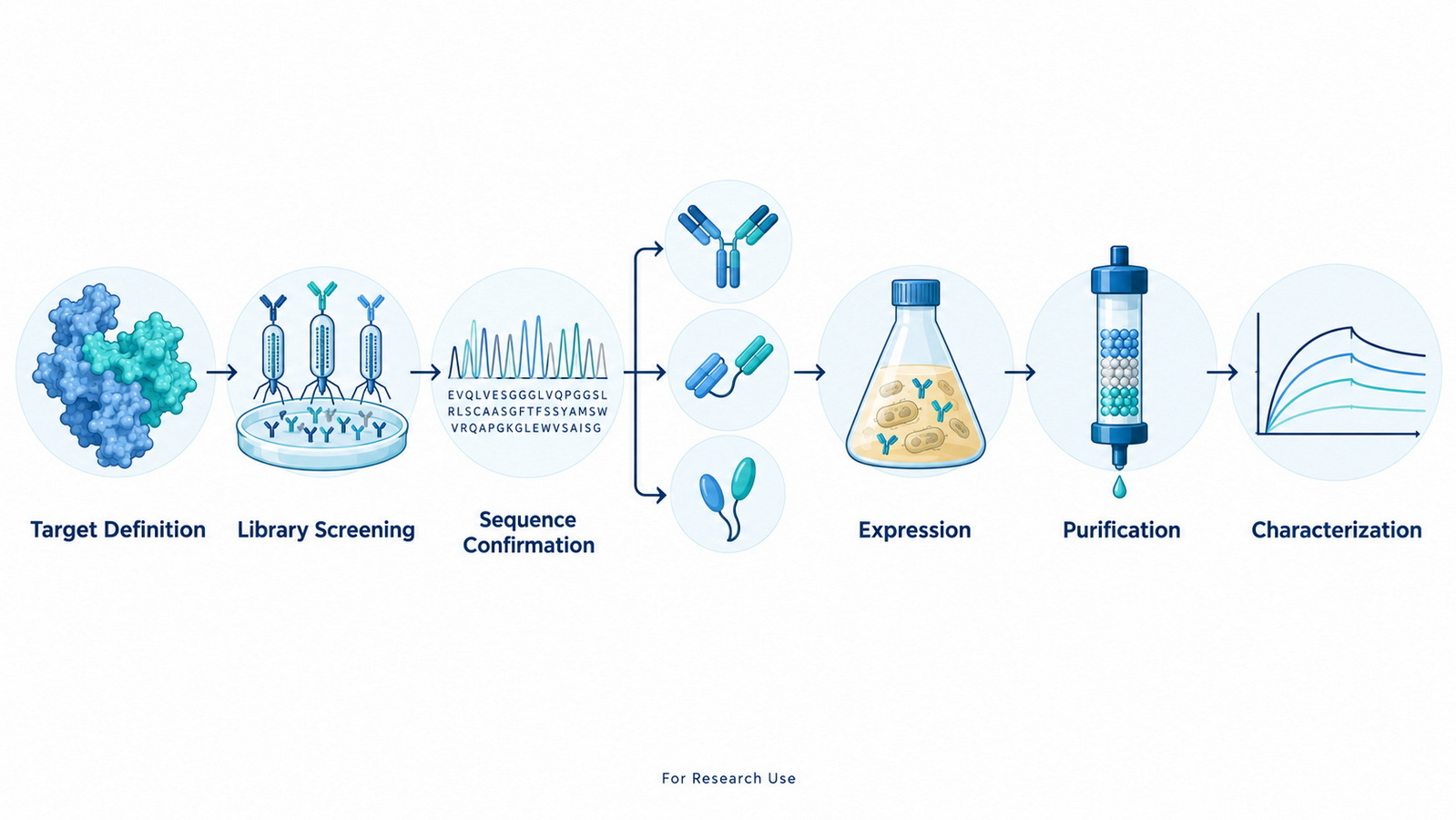
A Practical Workflow for Custom VHH Antibody Development
The following framework is a planning guide, not a promise that every research provider performs every assay.
1. Define the Research Question and Antigen Panel
Start with the intended application: neutralization research, structural analysis, diagnostic assay development, or target recognition.
Specify whether screening should use isolated RBD, full spike, or another domain. Include relevant variant antigens and negative controls. Antigen conformation and presentation can influence which binders emerge.
2. Select a Discovery Strategy
Immune, naive, and synthetic libraries offer different routes to VHH discovery. Immune libraries reflect an animal's response to immunization; naive and synthetic libraries can support discovery without target-specific animal immunization.
Library origin alone does not establish quality. Diversity, sequence representation, selection conditions, and counter-screening should match the project's goals.
3. Confirm Sequences and Compare Constructs
Sequence confirmed hits and review redundancy before advancing them. Plan construct boundaries, tags, linkers, and any fusion domains explicitly.
Maintain clear identifiers so that the sequence tested in a binding assay can be traced to the protein batch used in a functional experiment.
4. Produce and Purify Research-Grade Materials
Select an expression system appropriate to the construct and intended use. Standalone VHHs can often be produced in microbial systems, while more complex formats may require different expression strategies.
Assess identity, purity, aggregation, concentration, and storage behavior. Additional measurements, including endotoxin testing, should follow the requirements of the downstream experiment.
5. Connect Binding Data with Functional Evidence
Combine binding measurements with specificity controls and an appropriate functional assay. When comparing formats, report concentrations in both mass and molar units where useful.
A larger fusion protein and a small VHH have different molecular weights. Comparing only ng/mL can obscure the number of molecules or binding domains present.
6. Evaluate Developability Before Expanding the Study
Use a developability-oriented assessment to investigate solubility, aggregation, thermal behavior, and retained activity after relevant handling conditions.
For aerosol-related research, test the actual delivery process. Stability during storage does not establish stability during aerosol generation.
How to Compare Research Partners and Experimental Deliverables
I would prioritize traceable evidence over a headline affinity number. A useful report explains what was tested, how it was tested, and what remains uncertain.
Before commissioning a project, agree on:
- The antigen sequences, formats, and variant panel.
- The discovery route and selection criteria.
- Construct sequences and protein batch identifiers.
- Purity and aggregation assessment methods.
- Assay controls, replicates, and acceptance criteria.
- The boundaries between binding characterization and functional testing.
Avoid interpreting a small panel of successful examples as a guaranteed project outcome. Discovery timelines, expression yields, and neutralization profiles depend on the target and sequence.
No single measurement can replace a coherent evidence package. The most useful candidate is the one that answers the research question reproducibly.
Research Support from Gene Universal
Gene Universal is a U.S.-headquartered life sciences service provider supporting researchers in more than 100 countries. Its end-to-end research solutions span DNA/RNA, proteins, and antibodies, including custom antibody development and engineering.
For a VHH project, the initial discussion should connect sequence design, protein requirements, and characterization objectives with the services available for that specific project. Specialized assays and external testing needs should be confirmed before work begins.
Gene Universal's scope is research-focused. The company does not provide GMP manufacturing, CDMO services, or IND submission support. Project language and deliverables should reflect early discovery and characterization, preclinical research support, and fit-for-purpose research-grade materials.
Share your target, available sequences, preferred antibody format, required quantity, and experimental endpoints with Gene Universal to define a research-focused development plan and clarify deliverables before commissioning work.
Frequently Asked Questions
Are Llama Antibodies and Nanobodies the Same Thing?
Not exactly. Llamas produce several antibody classes. A nanobody commonly refers to an isolated VHH derived from a camelid heavy-chain-only antibody, rather than every antibody produced by a llama.
Can Nanobodies Cure COVID-19?
Laboratory neutralization and animal findings do not establish a human cure. Coronavirus-directed nanobodies remain useful research molecules, but conclusions about patient benefit require evidence for the specific product and intended use.
Must Every VHH Discovery Project Immunize a Llama?
No. Naive and synthetic libraries provide alternative discovery routes. The appropriate strategy depends on available resources, target properties, library quality, and the research objective.
Does Strong Spike Binding Guarantee Neutralization?
No. A binder may recognize an epitope that does not interfere with infection. Functional neutralization must be measured independently, using an assay suited to the intended claim.
Why Combine Several VHH Domains?
Multivalent constructs can alter avidity, molecular geometry, and functional activity. Combining distinct domains may also explore complementary epitopes. These benefits are hypotheses until demonstrated for the actual construct.
What Should I Prepare Before Requesting a VHH Project?
Prepare the target identity, antigen or sequence information, desired format, quantity, and downstream application. Define whether you need binding characterization, functional testing, or both, and confirm which activities fall within the provider's scope.
Supporting Research
1. Wrapp, D., et al. (2020). "Structural Basis for Potent Neutralization of Betacoronaviruses by Single-Domain Camelid Antibodies." *Cell*, 181(5), 1004–1015.e15. DOI: 10.1016/j.cell.2020.04.031. Supports the original coronavirus VHH findings, structural mechanisms, and the distinction between a standalone VHH and a bivalent Fc-fusion tested against pseudoviruses. [pubmed.ncbi.nlm.nih]
2. Jin, B.-K., Odongo, S., Radwanska, M., and Magez, S. (2023). "NANOBODIES®: A Review of Diagnostic and Therapeutic Applications." *International Journal of Molecular Sciences*, 24(6), 5994. DOI: 10.3390/ijms24065994. Provides background on VHH architecture, production strategies, molecular properties, and research applications. [pubmed.ncbi.nlm.nih]
3. Wang, J., et al. (2024). "Engineered Multivalent Nanobodies Efficiently Neutralize SARS-CoV-2 Omicron Subvariants BA.1, BA.4/5, XBB.1 and BQ.1.1." *Vaccines*, 12(4), 417. DOI: 10.3390/vaccines12040417. Supports the nine-nanobody discovery example and the reported geometric mean IC50 of 20.83 ng/mL for B13-B13-B13 across the tested pseudovirus panel. [pubmed.ncbi.nlm.nih]
4. "SARS-CoV-2 Specific Nanobodies Neutralize Different Variants of Concern and Reduce Virus Load in the Brain of h-ACE2 Transgenic Mice." (2024). *Viruses*, 16(2), 185. DOI: 10.3390/v16020185. Supports the discussion of variant testing, nanobody cocktails, and intranasal administration in a transgenic mouse model. [pubmed.ncbi.nlm.nih]
5. "Versatile and Multivalent Nanobodies Efficiently Neutralize SARS-CoV-2." (2020). *Science*. PubMed PMID: 33154108. Supports the discussion of multivalent engineering, microbial production, and experimentally investigated resistance to lyophilization and aerosolization. These findings apply to the constructs studied, not to all VHHs. [pubmed.ncbi.nlm.nih]