 +1 302-235-9792
 SIGN IN
 CONTACT US


- News
- How Oligo Synthesis Changed the World: From PCR to Programmable Biology
share


How Oligo Synthesis Changed the World: From PCR to Programmable Biology
Content Menu
● What Is Oligo Synthesis?
● From Hand-Built Sequences to Routine Research Tools
● How Oligos Made PCR Practical
● Oligos as Guides, Probes, and Molecular Addresses
>> Primers
>> Fluorescent Probes
>> Capture Oligos
>> Adapters and Barcodes
>> Antisense Oligos and siRNAs
>> Aptamers
● How Chemical Modifications Expand Oligo Function
● Genome-Scale CRISPR Screening
● Synthetic Genes, Proteins, and Antibodies
● DNA Data Storage Beyond Biology
● What the Expanding Oligo Field Means for Researchers
● A Practical Oligo Planning Framework
>> 1. What Is the Experimental Mechanism?
>> 2. What Target and Controls Are Required?
>> 3. Which Molecular Format Fits the Assay?
>> 4. What Sequence Risks Are Present?
>> 5. What Purification Level Is Appropriate?
>> 6. What Evidence Should Accompany the Material?
>> 7. How Will the Oligo Be Handled?
● Choosing Quality Controls for Research Oligos
● Common Reasons Oligo Experiments Underperform
>> The Target Sequence Is Incorrect
>> Secondary Structure Blocks Binding
>> Purification Does Not Match the Application
>> The Modification Changes Behavior
>> Handling Damages the Material
>> The Assay Lacks Suitable Controls
● Why Oligo Synthesis Will Keep Expanding
● Start Your Next Research Project
● Frequently Asked Questions
>> 1. What Is Oligo Synthesis Used For?
>> 2. How Are DNA Oligos Synthesized?
>> 3. Why Does Oligo Purity Matter?
>> 4. What Is the Difference Between a Primer and a Probe?
>> 5. Can Oligos Be Chemically Modified?
>> 6. What Information Should Be Supplied for a Custom Oligo Order?
>> 7. How Should Research Oligos Be Stored?
>> 8. Does Gene Universal Provide GMP, CDMO, or IND Submission Support?
● References
Oligo synthesis has changed the world by turning DNA and RNA sequences into practical, programmable tools. A custom oligonucleotide may contain only a few dozen bases, yet it can start a PCR reaction, detect a sequence variant, guide genome editing, assemble a synthetic gene, measure gene expression, or help researchers investigate how an RNA target behaves.
That combination of small physical size and precise informational content explains why oligos sit behind so much of modern life science. They connect a digital sequence on a computer to an experiment at the bench. Once researchers can order a defined sequence, they can test a hypothesis directly rather than waiting to isolate the same material from a biological source.
For scientists planning experiments, however, the most important lesson is not simply that oligos are versatile. Sequence design, synthesis chemistry, purification, quality control, and application context must work together. A theoretically correct sequence can still underperform if secondary structure, impurities, handling, or assay conditions are overlooked.
What Is Oligo Synthesis?
An oligonucleotide is a short, defined strand of DNA or RNA. Oligo synthesis is the controlled process used to build that strand one nucleotide at a time in a specified order.
DNA oligos commonly contain adenine, thymine, cytosine, and guanine. RNA oligos use uracil in place of thymine.
Modern chemical production commonly relies on solid-phase phosphoramidite synthesis. In simplified terms, a growing oligonucleotide chain remains attached to a solid support while repeated reaction cycles add protected nucleotide building blocks.
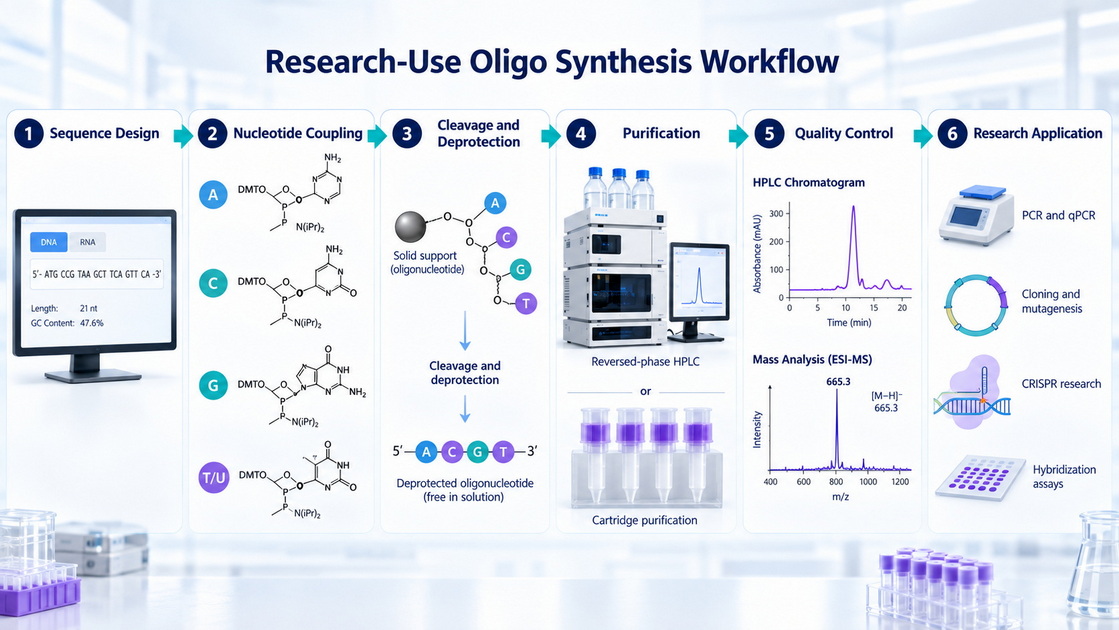
A typical synthesis workflow includes:
1. Sequence design: The required DNA or RNA sequence is reviewed for the intended research application.
2. Nucleotide coupling: Individual nucleotide building blocks are added through repeated chemical cycles.
3. Cleavage and deprotection: The synthesized sequence is released from the support, and protective chemical groups are removed.
4. Purification: Unwanted synthesis-related species are reduced according to the selected purification method.
5. Analytical assessment: Appropriate methods are used to examine identity, purity, concentration, or other requested attributes.
6. Formulation and delivery: The oligo is supplied in a format suitable for handling and downstream research.
The process is highly programmable, but it is not mathematically perfect. Every additional coupling step creates another opportunity for an incomplete reaction or side product.
This is why longer sequences, difficult base compositions, complex modifications, and demanding downstream assays require more deliberate planning.
From Hand-Built Sequences to Routine Research Tools
The history of synthetic oligonucleotides is a story of increasing control over biological information.
Early nucleic acid chemistry demanded extensive manual work. Researchers had to perform multiple chemical reactions, isolate intermediate products, and confirm that each stage had produced the intended material.
The pioneering synthesis of defined oligonucleotides helped researchers investigate the genetic code. Later, the total synthesis of a functional gene demonstrated that chemically produced fragments could be assembled into a biologically meaningful sequence.
A major practical shift came with phosphoramidite chemistry and automated synthesis. Faster coupling cycles, improved solid supports, better protecting groups, and automated instruments made custom DNA more accessible.
By the 1980s, synthetic oligos were already being used for:
- Gene isolation and cloning
- Sequence analysis
- Site-directed mutagenesis
- Hybridization experiments
- Detection of genetic differences
- Construction of longer DNA molecules
The deeper transformation was conceptual. DNA became both biological material and an engineerable information layer.
A researcher could define a sequence in software, synthesize it, introduce it into a controlled workflow, and observe a measurable result. That design-build-test logic now underpins molecular biology and much of synthetic biology.
How Oligos Made PCR Practical
PCR depends on two short oligonucleotide primers that define the boundaries of the DNA region to be amplified.
Each primer anneals to a complementary site on the template. It then provides a starting point for DNA polymerase. Repeated cycles of strand separation, primer binding, and extension can produce enough target DNA for downstream analysis.
The oligo is therefore not a passive reagent. Primer sequence determines what the reaction attempts to amplify.
Several design variables can affect PCR performance:
- Primer length: Influences binding specificity and melting behavior.
- GC content: Affects duplex stability and annealing conditions.
- Melting temperature: Helps determine suitable reaction parameters.
- Self-complementarity: May promote unwanted hairpin formation.
- Primer complementarity: Can result in primer-dimer formation.
- Target uniqueness: Influences whether the intended sequence is selectively amplified.
- Amplicon length: Should match the polymerase, sample quality, and downstream analysis.
- Template variation: Mutations or polymorphisms at primer-binding sites can reduce amplification.
Primers that form stable dimers or hairpins may compete with the intended template. Poorly selected target sites can also produce weak, inconsistent, or nonspecific amplification.
This programmable amplification principle supports many research workflows:
- Genotyping to distinguish alleles or engineered variants
- Cloning to amplify inserts and add designed terminal sequences
- Gene-expression studies using reverse-transcription quantitative PCR
- Pathogen research using sequence-specific detection assays
- Sequencing workflows using primers and adapters
- Site-directed mutagenesis to introduce planned sequence changes
A useful expert habit is to treat primer design as part of the experimental model rather than an ordering task at the end.
The best primer pair is the one that fits the sample, target, polymerase, amplicon, and readout together.
Oligos as Guides, Probes, and Molecular Addresses
Hybridization gives oligonucleotides their most important behavior: a well-designed strand can recognize a complementary nucleic acid sequence.
This makes an oligo a molecular address that can locate, amplify, label, capture, block, or modify a selected target.
Primers
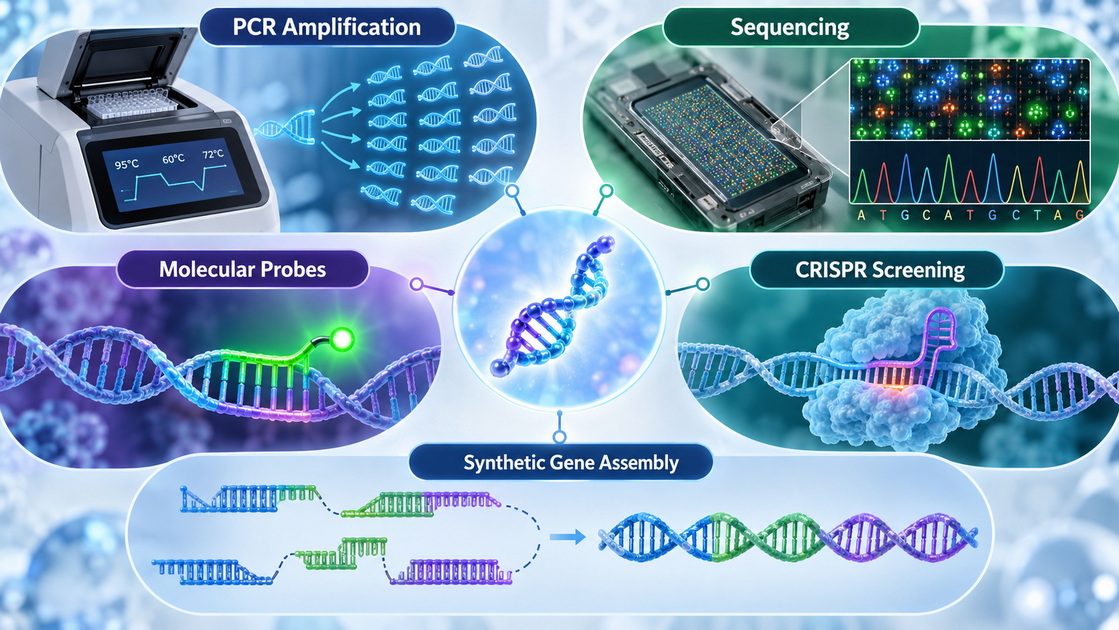
Primers bind to complementary regions and provide starting points for polymerase-mediated extension. They are fundamental to PCR, sequencing, cloning, and mutagenesis workflows.
Fluorescent Probes
Fluorescently labeled probes can report whether a target sequence is present or whether amplification has occurred. Probe-based assays can add another level of sequence recognition beyond primer binding.
Capture Oligos
Capture oligos can enrich selected sequences from a complex sample. They are commonly used when researchers need to isolate targeted regions before sequencing or another analytical step.
Adapters and Barcodes
Sequencing adapters prepare DNA or RNA fragments for platform-specific workflows. Molecular barcodes can help distinguish samples, libraries, or individual molecules.
Antisense Oligos and siRNAs
Antisense oligonucleotides and small interfering RNAs can help researchers investigate gene regulation. Their performance depends on target selection, chemistry, structure, delivery conditions, and biological context.
Aptamers
Aptamers are nucleic acid molecules selected to bind molecular targets through their three-dimensional structures. They may be used in binding studies, analytical assays, biosensing research, and molecular recognition workflows.
How Chemical Modifications Expand Oligo Function
Chemical modifications can alter how an oligonucleotide behaves in a research system.
Changes may be introduced into the base, sugar, backbone, or terminal position. The goal may be to influence stability, hybridization, detection, conjugation, purification, or interactions with other molecules.
Common modification categories include:
| Modification category | Potential research purpose |
|---|---|
| Fluorescent labels | Detection, imaging, multiplex assays, and probe-based analysis |
| Biotin or affinity tags | Capture, immobilization, and pull-down experiments |
| Phosphate modifications | Ligation, cloning, or enzymatic processing |
| Spacer molecules | Separation of functional groups from the oligo sequence |
| Backbone modifications | Changes to stability, nuclease resistance, or molecular interactions |
| Sugar modifications | Adjustment of binding behavior, stability, or structural properties |
| Amino and thiol groups | Attachment to surfaces, proteins, nanoparticles, or other molecules |
A modification is not automatically beneficial. Its value depends on the mechanism, assay format, biological system, and experimental controls.
For example, a modification selected to increase stability may also affect hybridization, charge, cellular uptake, protein interactions, or analytical behavior. Researchers should therefore define the expected function before selecting the chemistry.
Genome-Scale CRISPR Screening
CRISPR made the relationship between oligo synthesis and functional genomics especially visible.
A short guide sequence can direct a CRISPR-associated system toward a selected genomic region. When thousands of guide designs are synthesized as a pooled library, researchers can perturb many genes in parallel and connect those perturbations to measurable phenotypes.
Genome-scale screening changes the question from:
"Does this gene affect the phenotype?"
to:
"Which genes across the system affect the phenotype?"
Depending on the selected framework and experimental objective, pooled screens can support:
- Loss-of-function investigations
- Gene-activation studies
- Gene-repression studies
- Regulatory-region screening
- Drug-response research
- Host–pathogen interaction studies
- Synthetic-lethality investigations
- Phenotype-associated pathway discovery
Library quality matters at several levels.
Guide representation should remain balanced. Barcode-guide relationships must be reliable. Coverage should be maintained through cloning, delivery, selection, and readout.
Positive and negative controls should reveal whether the screen performed as intended. Biological replicates and suitable sequencing depth are also important.
A large library cannot rescue a poorly defined phenotype or an underpowered experiment. Library scale must be matched with sufficient experimental coverage.
Synthetic Genes, Proteins, and Antibodies
Oligos also serve as starting materials for larger biological constructs.
Overlapping synthetic fragments can be assembled into genes. Those genes can then be cloned into expression systems for protein production.
Sequence design may account for:
- Coding requirements
- Cloning strategy
- Expression host preferences
- Repeated regions
- GC distribution
- Restriction sites
- Signal peptides
- Affinity tags
- Downstream sequence verification
This creates an important end-to-end connection.
A digital protein concept can become a synthesized gene, an expression construct, a recombinant protein, and an assay reagent.
Antibody research follows a similar information flow. Variable-region sequences can be synthesized, cloned into suitable expression constructs, expressed, purified, and characterized during early discovery and characterization.
This integrated approach can reduce handoffs between separate workflow stages. It can also improve traceability between the initial sequence and the final research material.
Gene Universal supports global research teams with services spanning:
- Custom DNA and RNA oligos
- Gene synthesis
- Molecular cloning
- Recombinant protein services
- Antibody-related research services
- Early discovery and characterization workflows
- Preclinical research support
Gene Universal's services and materials are intended for research use. Gene Universal does not provide GMP manufacturing, CDMO programs, or IND submission support.
Stating this scope clearly helps research teams select an appropriate provider for each stage of a broader program.
DNA Data Storage Beyond Biology
One of the most striking applications of oligo synthesis sits outside conventional biology.
Digital files can be converted into nucleotide sequences, written into synthetic DNA, stored as physical molecules, and reconstructed through sequencing and computational decoding.
A simplified DNA data-storage workflow follows five stages:
1. Digital encoding: Binary information is converted into nucleotide sequences.
2. Sequence preparation: Address sequences and error-correction information are added.
3. DNA synthesis: The encoded sequences are produced as an oligo pool.
4. Physical storage: The DNA is preserved under suitable conditions.
5. Reading and decoding: Selected molecules are amplified or retrieved, sequenced, and computationally reconstructed.
Published demonstrations have stored operating-system files, images, text, and other digital content in synthetic DNA pools. A large-scale random-access experiment encoded more than 200 MB across over 13 million DNA oligonucleotides and demonstrated selective file recovery.
The approach is attractive because DNA can provide high information density and long-term molecular stability under suitable storage conditions.
The obstacles are equally important:
- Synthesis cost
- Writing speed
- Sequence errors
- Uneven oligo representation
- Index design
- Error-correction requirements
- Retrieval efficiency
- Sequencing costs
- Computational reconstruction
- Physical sample management
DNA storage is therefore best understood as a developing archival technology rather than a replacement for everyday electronic storage.
What the Expanding Oligo Field Means for Researchers
The oligonucleotide field now extends far beyond standard PCR primers.
A 2025 peer-reviewed review identified 13 antisense oligonucleotides, seven siRNA products, and two aptamers approved by the U.S. Food and Drug Administration at the time of its analysis. This development reflects the increasing maturity of sequence-directed mechanisms.
However, it should not blur the distinction between research services and regulated product development.
For discovery teams, the more actionable trend is the growing diversity of research designs:
- Modified DNA and RNA
- CRISPR guide libraries
- Fluorescent probes
- Sequencing adapters
- Molecular barcodes
- Capture panels
- Conjugated oligos
- Gene-regulation tools
- Aptamer libraries
- Synthetic gene assembly components
Current scientific literature also identifies several continuing challenges:
- Delivery into relevant cells or tissues
- Endosomal escape
- Nuclease stability
- Off-target activity
- Sequence-dependent immune effects
- Analytical complexity
- Scale-dependent synthesis performance
- Manufacturing sustainability
A balanced industry view avoids two extremes.
Oligos are neither simple strings that always behave exactly as predicted nor universal solutions to every biological question.
They are programmable molecules whose performance emerges from sequence, chemistry, formulation, biological context, and experimental design.
A Practical Oligo Planning Framework
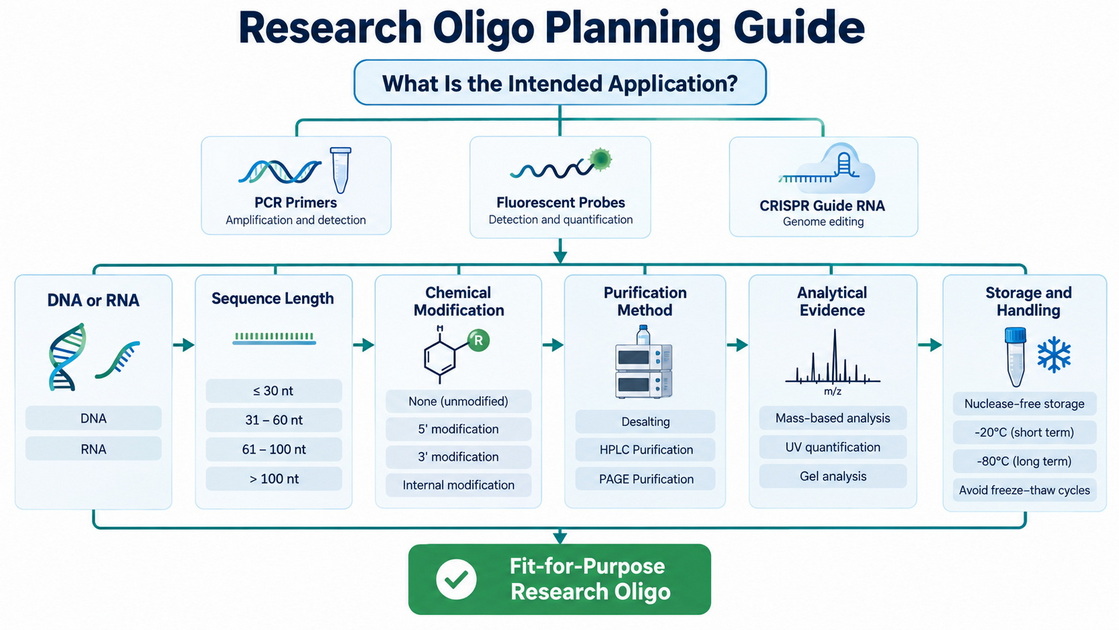
Before requesting a custom oligo, researchers can reduce delays by answering seven questions.
1. What Is the Experimental Mechanism?
Define the primary function of the oligo.
Will it:
- Prime
- Probe
- Capture
- Guide
- Block
- Assemble
- Barcode
- Detect
- Regulate
- Conjugate
The intended mechanism should guide every later specification.
2. What Target and Controls Are Required?
Confirm the correct reference sequence, transcript, isoform, variant, and strand orientation.
Consider whether the project requires:
- Positive controls
- Negative controls
- Scrambled controls
- Mismatch controls
- Untreated controls
- Multiple independent sequences against the same target
Controls should be planned at the design stage, not added only after an unexpected result.
3. Which Molecular Format Fits the Assay?
Determine whether the project requires:
- DNA or RNA
- Single-stranded or double-stranded material
- Individual oligos or pooled sequences
- Standard or modified bases
- A dry or solution-based format
- A specific synthesis scale
The molecular format should match the actual assay rather than a default specification.
4. What Sequence Risks Are Present?
Review the sequence for characteristics that could influence synthesis or downstream performance:
- Extreme GC content
- Repetitive motifs
- Self-complementarity
- Cross-hybridization
- Stable hairpins
- Long homopolymer regions
- Problematic terminal bases
- Target-region variation
- Difficult modification combinations
Computational analysis can identify risks, but experimental validation remains essential.
5. What Purification Level Is Appropriate?
Purification should be matched to:
- Oligo length
- Modification type
- Assay sensitivity
- Required full-length content
- Acceptable impurity burden
- Downstream application
- Project budget
More purification is not automatically necessary for every project. At the same time, insufficient purification may compromise sensitive experiments.
6. What Evidence Should Accompany the Material?
Depending on the application, researchers may need information related to:
- Yield
- Concentration
- Purity
- Molecular identity
- Duplex formation
- Modification incorporation
- Functional performance
The analytical package should answer the project's most important questions rather than simply generate more data.
7. How Will the Oligo Be Handled?
Plan the handling process before the material arrives.
Consider:
- Resuspension buffer
- Working concentration
- Storage temperature
- Light sensitivity
- Nuclease control
- Aliquot size
- Freeze-thaw exposure
- Sample labeling
- Plate or tube format
- Inventory tracking
This framework prevents a common procurement error: specifying a sequence without specifying its job.
Application context should drive the oligo specification.
Choosing Quality Controls for Research Oligos
Oligonucleotide synthesis can generate shorter failure sequences, longer products, protecting-group remnants, adducts, and other process-related species.
The most informative analytical approach depends on what the experiment needs to know.
| Research question | Common evidence | Why it matters |
|---|---|---|
| Is the expected molecular species present? | Mass-based analysis | Supports identity assessment by comparing observed and expected mass |
| How much full-length material is present relative to related species? | Chromatographic or electrophoretic analysis | Helps assess product heterogeneity |
| Is the supplied amount suitable for the experiment? | Yield or concentration measurement | Supports accurate reaction setup and normalization |
| Does a duplex form as intended? | Non-denaturing or application-specific assessment | Can reveal residual single strands or assembly issues |
| Was a selected modification incorporated? | Modification-appropriate analytical evidence | Supports confirmation of the requested molecular feature |
| Does the oligo perform in the intended system? | Fit-for-purpose functional assay | Connects chemical material with experimental performance |
Common Reasons Oligo Experiments Underperform
When an oligo-based experiment fails, the sequence is often blamed first. In practice, several interconnected factors may be responsible.
The Target Sequence Is Incorrect
The design may use the wrong transcript, genome assembly, strand orientation, or sequence version. A target region may also contain unexpected variants.
Secondary Structure Blocks Binding
A target site that appears suitable from the primary sequence may be inaccessible because the oligo or target forms a stable secondary structure.
Purification Does Not Match the Application
A basic research assay may tolerate a broader product profile, while a sensitive quantitative or functional assay may require more careful purification.
The Modification Changes Behavior
A chemical modification may improve one property but negatively affect another. Changes in charge, binding, stability, or steric environment can influence performance.
Handling Damages the Material
Repeated freeze-thaw cycles, nuclease contamination, light exposure, inappropriate buffers, or poor inventory practices can compromise results.
The Assay Lacks Suitable Controls
Without positive, negative, mismatch, or untreated controls, it may be difficult to determine whether the problem lies in the oligo, target, delivery method, instrument, or assay conditions.
A structured troubleshooting approach should review design, material quality, handling, delivery, controls, and readout rather than changing one variable without a clear rationale.
Why Oligo Synthesis Will Keep Expanding
Oligo synthesis continues to matter because it translates sequence knowledge into physical experiments.
Every improvement in design software, synthesis chemistry, enzymatic production, purification, analytical characterization, or high-throughput handling expands what researchers can test.
Future progress is likely to combine:
- Chemical and enzymatic synthesis methods
- Smarter sequence-design tools
- More efficient modification strategies
- Improved pooled-library production
- Better methods for difficult sequences
- Complementary analytical technologies
- More sustainable production processes
- Faster integration with automated laboratories
Sustainability will become increasingly important. Traditional solid-phase synthesis uses repeated reagent and solvent cycles, particularly as sequence length, production scale, and global demand increase.
New production methods will need to balance performance, scalability, sequence flexibility, analytical requirements, and environmental impact.
The enduring value of the oligo is simple:
It makes biological information actionable.
From a primer pair to a genome-scale library, a carefully specified sequence can help researchers move from an idea to measurable evidence.
Start Your Next Research Project
Need custom DNA/RNA oligos or a connected workflow involving gene synthesis, proteins, or antibodies?
Discuss your research objective, sequence requirements, modifications, purification expectations, and analytical needs with Gene Universal.
Gene Universal supports researchers in more than 100 countries with fit-for-purpose research-grade materials and end-to-end life science services, including DNA/RNA, gene synthesis, protein, and antibody-related workflows.
All services are provided within Gene Universal's stated research-use scope. The company does not provide GMP manufacturing, CDMO programs, or IND submission support.
Frequently Asked Questions
1. What Is Oligo Synthesis Used For?
Oligo synthesis produces defined DNA or RNA strands for PCR, sequencing, cloning, mutagenesis, hybridization probes, gene-expression studies, CRISPR guide libraries, synthetic gene assembly, and other research applications.
2. How Are DNA Oligos Synthesized?
Most custom DNA oligos are produced through repeated phosphoramidite coupling cycles on a solid support. The assembled strands are then cleaved, deprotected, and processed according to the requested purification and analytical specification.
3. Why Does Oligo Purity Matter?
Purity can affect sensitive assays because synthesis-related species may compete with, dilute, or otherwise interfere with the intended full-length oligo. The appropriate purification level depends on oligo length, modifications, assay design, and experimental tolerance.
4. What Is the Difference Between a Primer and a Probe?
A primer binds to a complementary target and provides a starting point for polymerase extension. A probe primarily detects or captures a complementary target, often through a fluorescent label, affinity tag, or surface attachment.
5. Can Oligos Be Chemically Modified?
Yes. Researchers can use base, sugar, backbone, or terminal modifications to influence stability, hybridization, detection, conjugation, and other properties. Modification selection should follow the intended mechanism and assay.
6. What Information Should Be Supplied for a Custom Oligo Order?
Provide the sequence in the correct orientation, DNA or RNA format, synthesis scale, purification method, modifications, preferred formulation, and analytical expectations. Describing the intended research application can also help determine whether the specification is appropriate.
7. How Should Research Oligos Be Stored?
Storage conditions depend on molecular format, modifications, formulation, concentration, and intended use. Researchers should limit unnecessary freeze-thaw cycles, maintain nuclease-free handling practices, protect light-sensitive modifications, and follow the provider's product-specific instructions.
8. Does Gene Universal Provide GMP, CDMO, or IND Submission Support?
No. Gene Universal provides research-use services, fit-for-purpose research-grade materials, early discovery and characterization, and preclinical research support. It does not provide GMP manufacturing, CDMO programs, or IND submission support.
References
1. Caruthers, M. H., et al. [Deoxyoligonucleotide Synthesis via the Phosphoramidite Method]. *Gene Amplification and Analysis* (1983). [pubmed.ncbi.nlm.nih]
2. Beaucage, S. L., and Caruthers, M. H. [Synthetic Strategies and Parameters Involved in the Synthesis of Oligodeoxyribonucleotides According to the Phosphoramidite Method]. *Current Protocols in Nucleic Acid Chemistry* (2001). [pubmed.ncbi.nlm.nih]
3. Khorana, H. G. [Total Synthesis of a Gene]. *Science* (1979). [pubmed.ncbi.nlm.nih]
4. Ellis, R. W. [The Applications of Synthetic Oligonucleotides to Molecular Biology]. *Pharmaceutical Research*. [pubmed.ncbi.nlm.nih]
5. Miles, L. A., et al. [Genome-Scale CRISPR Pooled Screens]. *Analytical Biochemistry* (2017). [pubmed.ncbi.nlm.nih]
6. Ceze, L., Nivala, J., and Strauss, K. [Molecular Digital Data Storage Using DNA]. *Nature Reviews Genetics* (2019). [pubmed.ncbi.nlm.nih]
7. Erlich, Y., and Zielinski, D. [DNA Fountain Enables a Robust and Efficient Storage Architecture]. *Science* (2017). [pubmed.ncbi.nlm.nih]
8. Organick, L., et al. [Random Access in Large-Scale DNA Data Storage]. *Nature Biotechnology* (2018). [pubmed.ncbi.nlm.nih]
9. Cronin, J. M., and Yu, A. M. [Small RNA or Oligonucleotide Drugs and Challenges in Evaluating Drug–Drug Interactions]. *Frontiers in Pharmacology* (2025). [pubmed.ncbi.nlm.nih]
10. Pourshahian, S. [Therapeutic Oligonucleotides, Impurities, Degradants, and Their Characterization by Mass Spectrometry]. *Mass Spectrometry Reviews* (2021). [pubmed.ncbi.nlm.nih]
11. U.S. Food and Drug Administration. [Clinical Pharmacology Considerations for the Development of Oligonucleotide Therapeutics] (2024). [fda]
12. European Medicines Agency. [Development and Manufacture of Oligonucleotides: Scientific Guideline] (2024). [ema.europa]