 +1 302-235-9792
 SIGN IN
 CONTACT US


- News
- Humanized Vs Fully Human Antibodies For Preclinical Research
share


Humanized Vs Fully Human Antibodies For Preclinical Research
Content Menu
● What Do Humanized and Fully Human Antibodies Actually Mean?
● Key Structural and Sequence Differences
>> Sequence origin
>> Generation technologies
● Immunogenicity: How Big Is the Gap Today?
● Functional Performance, Epitope Coverage, and Developability
>> Epitope diversity
>> Affinity and biophysics
>> Developability‑oriented assessment
● Humanized vs Fully Human: Strategic Pros and Cons
>> Strategic advantages and limitations
● How Gene Universal Fits Into This Landscape
● Expert‑Level Selection Framework: When to Favor Each Format
>> When humanized antibodies are often the better fit
>> When fully human antibodies often make more sense
● Practical Workflow Example: From Murine Hit to Humanized and Fully Human Panels
● Actionable Considerations for Teams Working With Gene Universal
● FAQs on Humanized vs Fully Human Antibodies
● References
Selecting between humanized antibodies and fully human antibodies is no longer a narrow "immunogenicity only" question; it is a strategic R&D decision that shapes epitope coverage, developability risk, timelines, and costs throughout discovery and preclinical research.
What Do Humanized and Fully Human Antibodies Actually Mean?
From an antibody engineer's perspective, the core difference is how much of the original non‑human sequence remains in the final molecule.
Humanized antibodies:
- Start from a non‑human (typically mouse) monoclonal antibody.
- The CDRs (antigen‑binding loops) are grafted into a human variable region framework, with human constant regions.
- Usually retain a small number of back‑mutated framework residues from the original species to preserve affinity and stability.
- Overall, they are "mostly human" at the variable region level, often above 90% human.
Fully human antibodies:
- Contain human‑origin sequences across both variable and constant regions, including CDRs and frameworks.
- Are typically generated by phage or yeast display libraries, or by transgenic animals carrying human immunoglobulin loci.
- Are conceptually "entirely human" in amino acid composition within the limits of current technology.
In practice, both formats are compatible with modern antibody engineering workflows, but they come with distinct trade‑offs in immunogenicity risk, epitope diversity, and engineering flexibility that matter for early discovery and characterization.
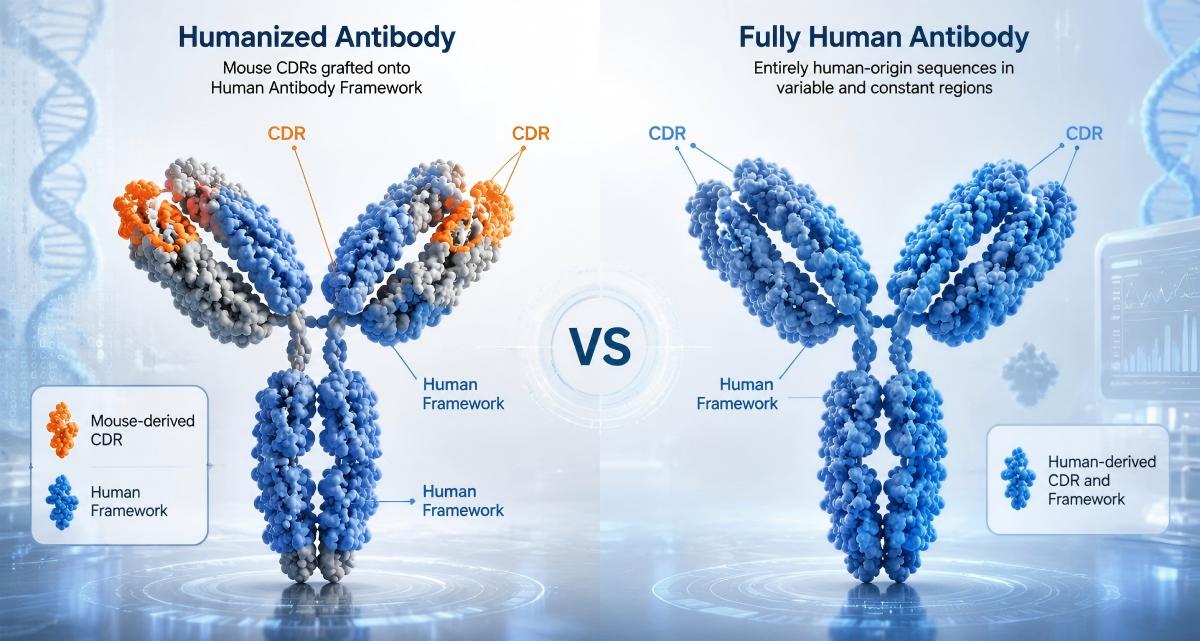
Key Structural and Sequence Differences
At the molecular level, the distinction between humanized and fully human antibodies can be summarized in terms of sequence origin and design control.
Sequence origin
Humanized antibodies:
- Use non‑human CDRs precisely grafted onto human variable frameworks.
- Incorporate limited non‑human framework residues when essential for binding or structural integrity.
Fully human antibodies:
- Derive both CDRs and frameworks from human germline or human‑based combinatorial libraries.
- Avoid deliberate introduction of non‑human residues during discovery.
Generation technologies
Humanized antibodies are commonly created through:
- Classic CDR grafting and framework back‑mutation.
- Structure‑guided or in silico humanization designed to preserve paratope geometry and biophysical properties.
Fully human antibodies are usually obtained by:
- Transgenic mice expressing human immunoglobulin loci.
- Phage, yeast, or mammalian display libraries built from human antibody repertoires.
This underlying distinction drives many practical differences, including immunogenicity profile, epitope space, and the engineering effort needed to obtain fit‑for‑purpose research‑grade materials.
Immunogenicity: How Big Is the Gap Today?
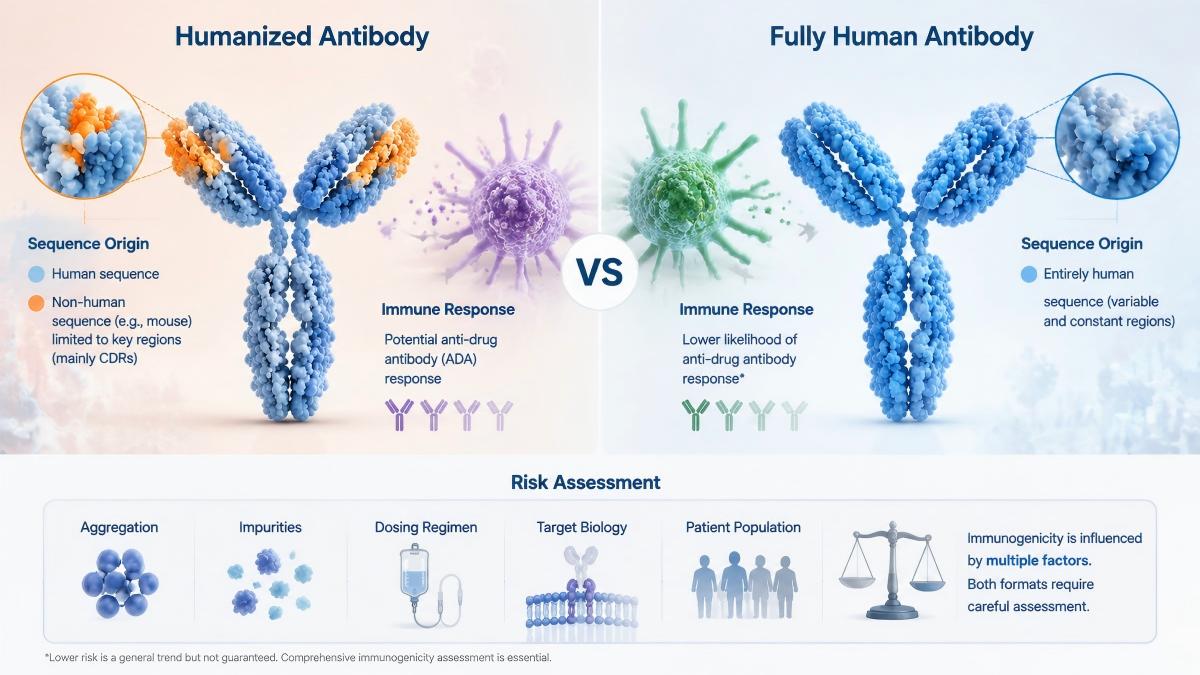
One common assumption is that fully human antibodies are always dramatically less immunogenic than humanized antibodies. The reality is more nuanced and depends on multiple molecular and clinical factors.
Humanized antibodies:
- Show substantially reduced immunogenicity compared with murine or simple chimeric antibodies.
- In many indications, appear well tolerated, but anti‑drug antibody responses can still occur.
- Immunogenicity can be influenced by aggregation, impurities, dosing regimen, target biology, and patient population, not just sequence "human‑ness."
Fully human antibodies:
- Are intuitively expected to carry lower immunogenicity risk due to their human sequence background.
- Can still trigger immune responses when other risk factors are present.
- Benefit from "human‑like" germline usage, but do not eliminate the need for careful immunogenicity risk assessment.
For research‑use candidates in discovery and preclinical models, differences in immunogenicity risk may be less visible in short‑term in vivo studies, where host species is often non‑human. However, understanding format impact early helps guide developability‑oriented assessment and informs which molecules are most promising to carry forward.
Functional Performance, Epitope Coverage, and Developability
From a project leader's viewpoint, the key question is often: which format is more likely to give the right epitope, with the right biophysics, on a tractable timeline?
Epitope diversity
Humanized antibodies:
- Originate from immune responses in non‑human species, which can access epitopes that human repertoires may not frequently target.
- Are valuable for structurally conserved antigens or poorly immunogenic targets.
- May introduce sequence motifs that are less familiar to the human immune system.
Fully human antibodies:
- Reflect constraints of human germline repertoires and thus recognize epitopes more aligned with human immune responses.
- Benefit from advances in transgenic animal platforms and human display libraries that provide broad, high‑affinity epitope coverage.
Affinity and biophysics
- Both humanized and fully human antibodies can reach very high affinities when coupled with affinity maturation and rational engineering.
- Humanization can risk affinity loss during CDR grafting, which requires back‑mutation or structural optimization to restore function.
- Fully human antibodies avoid the grafting step but may require larger early screening to find clones combining strong affinity with favorable biophysical properties.
Developability‑oriented assessment
For both formats, modern discovery pipelines now incorporate early screens for:
- Aggregation propensity and self‑association
- Non‑specific binding and polyreactivity
- Thermal and chemical stability
- Charge heterogeneity and post‑translational modification profiles
These assessments during early discovery and preclinical research help identify molecules that are more likely to remain stable and well behaved, and they significantly reduce the risk of late‑stage surprises.
Humanized vs Fully Human: Strategic Pros and Cons
From the perspective of an R&D director coordinating multiple programs, the pros and cons of each format can be summarized as follows.
Strategic advantages and limitations
Humanized antibodies:
- Leverage existing non‑human antibodies, making them ideal when strong murine or rabbit leads already exist.
- Provide explicit design levers through CDR grafting and framework tuning.
- Require specialized humanization expertise and iterative optimization cycles.
- Offer a good balance between epitope diversity and higher "human‑ness" than chimeric antibodies.
Fully human antibodies:
- Fit well with platform‑based discovery strategies built around transgenic animals or large human libraries.
- Eliminate the need for later humanization, streamlining the path from hit to research‑grade lead.
- Require up‑front investment in proprietary libraries or access to advanced platforms.
- Align sequence origin closely with human repertoires, which many teams see as a strategic advantage.
In real portfolios, the decision is rarely purely binary. Many organizations intentionally maintain a mix of humanized and fully human antibodies to match different targets, timelines, and historical assets.
How Gene Universal Fits Into This Landscape
In practice, the impact of format choice is only realized if teams can reliably convert design concepts into well‑characterized research materials. This is where a research‑focused, end‑to‑end provider like Gene Universal can play a central role.
Gene Universal specializes in integrating:
- DNA and RNA design and synthesis
- Expression construct optimization
- Protein and antibody expression and purification
- Analytical characterization to support early discovery and preclinical research
Within this scope, Gene Universal can support both humanized and fully human antibody programs by:
- Designing and cloning humanized variable regions based on client‑supplied murine or other non‑human precursors, with codon optimization and sequence analysis for expression and stability.
- Expressing humanized and fully human antibodies side by side so that clients can directly compare binding, potency, and biophysical properties in their own assay systems.
- Producing rapid, flexible research‑grade antibody batches for in vitro assays, ex vivo models, and early in vivo work, without implying any GMP or late‑stage development services.
Later development activities such as GMP manufacturing, CDMO engagement, or regulatory submissions remain with the client or specialized downstream partners. Gene Universal focuses on accelerating and de‑risking the discovery‑to‑preclinical continuum.
Expert‑Level Selection Framework: When to Favor Each Format
Drawing on the types of decisions experienced teams make, the following practical framework can help decide when to favor humanized or fully human antibodies.
When humanized antibodies are often the better fit
- You have a high‑value non‑human lead
- For example, a murine antibody with strong in vivo data or mechanistic insights. Humanization allows you to preserve this biology while shifting toward a more human sequence background.
- You are working on conserved or poorly immunogenic antigens
- Non‑human immune systems can recognize epitopes that human repertoires rarely access. Humanization lets you exploit these epitopes while improving sequence compatibility.
- You require tight, rational control of the paratope
- Humanization workflows involve explicit framework choices and back‑mutations, which provide fine‑tuned control over affinity, specificity, and biophysical behavior.
When fully human antibodies often make more sense
- You are building a long‑term antibody platform
- Investing in fully human transgenic animals or human display libraries aligns with a scalable discovery model across many targets.
- You anticipate extensive combination studies or chronic administration scenarios
- A fully human sequence background is an attractive default when long exposure and repeated dosing are expected, even though immunogenicity risk cannot be entirely removed.
- You want close alignment with human immune biology
- Fully human antibodies can support more physiologically relevant epitope recognition and may simplify translation between preclinical findings and human biology.
For high‑value programs, a pragmatic solution is to generate both humanized and fully human panels and then let the data decide, especially when supported by partners who can rapidly express and characterize multiple candidates.
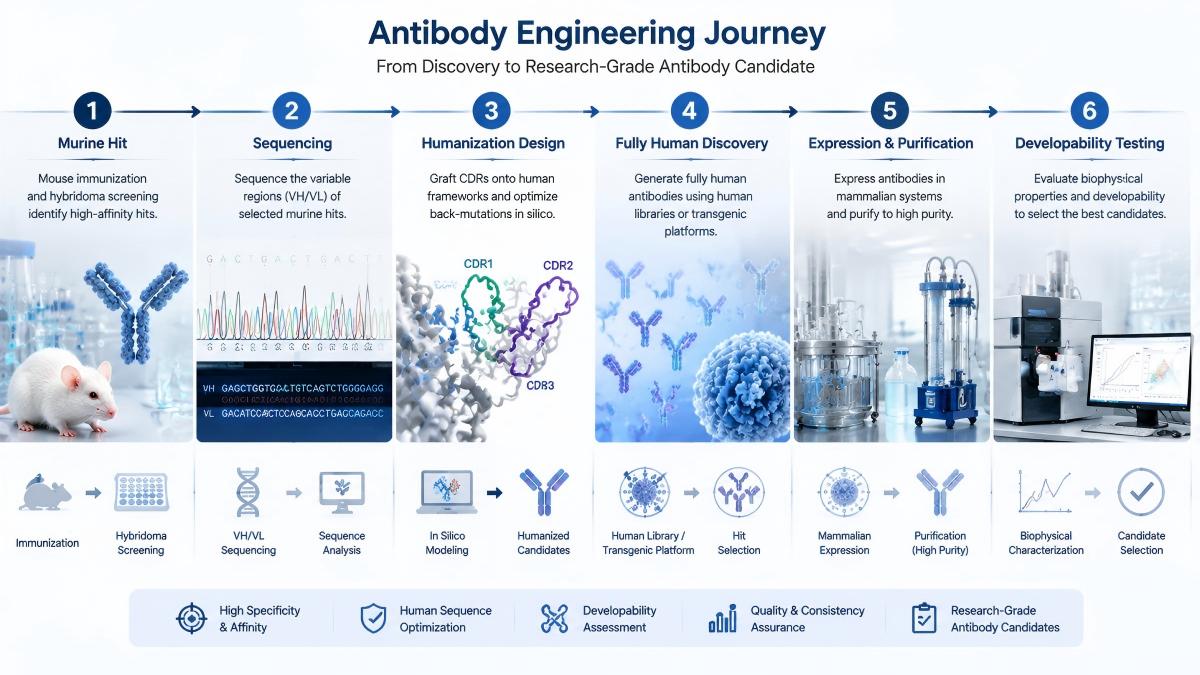
Practical Workflow Example: From Murine Hit to Humanized and Fully Human Panels
To show how these differences translate into a real project, consider a typical workflow that leverages Gene Universal–type capabilities.
1. Start from a murine hybridoma hit
- Sequence VH and VL regions.
- Confirm specificity and affinity in primary binding assays and orthogonal formats.
2. Design a humanized variant
- Select suitable human germline frameworks based on sequence similarity and structural modeling.
- Graft CDRs onto these frameworks, introducing defined back‑mutations where needed to preserve binding and stability.
- Optimize codons for the chosen expression host and assemble expression constructs.
3. Generate a fully human panel in parallel
- Use a human antibody display library or fully human transgenic animals to discover new binders against the same antigen.
- Apply early selection pressure for both affinity and desirable biophysical traits.
4. Express both sets as full‑length IgG
- Produce research‑grade antibody batches via transient expression in mammalian cells.
- Purify and perform basic quality control on yield, purity, and binding activity.
5. Run developability‑oriented assessments
- Compare aggregation, thermal stability, non‑specific binding behavior, and functional potency across both humanized and fully human candidates.
- Use this information to rank molecules alongside epitope binning and mechanism‑of‑action data.
6. Advance a short‑list into deeper in vivo and mechanistic studies
- Select both humanized and fully human leads that best meet your scientific and strategic criteria.
- Use research‑grade material for detailed pharmacology, biomarker work, and combination studies in preclinical models.
In such a workflow, a partner like Gene Universal provides the integrated molecular biology, expression, and purification capabilities that make rapid parallel testing feasible.
Actionable Considerations for Teams Working With Gene Universal
If your organization collaborates with Gene Universal or a similar research‑oriented provider, several best practices will help you extract more value from the humanized vs fully human decision.
- Clarify your primary objective
- Decide whether your near‑term focus is target validation, mechanistic exploration, or preclinical model selection. This influences how aggressively you need to prioritize a specific format up front.
- Define format priorities in the technical brief
- Specify whether epitope novelty, sequence human‑ness, or rapid turnaround is most critical. This guides construct design, expression strategy, and analytical depth.
- Request comprehensive analytical packages
- Include binding kinetics, purity profiles, and basic biophysical readouts with every batch of antibodies. This allows you to make data‑driven decisions and to compare humanized and fully human candidates on equal footing.
- Plan for downstream hand‑offs early
- Maintain clean sequence records, expression conditions, and analytical reports for every candidate. When you later transfer molecules to a CDMO or internal late‑stage development team, this documentation will be invaluable.
By aligning format strategy with execution capabilities, you can decouple early discovery speed from downstream constraints while still preserving options for future development.
FAQs on Humanized vs Fully Human Antibodies
1. Are fully human antibodies always less immunogenic than humanized antibodies?
No. Both humanized and fully human antibodies show substantially lower immunogenicity than murine antibodies, but neither format completely eliminates the risk of anti‑drug antibody responses. Other factors such as aggregation, impurities, target biology, and dose regimen also play major roles.
2. Can I start with a murine antibody and still end up with a competitive candidate?
Yes. Many successful monoclonal antibodies began as murine leads. With modern humanization techniques, careful CDR grafting, and framework optimization, it is possible to retain affinity, specificity, and robust biophysical properties in the resulting humanized antibody.
3. Do I need different analytical assays for humanized vs fully human antibodies in preclinical research?
In most cases, no. The core analytical and functional assays are the same: binding kinetics, epitope binning, stability, aggregation, and in vitro potency. Additional in silico and experimental immunogenicity assessment can be layered onto both formats as needed.
4. How does the choice of format impact in vivo models?
In short‑term animal studies, format differences often show up more in pharmacology than in immunogenicity. Affinity, target engagement, effector function, and off‑target interactions tend to dominate. In longer‑term or repeated‑dose models, format and sequence context may influence the risk of anti‑drug responses.
5. What is the best way to compare humanized and fully human candidates for a new target?
A practical approach is to generate both humanized and fully human panels, produce them as research‑grade antibodies, and compare them head‑to‑head across binding, functional assays, and developability‑oriented assessments. This lets you prioritize molecules based on data rather than assumptions about format.
References
1. Shankar G, Devanarayan V, Amaravadi L, et al. "Recommendations for the assessment and reporting of anti drug antibody immunogenicity." Journal of Immunological Methods. https://pmc.ncbi.nlm.nih.gov/articles/PMC2881252/
2. "Humanized Antibody – an overview." ScienceDirect Topics. https://www.sciencedirect.com/topics/immunology-and-microbiology/humanized-antibody
3. Menegatti S, et al. "Monoclonal Antibodies in Clinical Practice." StatPearls. NCBI Bookshelf, National Center for Biotechnology Information (NIH). https://www.ncbi.nlm.nih.gov/books/NBK572118/
4. Almagro JC, Fransson J. "Humanization of antibodies." Methods in Molecular Biology / NCBI Bookshelf. https://www.ncbi.nlm.nih.gov/books/NBK27136/
5. Ecker DM, Jones SD, Levine HL. "The therapeutic monoclonal antibody market." Nature Reviews Drug Discovery. https://www.nature.com/articles/nrd2015
6. Mallbris L, et al. "Molecular Insights into Fully Human and Humanized Monoclonal Antibodies: What Are the Differences and Should Dermatologists Care?" Journal of Clinical and Aesthetic Dermatology. https://pmc.ncbi.nlm.nih.gov/articles/PMC5022998/
7. "Immunogenicity Assessment for Therapeutic Protein Products." U.S. Food and Drug Administration (FDA) Guidance for Industry. https://www.fda.gov/regulatory-information/search-fda-guidance-documents/immunogenicity-assessment-therapeutic-protein-products
8. "Guideline on Immunogenicity Assessment of Therapeutic Proteins." European Medicines Agency (EMA). https://www.ema.europa.eu/en/search/search?search_api_fulltext=immunogenicity%20therapeutic%20proteins
9. "Monoclonal Antibody Production." NCBI Bookshelf, National Research Council, National Academies Press. https://www.ncbi.nlm.nih.gov/books/NBK100168/
10. "Preclinical Product Development Services for Infectious Disease." National Institute of Allergy and Infectious Diseases (NIAID), NIH. https://www.niaid.nih.gov/research/preclinical-product-development-services-infectious-disease