 +1 302-235-9792
 SIGN IN
 CONTACT US


- News
- In Vivo vs In Vitro Antibody Production: A Comparative Analysis for Modern Biotech Research
share


In Vivo vs In Vitro Antibody Production: A Comparative Analysis for Modern Biotech Research
Content Menu
● What Do "In Vivo" and "In Vitro" Antibody Production Mean?
● Core Workflow Overview: In Vivo vs In Vitro
>> In Vivo Antibody Production Workflow
>> In Vitro Antibody Production Workflow
● Key Differences at a Glance
>> Practical Comparison of In Vivo vs In Vitro Antibody Production
● Time, Cost, and Scale in Modern Antibody Programs
● Ethical and Policy Trends Around Ascites Alternatives
● Analytical and Functional Quality Considerations
>> In Vivo Quality Considerations
>> In Vitro Quality Considerations
● Application‑Focused Comparison: When Scientists Choose In Vivo vs In Vitro
>> Use Cases Where In Vivo Still Makes Sense
>> Use Cases Where In Vitro Is Typically Preferred
● Expert Perspective: Strategic Program Design With a Research‑Focused Provider
● Practical Decision Framework for Biotech Teams
● Future Trends: In Vitro Platforms as the Default for Discovery
● How a Research‑Focused Partner Can Help
● Call to Action: Designing Your Next Antibody Program
● Frequently Asked Questions (FAQ)
● References
As antibody discovery moves deeper into complex targets and multi‑specific formats, choosing between in vivo and in vitro antibody production has become a strategic decision rather than a simple technical preference. From the perspective of a global custom antibody development and engineering partner focused on research-grade, fit‑for‑purpose materials, understanding these trade‑offs is critical for designing efficient, ethical, and scalable workflows.
In this article, we compare in vivo antibody production (typically mouse ascites or serum‑based approaches) with in vitro antibody production (cell‑culture and recombinant systems), and map them onto real‑world biotech applications in discovery, mechanism‑of‑action studies, and assay development.
What Do "In Vivo" and "In Vitro" Antibody Production Mean?
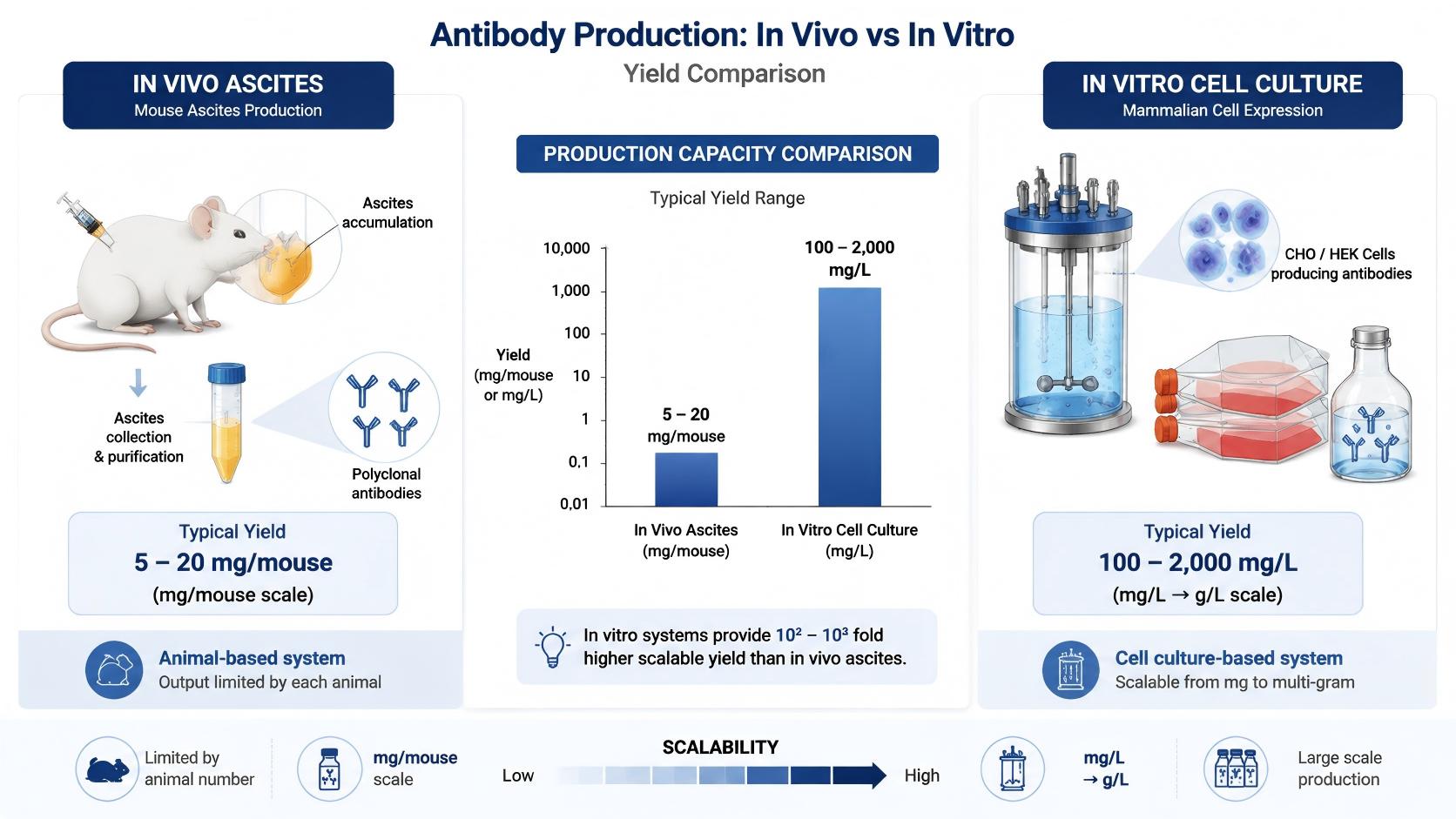
In antibody production, in vivo refers to generating antibodies inside living animals, most commonly mice, by immunization and subsequent serum or ascites collection. In contrast, in vitro antibody production relies on cell culture—such as hybridoma, CHO, or HEK systems—to produce antibodies in controlled bioreactors or flasks outside the animal.
From a scientist's practical perspective:
- In vivo production feels more immunology‑driven and physiologic, relying on the full immune system of the host.
- In vitro production feels more bioprocess‑driven, emphasizing controlled media, bioreactors, and recombinant expression constructs.
This conceptual difference underpins nearly every trade‑off discussed below.
Core Workflow Overview: In Vivo vs In Vitro
In Vivo Antibody Production Workflow
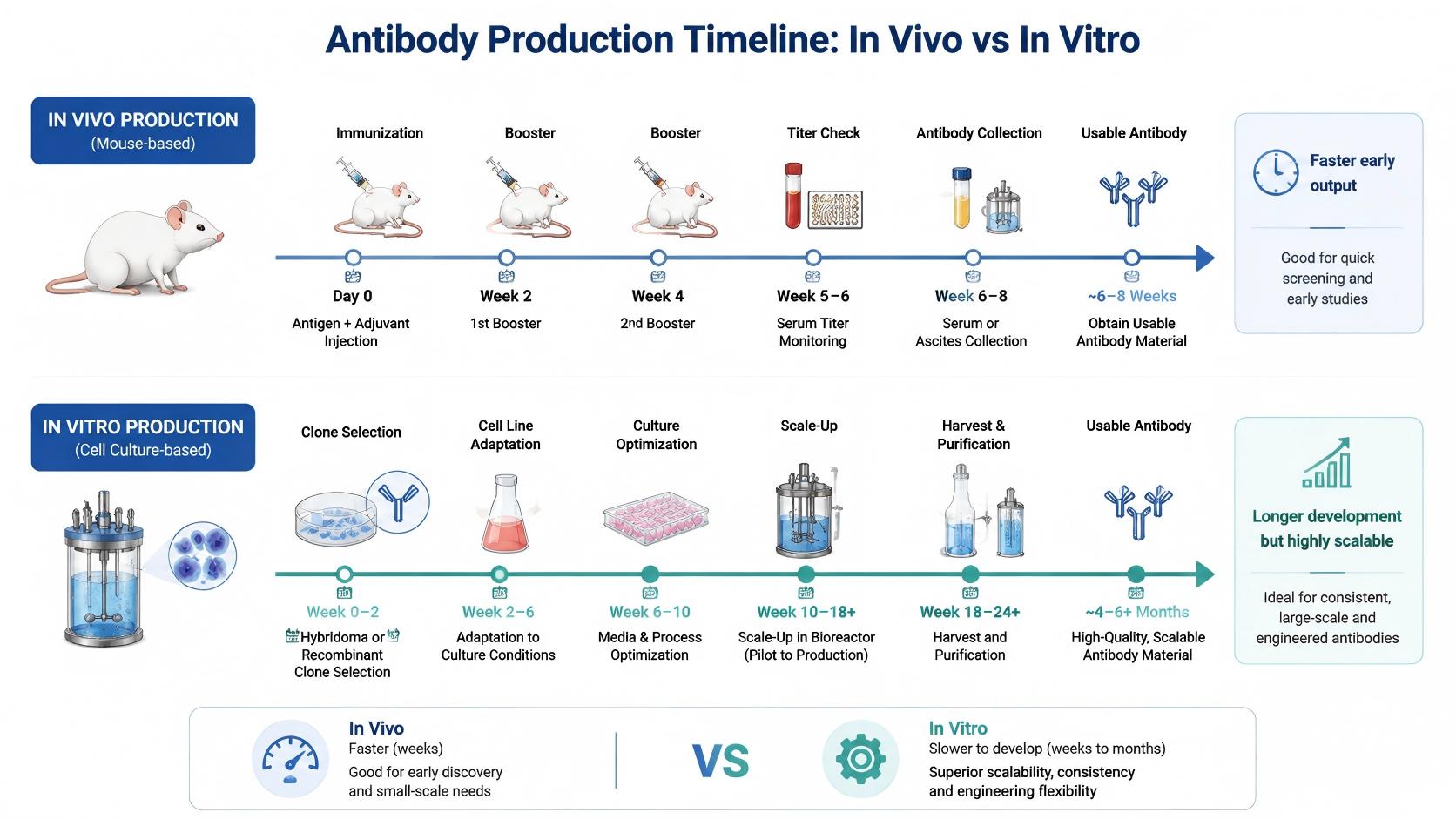
In vivo workflows typically involve:
1. Antigen preparation and formulation (protein, peptide, or conjugate plus adjuvant).
2. Animal immunization (for example, repetitive dosing in mice).
3. Boosts and titer monitoring via serum sampling.
4. Serum collection for polyclonal antibodies, or
5. Hybridoma generation (fusion of B cells with myeloma cells) followed by in vivo ascites production in mice.
From a bench scientist's viewpoint, the key advantages are:
- Familiar protocols in many academic and diagnostic labs.
- Relatively forgiving culture requirements because the animal provides an optimized in vivo microenvironment.
In Vitro Antibody Production Workflow
In vitro workflows typically include:
1. Clone selection (hybridoma or recombinant expression vector).
2. Adaptation to cell culture in flasks, bags, or bioreactors, often using mammalian cells such as CHO or HEK.
3. Optimization of culture conditions (serum‑free or low‑serum media, feeding strategies, oxygen control).
4. Scale‑up and production in high‑density systems (such as stirred‑tank bioreactors or hollow‑fiber systems).
5. Harvest and downstream purification from culture supernatant.
From an industry perspective, this enables:
- Tunable production runs from milligrams to multi‑gram research batches.
- Easier integration with modern recombinant and engineering workflows, including Fc variants, antibody fragments, and bispecifics.
Key Differences at a Glance
Practical Comparison of In Vivo vs In Vitro Antibody Production
| Dimension | In Vivo Antibody Production | In Vitro Antibody Production |
|---|---|---|
| Biological context | Full, intact immune system in animals, including antigen processing and in vivo selection. | Isolated cell systems under controlled, often serum‑reduced conditions. |
| Typical platforms | Mouse serum, mouse ascites, sometimes other species for polyclonals. | Hybridoma culture, CHO/HEK expression, hollow‑fiber or stirred‑tank bioreactors. |
| Timeline for small batches | Can deliver certain monoclonal antibody amounts in a few weeks in some workflows. | More variable; cell line adaptation and optimization can extend timelines but can be shortened with pre‑optimized systems. |
| Scalability | Economical for small to medium amounts; scaling involves more animals. | Highly scalable once optimized; favorable economics at larger production scales. |
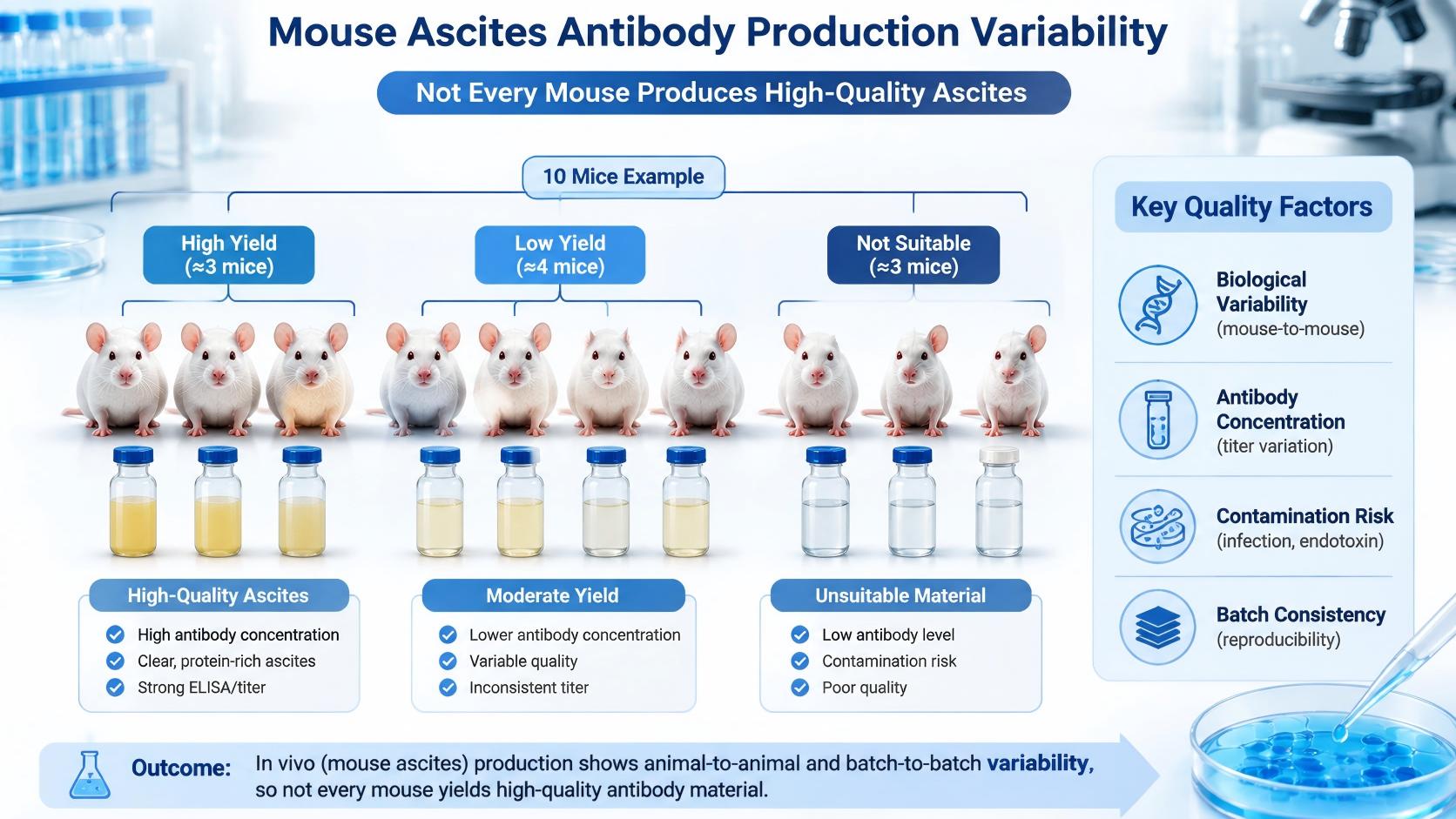
| Product consistency | Biological variability between animals, potential for host immunoglobulin contaminants. | Higher lot‑to‑lot consistency and controlled media composition. |
| Ethical/animal use | Requires animal use; ascites methods face scrutiny and restrictions. | Substantially reduces or avoids live‑animal use once cell line is established. |
| Suitability for engineering | Less flexible for extensive sequence engineering. | Ideal for recombinant formats and sequence‑engineered variants. |
Time, Cost, and Scale in Modern Antibody Programs
From a large‑scale monoclonal antibody production perspective, comparative analyses have shown that:
- For small‑scale production, in vitro methods can initially appear more expensive than in vivo methods, depending on the cell line and platform.
- At larger scales, in vitro systems become economically competitive or favorable, especially when optimization costs are spread across multiple production campaigns.
- When time to first usable antibody is critical and only modest quantities are needed, in vivo methods can provide usable material on relatively short timelines.
However, traditional cost comparisons often underestimate:
- The full cost of animal housing, veterinary care, and animal facility infrastructure.
- The added value of avoiding animal‑derived contaminants and simplifying downstream analytical testing.
As a service provider working with global biotech clients, this means:
- For early proof‑of‑concept or pilot assays, in vivo or mixed approaches may still be appropriate where timelines dominate and cell lines are not pre‑optimized.
- For ongoing discovery programs, high‑throughput screens, and engineered antibody formats, in vitro platforms offer more predictable economics and better scalability over time.
Ethical and Policy Trends Around Ascites Alternatives
Ethical and policy guidance worldwide has progressively emphasized the reduction of in vivo ascites methods wherever viable in vitro alternatives exist.
Key themes include:
- Animal welfare concerns: Ascites methods are associated with more than minimal pain or distress, requiring strong scientific justification and enhanced veterinary oversight.
- Regional restrictions: Some regulatory environments have restricted or effectively phased out routine ascites production for monoclonal antibodies, favoring in vitro systems instead.
- Three Rs principle (Replacement, Reduction, Refinement): In vitro monoclonal antibody production is frequently cited as a practical example of replacing or reducing animal use in antibody generation.
For a global research‑focused services company, prioritizing in vitro platforms and designing projects to minimize or avoid ascites not only aligns with these ethical frameworks but also reduces administrative burden and reputational risk.
Analytical and Functional Quality Considerations
Both in vivo and in vitro systems can deliver monoclonal antibodies that meet stringent research requirements, but the risk profiles differ.
In Vivo Quality Considerations
Important considerations for in vivo‑derived antibodies include:
- Endogenous immunoglobulin contamination: Ascites and serum often contain host immunoglobulins that must be carefully removed or controlled.
- Pathogen risk: Mouse‑derived material can carry murine pathogens, requiring validated health monitoring and specific pathogen‑free colonies.
- Batch variability: Differences between animals and production runs can introduce variation in glycosylation, aggregation, or binding behavior.
In Vitro Quality Considerations
For in vitro systems, key issues include:
- Media‑related impurities: Residual bovine immunoglobulins and endotoxin from serum‑containing media can complicate downstream purification and assays.
- Clone stability and adaptation: A fraction of hybridoma or recombinant clones may not adapt well to certain in vitro systems, underscoring the need for robust cell line engineering and banking.
- Process sensitivity: In vitro systems are more exposed to contamination risks and require trained personnel, environmental control, and standardized operating procedures.
For developability‑oriented assessment and early discovery programs that feed into complex downstream workflows, in vitro systems provide clearer control over these variables, supporting consistent characterization and fit‑for‑purpose research‑grade outputs.
Application‑Focused Comparison: When Scientists Choose In Vivo vs In Vitro
Use Cases Where In Vivo Still Makes Sense
From the viewpoint of a bench immunologist or diagnostic lab, in vivo methods can remain attractive when:
- The goal is exploratory polyclonal antibody generation for early biomarker detection or assay feasibility studies.
- Existing animal facilities and workflows are already in place, making incremental in vivo projects relatively inexpensive.
- Challenging hybridoma lines or antigens do not adapt easily to in vitro conditions, but can still be supported by the in vivo microenvironment.
In these scenarios, speed to first antibody and the practicality of using existing infrastructure can outweigh disadvantages, particularly in early exploratory stages.
Use Cases Where In Vitro Is Typically Preferred
For biotech teams planning multi‑year discovery programs and deep engineering pipelines, in vitro approaches are often the default when:
- The project involves recombinant and engineered formats, including Fc variants, antibody fragments, and bispecific constructs that require precise sequence control.
- The program relies on high‑throughput screening, where reproducible, lot‑to‑lot consistent antibody batches are essential for robust datasets.
- The organization operates in multi‑site, global collaborations, where harmonized antibody lots must be replicated and distributed consistently.
In these settings, in vitro systems support scalable, reproducible manufacturing of fit‑for‑purpose research‑grade antibodies, closely aligned with modern biopharmaceutical discovery practices.
Expert Perspective: Strategic Program Design With a Research‑Focused Provider
As a custom antibody development and engineering partner focused on DNA/RNA‑to‑antibody pipelines for research rather than regulatory‑grade manufacturing, a provider like Gene Universal typically supports clients at the early discovery and characterization stages.
From this vantage point, a practical strategic approach is to:
- Start with in vitro‑compatible designs: Use recombinant constructs and expression vectors from the outset to simplify scaling, engineering, and tech transfer.
- Reserve in vivo production for cases where immunological context, animal model specificity, or certain functional readouts are central to the scientific question.
- Plan explicitly for fit‑for‑purpose research‑grade materials, separating discovery workflows from later GMP or CDMO steps handled by specialized partners.
This strategy aligns with scientific best practices, ethical expectations, and the need to generate robust, well‑characterized antibodies ready to support diverse preclinical research applications.
Practical Decision Framework for Biotech Teams
To guide scientists and project managers, the following decision framework can help structure discussions around in vivo versus in vitro antibody production.
1. Define primary use
Is the antibody primarily for internal research assays, mechanistic studies, screening campaigns, or external diagnostics?
2. Estimate quantity and timeline
Do you need a one‑off pilot batch in a few weeks, or ongoing multi‑gram production over months or years?
3. Assess engineering requirements
Will the antibody undergo extensive sequence optimization, humanization, format switching, or multi‑specific design during the program?
4. Evaluate ethical and institutional context
Are you operating under institutional or regional policies that explicitly prioritize in vitro alternatives and limit ascites production?
In many modern programs:
- Short‑term, low‑volume, exploratory projects may still justify in vivo methods when resources are constrained and institutional approvals are already in place.
- Long‑term, modular discovery programs benefit from a primarily in vitro strategy, supported by recombinant expression platforms and structured analytical characterization.
Future Trends: In Vitro Platforms as the Default for Discovery
As recombinant technologies, serum‑free media, single‑use bioreactors, and automation mature, in vitro systems are steadily becoming the standard for most commercial‑scale monoclonal antibody production and for many research‑grade workflows.
Key long‑term drivers include:
- Reduced animal use and alignment with evolving ethical and institutional expectations.
- Improved process control and analytics, enabling tight control over product quality attributes such as glycosylation, aggregation, and potency.
- Compatibility with novel antibody modalities, including multi‑specifics, Fc‑engineered variants, and fragments, that rely on sequence‑defined expression systems.
For research‑focused service providers, embedding these trends into service design—such as offering integrated DNA‑to‑antibody in vitro pipelines—positions clients to move smoothly from early antigen validation through more advanced developability‑oriented assessments, with minimal re‑engineering of upstream choices.
How a Research‑Focused Partner Can Help
A global life‑science services provider that focuses on end‑to‑end research solutions rather than GMP or IND submission support can deliver value in several concrete ways:
- Custom antibody design and engineering
Support from antigen and epitope design through codon‑optimized recombinant antibody sequences, tailored to the chosen expression system.
- Flexible in vitro production formats
Small‑scale pilot batches for assay feasibility and larger research‑grade runs for multi‑site studies, leveraging scalable bioreactor platforms.
- Integrated characterization
Affinity, specificity, and developability‑oriented assessments aligned with the intended research application, ensuring that antibodies are ready for complex preclinical workflows.
By aligning discovery workflows with in vitro‑first strategies, clients can shorten iteration cycles, reduce ethical and operational burdens, and generate antibodies ready to support everything from mechanistic studies to large‑scale screening campaigns.
Call to Action: Designing Your Next Antibody Program
If your team is planning a new antibody discovery or characterization project and is weighing in vivo versus in vitro antibody production, now is the ideal time to formalize a strategy that:
- Prioritizes in vitro platforms for scalable, reproducible, and ethically aligned antibody supply.
- Uses in vivo approaches selectively, where immunological context or rapid early output clearly justifies their use.
- Leverages a partner specializing in research‑grade, fit‑for‑purpose antibodies rather than regulatory manufacturing, ensuring your discovery pipeline remains agile and innovation‑focused.
Consider mapping your upcoming project's quantity needs, timelines, engineering plans, and ethical constraints, then engaging a specialist provider to co‑design an in vitro‑centric workflow that supports both your immediate experiments and future expansion.
Frequently Asked Questions (FAQ)
1. Are in vitro methods always better than in vivo for antibody production?
Not always. In vitro systems offer advantages in scalability, consistency, and animal‑reduction, but in vivo approaches can still be attractive for early, small‑scale projects where time to first antibody and existing animal facilities are the primary constraints.
2. How quickly can I obtain monoclonal antibodies using in vivo methods?
For an established antibody-producing hybridoma, ascites-based production may provide usable monoclonal antibody material within several weeks, assuming appropriate ethical approval, animal health monitoring, and successful production.Full monoclonal antibody generation from immunization through clone screening usually requires a longer development timeline.
3. What are the main risks of continued ascites‑based production?
Ascites methods are associated with animal welfare concerns, higher ethical and institutional scrutiny, and potential contamination with host immunoglobulins and pathogens, all of which require robust monitoring, documentation, and downstream testing.
4. Why are in vitro platforms favored for engineered and recombinant antibodies?
In vitro recombinant mammalian expression provides precise control over antibody sequence and format, while enabling more systematic monitoring and optimization of product quality attributes such as glycosylation, aggregation, and potency.
5. How should research teams separate discovery from later manufacturing steps?
A practical approach is to focus on fit‑for‑purpose research‑grade antibodies during discovery, using in vitro systems that support rapid iteration and deep characterization, and later transfer successful candidates to specialized GMP or CDMO partners for subsequent manufacturing stages.
References
1. National Research Council (US) Committee on Methods of Producing Monoclonal Antibodies. Large‑Scale Production of Monoclonal Antibodies. NCBI Bookshelf. https://www.ncbi.nlm.nih.gov/books/NBK100189/
2. Assay Genie. In Vitro vs In Vivo: Key Differences & When to Use Each. https://www.assaygenie.com/blog/in-vitro-vs-in-vivo-key-differences-when-to-use-each/
3. Evitria. In Vivo vs In Vitro Antibody Production: A Comparative Study. https://www.evitria.com/journal/antibodies/in-vivo-in-vitro-antibody-production/
4. Evitria. In Vitro Antibody Production: Comprehensive Guide. https://www.evitria.com/journal/antibodies/in-vitro-antibody-production/
5. Boston University IACUC. Ascites Method for Antibody Production in Mice. https://www.bu.edu/research/forms-policies/ascites-method-for-antibody-production-in-mice-iacuc/
6. National Research Council (US) Committee on Methods of Producing Monoclonal Antibodies. Conclusions and Recommendations – Monoclonal Antibody Production. NCBI Bookshelf. https://www.ncbi.nlm.nih.gov/books/NBK100204/