 +1 302-235-9792
 SIGN IN
 CONTACT US


- News
- Isotype Switching vs Point Mutations: Engineering Antibody Effector Functions (ADCC/CDC) for Enhanced Anti-Tumor Efficacy
share


Isotype Switching vs Point Mutations: Engineering Antibody Effector Functions (ADCC/CDC) for Enhanced Anti-Tumor Efficacy
Content Menu
● ADCC and CDC: Two Different Routes to Antibody-Mediated Tumor Killing
>> How ADCC Recruits Immune Effector Cells
>> How CDC Activates Complement
● Isotype Switching: Changing the Antibody's Constant-Region Framework
>> IgG1 and IgG3: Strong Effector Activity With Different Properties
>> IgG2 and IgG4: Lower Effector Activity Can Be Useful
● Fc Point Mutations: Fine-Tuning ADCC and CDC
>> ADCC-Enhancing Mutations: S239D/I332E
>> CDC-Enhancing Mutations: E430G
● Isotype Switching vs Point Mutations: Comparison Table
● Choosing Between ADCC Enhancement and CDC Enhancement
>> When ADCC Is the Primary Research Objective
>> When CDC Is the Primary Research Objective
● Surface Assembly Helps Explain Subclass Differences
● What Margetuximab Teaches About Fc Engineering
● A Practical Workflow for Custom Antibody Development
>> 1. Define the Biological Question
>> 2. Build a Matched Comparison Panel
>> 3. Control Product-Quality Differences
>> 4. Measure Binding and Function Separately
>> 5. Perform a Developability-Oriented Assessment
● Why "More ADCC Plus More CDC" Is Not Automatically Better
● Research-Focused Support for Antibody Projects
● Start With a Mechanism-Defined Research Brief
● Frequently Asked Questions
>> 1. Does isotype switching change antigen specificity?
>> 2. Are Fc point mutations the same as affinity maturation?
>> 3. Is IgG3 always better than IgG1 for CDC?
>> 4. Can glycosylation affect an isotype-versus-mutation comparison?
>> 5. Does stronger ADCC guarantee better anti-tumor outcomes?
>> 6. What information should researchers send Gene Universal?
● Source Documentation
Isotype switching vs point mutations is a central decision in custom antibody development for cancer research. Both approaches can change antibody-dependent cellular cytotoxicity (ADCC) and complement-dependent cytotoxicity (CDC), but they act differently. Isotype switching replaces the constant-region framework; Fc point mutations modify selected amino acids within that framework. The best choice depends on the target, the intended immune mechanism, and the properties required for a useful research antibody.
My guiding recommendation is to prioritize selectivity rather than maximum immune activation. An antibody that produces stronger killing in one assay is not necessarily the best molecule for investigating a particular tumor biology question.
For discovery teams, the objective is a well-characterized research-use candidate with a defensible connection between its design and its measured function.
ADCC and CDC: Two Different Routes to Antibody-Mediated Tumor Killing
An antibody's Fab regions recognize the antigen. Its Fc region connects that recognition event to immune receptors and complement proteins. Subclass, sequence, and glycosylation all influence these interactions.
How ADCC Recruits Immune Effector Cells
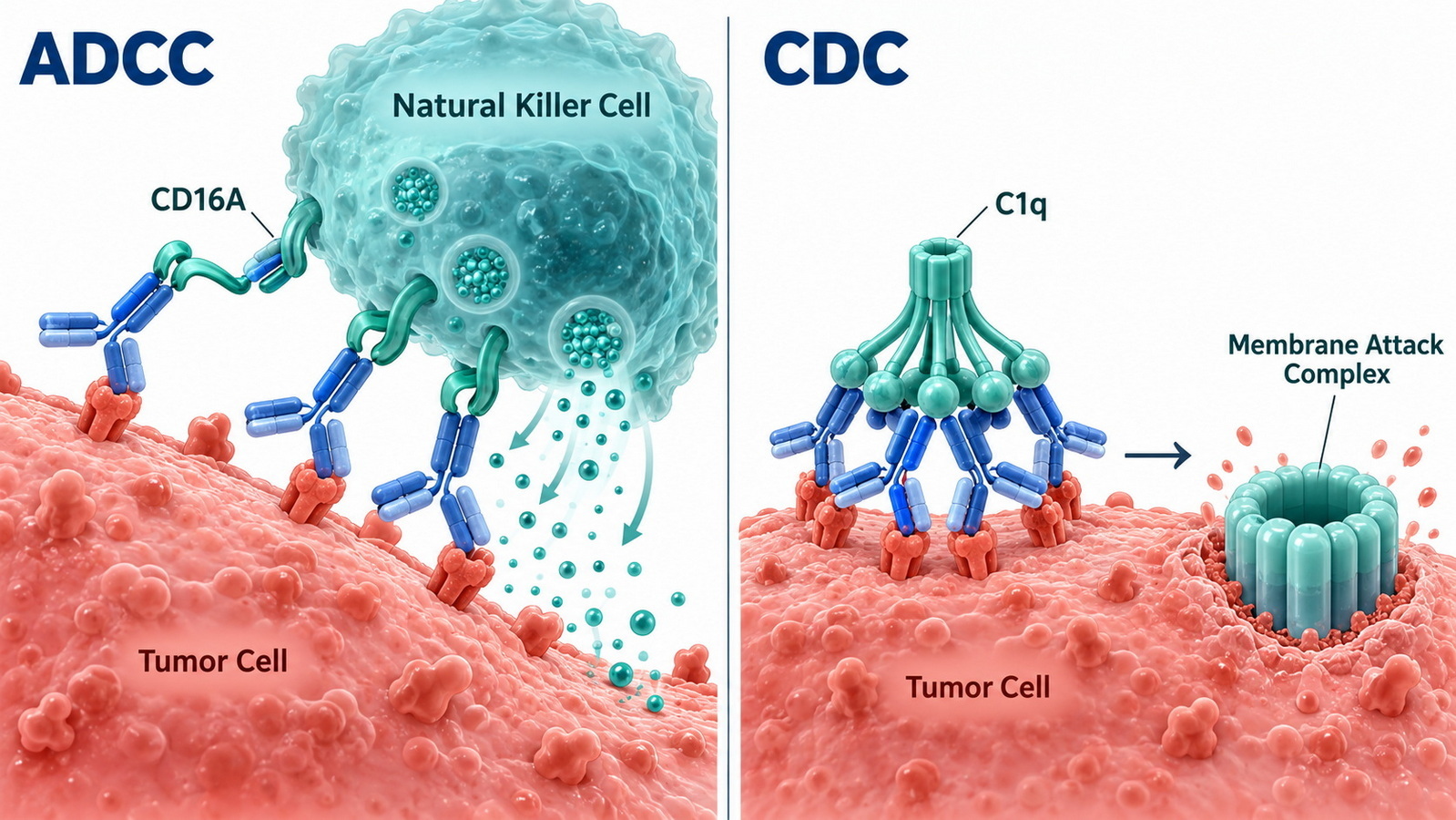
ADCC occurs when an antibody binds a target cell and recruits an immune effector cell through Fc receptors.
Natural killer cells are important participants. Their FcγRIIIa receptor, also called CD16A, recognizes antibody-coated targets and can trigger cytotoxic activity. Engineering stronger FcγRIIIa engagement is therefore a common approach to enhancing ADCC.
However, receptor binding is not equivalent to cell killing. Target expression, effector-cell characteristics, and assay conditions influence the functional result.
How CDC Activates Complement
CDC begins when antibodies bound to a target recruit C1, whose recognition component is C1q. Classical complement activation can ultimately produce membrane attack complexes that damage the cell membrane.
For IgG, complement activation depends substantially on neighboring antibodies assembling into suitable oligomers on antigenic surfaces. Ordered hexamers provide an effective arrangement for multivalent C1 engagement.
This distinction matters: improving immune-cell recruitment and improving complement activation require different design and testing strategies.
Isotype Switching: Changing the Antibody's Constant-Region Framework
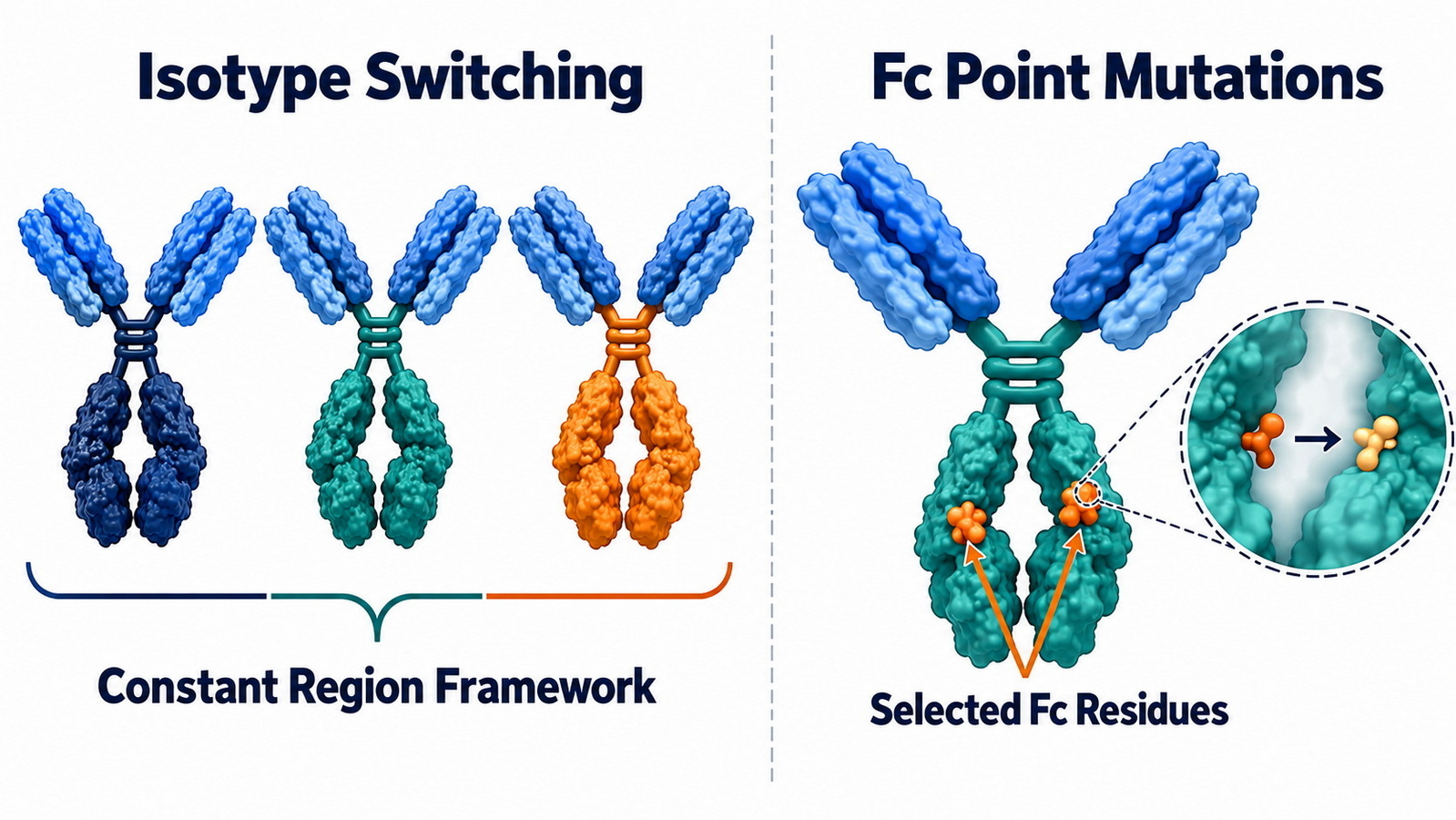
In natural immunity, class-switch recombination changes antibody constant regions while retaining antigen specificity.
In recombinant antibody engineering, the expression "isotype switching" often describes placing the same variable regions onto a different constant-region backbone. This article primarily compares human IgG subclass switching, rather than switching between entirely different antibody classes such as IgG and IgM.
IgG1 and IgG3: Strong Effector Activity With Different Properties
IgG1 and IgG3 generally support stronger activating effector functions than IgG2 and IgG4. Both can recruit cellular effectors and activate complement, although their performance depends on the experimental context.
IgG1 is a common starting framework for effector-active antibodies. IgG3 offers strong complement activity but differs in hinge architecture, allotype-dependent properties, and interactions affecting antibody persistence.
The practical lesson is not that one subclass always wins. It is that subclass selection changes several molecular properties simultaneously.
IgG2 and IgG4: Lower Effector Activity Can Be Useful
IgG2 and IgG4 generally show less activating effector activity than IgG1 and IgG3. IgG4 is particularly relevant when target engagement or pathway blockade is desired without strong complement activation.
Reduced activity may be beneficial when the target is expressed on immune cells that should remain functional.
Neither subclass should be described as universally inactive. Activity depends on the receptor, antigen arrangement, and experimental conditions.
Fc Point Mutations: Fine-Tuning ADCC and CDC
Fc point mutations replace selected amino acids without changing the entire subclass framework.
For example, S239D indicates substitution of serine with aspartic acid at position 239. Mutation positions should always be reported with the numbering convention used, commonly EU numbering in Fc-engineering literature.
ADCC-Enhancing Mutations: S239D/I332E
S239D/I332E is an established mutation combination used to enhance FcγRIIIa engagement and ADCC.
Tafasitamab is a therapeutic example incorporating these substitutions. Its design demonstrates the relevance of targeted Fc modification, but does not establish that the same mutations will improve every research antibody.
An important complication is that Fc modifications can affect multiple receptors. Evaluation should therefore consider activating and inhibitory receptor interactions rather than measuring CD16A binding alone.
CDC-Enhancing Mutations: E430G
E430G is a prominent example of a substitution that promotes Fc-mediated assembly after antigen binding.
Research on hexamerization-enhanced antibodies links improved surface organization to stronger complement recruitment and CDC. This shifts the engineering objective from isolated binding affinity toward productive assembly on the target membrane.
The resulting activity still depends on the antigen and cellular environment.
Isotype Switching vs Point Mutations: Comparison Table
The following comparison summarizes the mechanistic distinction between changing the backbone and modifying specific Fc interactions. Neither strategy removes the need for functional characterization.
| Factor | Isotype switching | Fc point mutations |
|---|---|---|
| Main change | Replaces the constant-region subclass framework | Replaces selected Fc residues |
| Functional scope | Broad changes across several properties | More focused tuning, with possible secondary effects |
| ADCC strategy | Select a subclass with suitable receptor engagement | Modify receptor interactions within a chosen backbone |
| CDC strategy | Compare complement-active subclass frameworks | Promote complement recruitment or antibody assembly |
| Structural impact | Changes hinge and constant-region architecture | Retains the subclass but alters particular interactions |
| Main research question | Which framework fits the intended mechanism? | Which modification addresses the limiting interaction? |
| Essential validation | Binding, function, purity, and stability | The same tests, plus mutation-specific characterization |
The approaches can be combined. A team may first select an appropriate subclass and then introduce mutations to address a defined functional limitation.
Choosing Between ADCC Enhancement and CDC Enhancement
When ADCC Is the Primary Research Objective
If the question concerns natural-killer-cell-mediated tumor killing, an IgG1 backbone with targeted Fc optimization is a reasonable starting hypothesis.
Compare the parental antibody against engineered variants using actual cytotoxicity assays. Include multiple effector-cell donors where feasible.
Glycosylation requires particular attention. Reduced core fucosylation can enhance FcγRIIIa engagement independently of subclass switching or Fc amino-acid changes. Unmatched glycan profiles can therefore confound the comparison.
When CDC Is the Primary Research Objective
If complement-mediated killing is central, compare suitable IgG subclasses alongside a hexamerization-enhancing variant.
Antigen density, hinge properties, antibody concentration, and complement availability can influence the observed ranking. Research comparing subclasses demonstrates that these contextual factors can change complement activation patterns.
Consequently, stronger C1q binding alone is insufficient evidence for choosing a CDC-focused candidate.
Surface Assembly Helps Explain Subclass Differences
A 2024 study investigated why IgG subclasses differ in complement activation.
The researchers found that their varying ability to form sufficiently large oligomers on antigenic surfaces helps govern multivalent C1 binding and activation. This provides a mechanistic explanation beyond a simple comparison of individual Fc–C1 interactions.
The implication for custom antibody development is significant: antigen presentation should be treated as part of the engineering problem.
A variant that performs well against a densely expressed antigen may behave differently when expression is low or antibody spacing is unfavorable. Testing across target-expression levels can make the comparison more informative.
What Margetuximab Teaches About Fc Engineering
Margetuximab offers a useful example of the gap between mechanistic improvement and patient outcomes.
In SOPHIA, margetuximab plus chemotherapy achieved median progression-free survival of 5.8 months, compared with 4.9 months for trastuzumab plus chemotherapy.
The final overall-survival analysis reported medians of 21.6 and 21.9 months, respectively. The hazard ratio was 0.95, with a 95% confidence interval of 0.77–1.17; the study did not demonstrate an overall-survival advantage.
For research communication, distinguish clearly between:
- Improved receptor engagement.
- Increased laboratory cytotoxicity.
- Improvement in a clinical disease-control endpoint.
- Demonstrated survival benefit.
Clinical examples provide context for discovery research. They do not imply that a research service provides therapeutic manufacturing or submission support.
A Practical Workflow for Custom Antibody Development
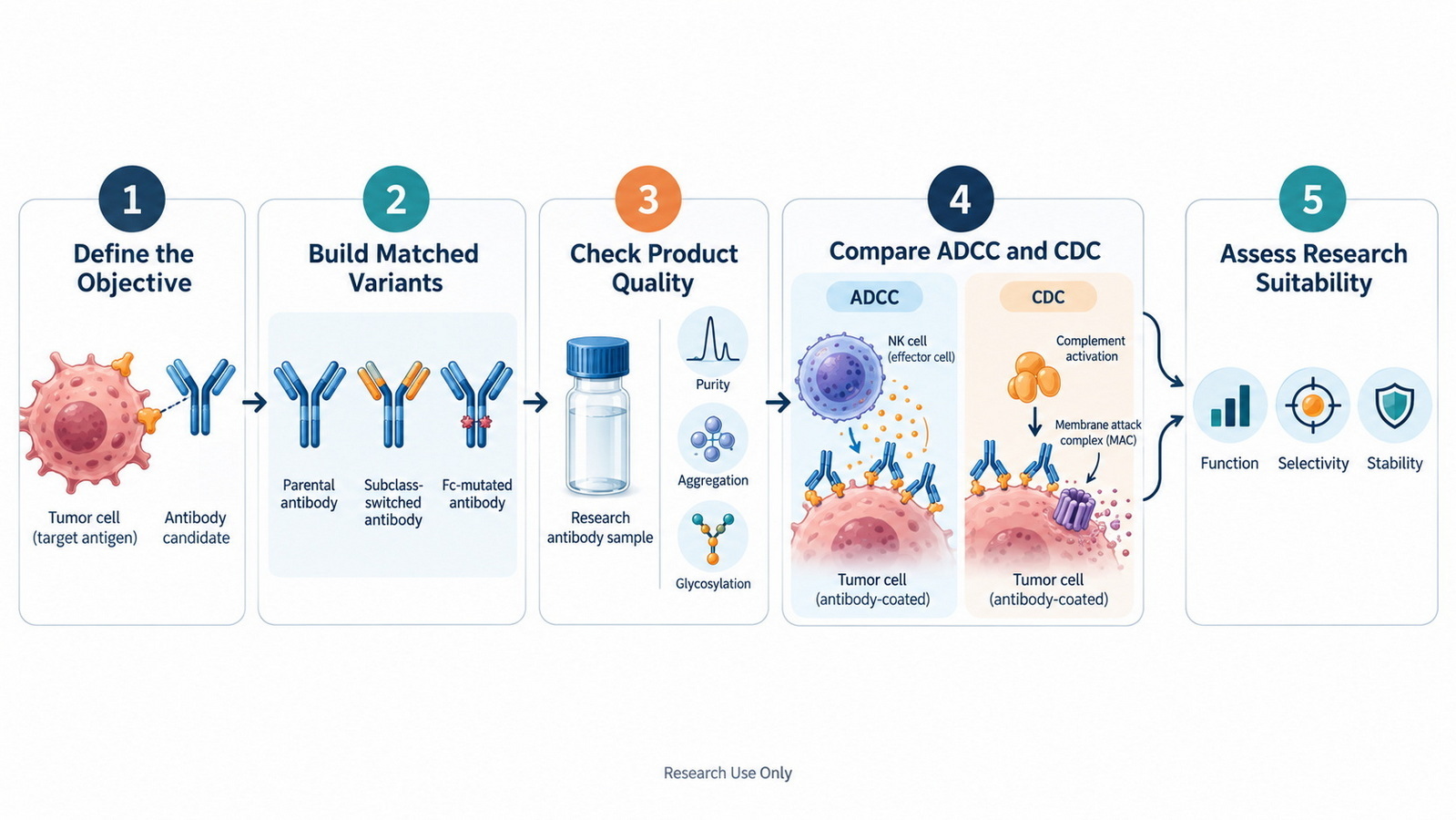
The following workflow is a proposed research framework, not a claim that every listed assay is available from a particular provider.
1. Define the Biological Question
Specify whether the antibody should recruit immune cells, activate complement, support both mechanisms, or minimize depletion.
Begin with the target biology—not a preferred mutation.
2. Build a Matched Comparison Panel
Consider including:
- The parental antibody.
- Relevant subclass-switched versions.
- An ADCC-focused Fc variant.
- A CDC-focused Fc variant.
Keep variable-region sequences constant where practical. Document subclass, allotype, mutation numbering, and expression conditions.
3. Control Product-Quality Differences
Characterize purity, aggregation, concentration, and glycosylation.
These factors can influence Fc behavior independently of the intended sequence change, so they should be considered before attributing functional differences to engineering.
4. Measure Binding and Function Separately
For ADCC, combine receptor-binding measurements with target-cell killing.
For CDC, assess complement-dependent killing rather than relying exclusively on C1q binding.
Include appropriate controls, such as antigen-negative cells and conditions that distinguish complement-dependent from complement-independent effects.
5. Perform a Developability-Oriented Assessment
Evaluate stability, aggregation tendency, and consistency between research batches.
Select a candidate that fits the intended experiment and remains suitable for handling, storage, and downstream characterization.
Why "More ADCC Plus More CDC" Is Not Automatically Better
Combining engineering strategies can be attractive, but additive activity should not be assumed.
Fc-receptor and complement interactions involve overlapping structural regions. A modification intended to improve one function may influence another, while glycosylation adds another layer of variation.
My preferred approach is to identify the dominant bottleneck first. Address that bottleneck, then test whether the change preserves other properties required by the project.
This mechanism-first strategy produces a more interpretable comparison than selecting a molecule solely because it has the strongest result in one assay.
Research-Focused Support for Antibody Projects
Gene Universal is a U.S.-headquartered life science service provider supporting research and innovation in more than 100 countries. Its stated scope spans DNA/RNA through proteins and antibodies.
For an isotype-switching or Fc-mutation project, begin by sharing the target, available sequences, intended mechanism, required formats, and characterization priorities.
Discuss which research-stage deliverables Gene Universal can provide directly and which functional studies require an external laboratory.
Gene Universal does not provide GMP manufacturing, CDMO services, or IND-submission support. The appropriate scope is early discovery and characterization, preclinical research support, and fit-for-purpose research-grade materials.
Start With a Mechanism-Defined Research Brief
Contact Gene Universal to discuss a custom antibody development project built around a clear biological question.
Request a defined scope covering variant design, research-grade material requirements, and characterization deliverables. Make the decision between isotype switching and Fc point mutations through matched evidence—not assumptions about universal superiority.
Frequently Asked Questions
1. Does isotype switching change antigen specificity?
It generally retains the variable regions responsible for specificity. However, the new format should still undergo binding and functional testing because constant-region architecture changes.
2. Are Fc point mutations the same as affinity maturation?
No. Fc engineering targets effector interactions and related Fc properties. Affinity maturation generally aims to improve antigen recognition through changes in the variable regions.
3. Is IgG3 always better than IgG1 for CDC?
No. IgG3 has strong complement activity, but subclass performance depends on antigen presentation and assay conditions. A matched functional comparison is more useful than a universal ranking.
4. Can glycosylation affect an isotype-versus-mutation comparison?
Yes. Glycosylation influences Fc interactions. Differences between preparations can complicate attribution of activity to subclass or sequence changes.
5. Does stronger ADCC guarantee better anti-tumor outcomes?
No. Laboratory activity and clinical benefit are different endpoints. SOPHIA's final analysis illustrates why improved Fc function should not be equated with a demonstrated survival advantage.
6. What information should researchers send Gene Universal?
Provide the target, sequences if available, intended effector function, comparator, requested formats, and research deliverables. Confirm functional-assay availability and project boundaries before work begins.
Source Documentation
The technical discussion draws on the following permitted literature sources. Recommendations and the proposed workflow are editorial synthesis; the company profile and service limitations were supplied in the brief.
1- Vidarsson G, Dekkers G, Rispens T. "IgG subclasses and allotypes: from structure to effector functions." *Frontiers in Immunology*. 2014;5:520. Supports subclass structure, receptor engagement, complement activity, and FcRn distinctions. PubMed PMID: 25368619. [pubmed.ncbi.nlm.nih]
2- "The Ligands for Human IgG and Their Effector Functions." PubMed PMID: 31544836. Supports Fc-engaging molecules and the effects of subclass, allotype, and glycosylation. [pubmed.ncbi.nlm.nih]
3- "Fc-Engineered Therapeutic Antibodies: Recent Advances and Future Directions." *Pharmaceutics*. 2023;15(10):2402. DOI: 10.3390/pharmaceutics15102402. Supports Fc engineering, ADCC-focused substitutions, and glycoengineering. PubMed PMID: 37896162. [pubmed.ncbi.nlm.nih]
4- "Antibodies That Efficiently Form Hexamers upon Antigen Binding Can Induce Complement-Dependent Cytotoxicity under Complement-Limiting Conditions." 2016. Supports antigen-dependent hexamerization and complement-mediated activity. PubMed PMID: 27474078. [pubmed.ncbi.nlm.nih]
5- "Complement activation by IgG subclasses is governed by their ability to oligomerize upon antigen binding." *Proceedings of the National Academy of Sciences*. 2024. DOI: 10.1073/pnas.2406192121. Supports the surface-assembly explanation of subclass differences. PubMed PMID: 39436656. [pubmed.ncbi.nlm.nih]
6- "The IgG subclass pattern of complement activation depends on epitope density and antibody and complement concentration." *Scandinavian Journal of Immunology*. 1989;30(3):379–382. DOI: 10.1111/j.1365-3083.1989.tb01225.x. Supports context-dependent complement comparisons. PubMed PMID: 2476845. [pubmed.ncbi.nlm.nih]
7- "Margetuximab plus Chemotherapy for Advanced or Metastatic HER2-Positive Breast Cancer: FDA Approval Summary." Supports the SOPHIA progression-free-survival figures. PubMed PMID: 34916216. [pubmed.ncbi.nlm.nih]
8- "Margetuximab Versus Trastuzumab in Patients With Previously Treated HER2-Positive Advanced Breast Cancer (SOPHIA): Final Overall Survival Results From a Randomized Phase 3 Trial." Supports the final overall-survival comparison. PubMed PMID: 36332179. [pubmed.ncbi.nlm.nih]