 +1 302-235-9792
 SIGN IN
 CONTACT US


- News
- Mastering siRNA Design for Precision Gene Silencing: A 2026 Expert Guide for Antibody and RNAi Researchers
share


Mastering siRNA Design for Precision Gene Silencing: A 2026 Expert Guide for Antibody and RNAi Researchers
Content Menu
● What Is siRNA and How Does RNA Interference Work
● Core Principles of Optimal siRNA Design
>> mRNA Target Accessibility and Secondary Structure
>> Strategic Target Site Selection
>> GC Content and Sequence Composition
>> Thermodynamic Asymmetry for Strand Selection
● Understanding and Mitigating Off-Target Effects
>> Recent Advances in Off-Target Suppression (2025-2026)
● Engineering siRNA Stability for Research and Translational Use
>> Chemical Backbone Modifications
>> Immunogenicity Considerations
>> Delivery Innovations Extending siRNA Utility
● The Antibody-siRNA Connection: An Emerging Frontier for Research-Grade Targeted Delivery
>> Practical Workflow: From Target Gene to Validated Antibody Candidate
● Conclusion
● Frequently Asked Questions
● References
Small interfering RNA (siRNA) has become one of the most versatile tools in modern molecular biology, enabling researchers to silence disease-relevant genes with remarkable specificity. For scientists working across genomics, protein engineering, and custom antibody development, understanding siRNA design fundamentals is central to validating gene function, building knockdown cell lines, and characterizing candidate targets before they ever reach an antibody discovery campaign.
This guide breaks down the core principles of siRNA design, off-target mitigation, and stability engineering, then extends the discussion into an area often overlooked elsewhere: how siRNA-based gene silencing data connects directly to antibody target validation and custom antibody engineering workflows.
What Is siRNA and How Does RNA Interference Work
Small interfering RNAs are short, double-stranded RNA molecules, typically 20 to 24 nucleotides long, that hijack the cell's natural RNA interference (RNAi) pathway to degrade specific messenger RNA (mRNA) transcripts. The modern RNAi field was established by the landmark 1998 demonstration that double-stranded RNA could trigger potent, sequence-specific gene silencing in Caenorhabditis elegans. RNAi was subsequently shown to participate in endogenous gene regulation and antiviral defense in multiple organisms.
The mechanism is elegant. Once a synthetic or endogenous siRNA duplex loads onto the RNA-induced silencing complex (RISC), the passenger strand is cleaved and discarded, while the guide strand remains bound to RISC. The Argonaute (AGO) protein then uses this guide strand to locate a complementary mRNA sequence and cleave it, blocking translation before a protein is ever made.
Key takeaway: Because siRNA acts post-transcriptionally, it offers researchers a fast, programmable way to knock down virtually any gene of interest without altering the underlying DNA sequence.

Core Principles of Optimal siRNA Design
Designing an effective siRNA sequence is not a matter of guesswork — it requires evaluating several interacting molecular variables simultaneously.
mRNA Target Accessibility and Secondary Structure
Not every region of an mRNA transcript is equally accessible to siRNA binding. Stable secondary structures such as hairpins and stem-loops can physically block siRNA-RISC engagement. Computational folding tools that estimate local free energy (ΔG) help researchers identify open, low-structure regions where siRNA binding is thermodynamically favorable. Coding sequence (CDS) regions generally outperform untranslated regions (UTRs) because they combine better structural openness with stronger evolutionary conservation across species.
Strategic Target Site Selection
Candidate siRNA sites may be selected from either coding sequences or untranslated regions. Rather than relying on a fixed distance from the start codon, candidates should be prioritized based on transcript and isoform coverage, local accessibility, sequence features, known variants, and predicted off-target risk. Regions overlapping splice junctions or experimentally supported RNA-binding protein sites may require additional evaluation.
GC Content and Sequence Composition
GC content sits at the heart of siRNA functionality. Sequences that are too GC-rich (above roughly 60%) form duplexes that are too thermodynamically stable to unwind efficiently inside RISC, while GC-poor sequences may bind too weakly to be effective. Avoid long homopolymeric stretches and excessively GC-rich sequences that may promote undesirable self-structure, synthesis difficulties, or unfavorable strand loading. Screen bona fide G-rich quadruplex-forming motifs separately when relevant.
Thermodynamic Asymmetry for Strand Selection
One of the more technical but critical design considerations is thermodynamic asymmetry. Engineering the guide (antisense) strand with a relatively unstable 5' end and a comparatively stable 3' end biases RISC toward loading the intended guide strand rather than the passenger strand, improving both potency and predictability of silencing outcomes.
Practical design checklist:
- Screen the transcript for regions with high predicted accessibility or low target-opening energy.
- Prioritize CDS binding sites 50-100 nucleotides downstream of the start codon
- Target approximately 30-52% overall GC content
- Avoid long homopolymeric or highly GC-rich stretches and screen potential G-rich quadruplex-forming motifs where applicable.
- Engineer 5'/3' thermodynamic asymmetry into the guide strand
- Run BLAST-based homology screening against the transcriptome before finalizing candidates
Understanding and Mitigating Off-Target Effects
Off-target activity remains the single most cited limitation of siRNA-based research tools, and it comes in two distinct flavors that require different mitigation strategies.
| Off-target mechanism | Cause | Primary mitigation strategy |
|---|---|---|
| Homology-driven silencing | Guide strand binds partially complementary sequences elsewhere in the transcriptome | Bioinformatic homology screening, sequence filtering |
| miRNA-like seed effects | Seed region (nt 2-8) mimics endogenous microRNA activity on unrelated 3' UTRs | Seed-region chemical modification (2'-OMe, LNA), thermodynamic tuning |
Research has shown that seed-matched off-target silencing is strongly correlated with 3' UTR seed complementarity rather than overall sequence identity, meaning even a well-matched siRNA can still trigger unintended knockdown if its seed sequence happens to match unrelated transcripts. This finding reshaped how experienced RNAi researchers approach candidate screening: overall BLAST identity alone is an insufficient filter.
Recent Advances in Off-Target Suppression (2025-2026)
A 2026 study introduced a combined strategy using seed-region 2'-diol chemical modifications alongside an extended 3'-overhang sense-strand design, reporting measurable reductions in both sense-strand-mediated and miRNA-like off-target interactions while preserving on-target RNAi activity. This reflects a broader shift toward pairing rational sequence design with targeted chemistry rather than relying on sequence selection alone.
Separately, research differentiating the two functional halves of the seed region (nucleotides 2-5 versus 6-8) found that 2'-OMe modifications at positions 2-5 specifically suppressed off-target activity without reducing on-target knockdown, while modifications at positions 6-8 could actually enhance both on-target and off-target effects. This nuance matters enormously for researchers designing siRNA panels intended for downstream functional or antibody-target validation studies, where false-positive phenotypes from off-target silencing can derail an entire discovery timeline.

Engineering siRNA Stability for Research and Translational Use
Naked, unmodified siRNA is highly vulnerable to nuclease degradation in biological systems, which limits its functional half-life in both cell-based assays and in vivo research models.
Chemical Backbone Modifications
The most widely validated stabilization strategies include 2'-O-methyl and 2'-fluoro substitutions on the ribose backbone, combined with phosphorothioate (PS) linkages replacing vulnerable phosphate bonds. Together, these modifications substantially extend oligonucleotide half-life while preserving silencing potency and improving the overall safety profile of the molecule.
Immunogenicity Considerations
Unmodified siRNA sequences containing GU-rich motifs can inadvertently trigger innate immune pattern-recognition receptors such as TLR7/8, provoking unwanted inflammatory cytokine responses in research models. Backbone and nucleoside modifications that reduce this immunostimulatory potential are now considered standard practice in any rigorously designed siRNA panel intended for downstream mechanistic or developability-oriented assessment work.
Delivery Innovations Extending siRNA Utility
GalNAc conjugation, which exploits hepatocyte-specific asialoglycoprotein receptors, has dramatically improved liver-targeted delivery efficiency and underpins several FDA-approved siRNA therapeutics on the market today, including patisiran, givosiran, lumasiran, inclisiran, vutrisiran, nedosiran, and fitusiran. Lipid nanoparticle (LNP) formulations using ionizable lipids continue to expand tissue tropism options beyond the liver, achieving encapsulation efficiencies exceeding 90% in optimized formulations.
The Antibody-siRNA Connection: An Emerging Frontier for Research-Grade Targeted Delivery
One area of siRNA innovation with direct relevance to antibody engineering teams is the growing use of antibody-oligonucleotide conjugates (AOCs) as research-grade extrahepatic delivery vehicles. Because naked siRNA and even GalNAc-conjugated siRNA are largely confined to liver-directed delivery, researchers have increasingly turned to antibodies as targeting modules to extend siRNA silencing activity into other tissue types and cell populations.
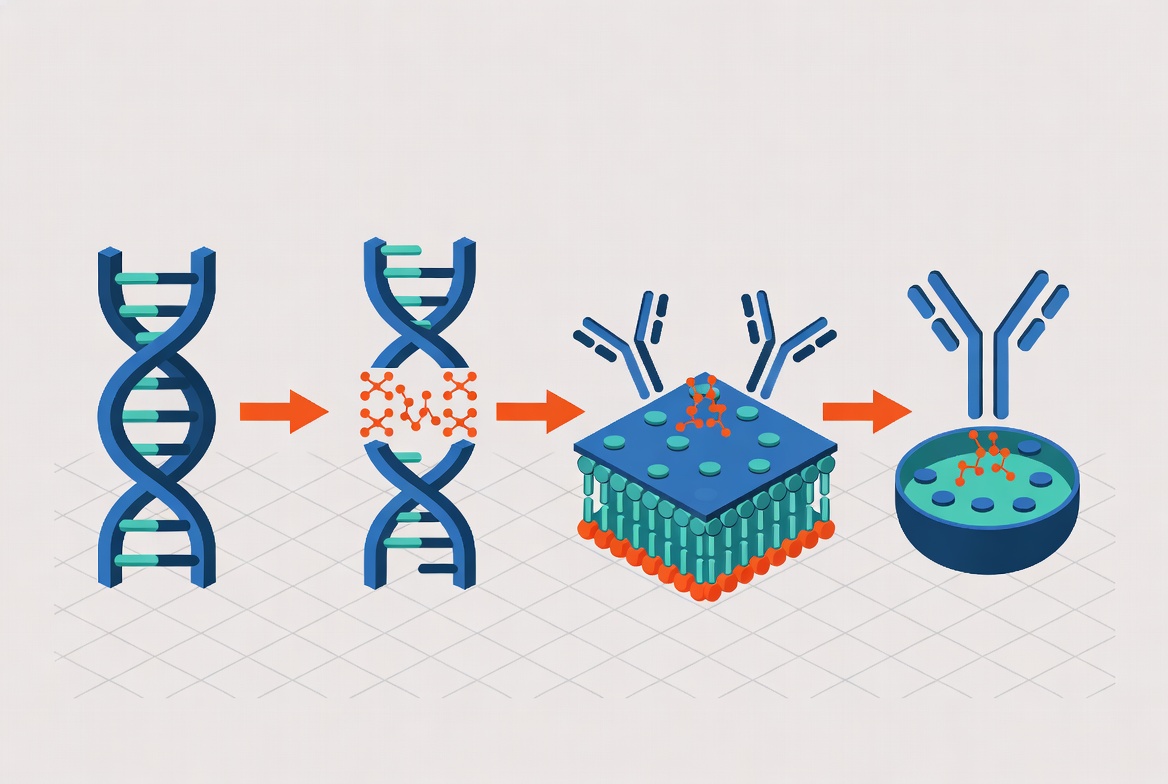
Structure-activity work on antibody-oligonucleotide conjugates has demonstrated that conjugation chemistry, linker rigidity, and conjugation site selection on the antibody scaffold all materially influence downstream mRNA knockdown efficiency. Site-specific conjugation approaches — for example, engineering cysteine residues at defined antibody positions for sulfo-SMCC linker attachment — have produced homogeneous antibody-siRNA conjugates capable of inducing 70-80% target mRNA knockdown in tumor cell models through receptor-mediated uptake alone, without requiring cationic transfection assistance.
This convergence matters for research teams pursuing early discovery and characterization of novel targets: a well-validated antibody against a cell-surface receptor of interest can, in principle, be paired with a rationally designed siRNA cargo to interrogate gene function in a cell-type-specific manner, well before any therapeutic development questions enter the picture. For organizations engineering custom antibodies against emerging surface antigens, this represents a natural extension point where antibody generation and RNAi-based functional validation intersect as complementary research tools.
Practical Workflow: From Target Gene to Validated Antibody Candidate
1. Identify and validate the target gene using siRNA knockdown panels designed with the accessibility, GC content, and seed-region principles outlined above.
2. Confirm phenotype specificity with NGS-based off-target profiling and, ideally, at least two independent non-overlapping siRNA sequences targeting the same transcript to rule out seed-region artifacts.
3. Design and generate custom antibodies against the validated target's extracellular domain, incorporating sequence and structural analysis to support developability-oriented assessment.
4. Characterize antibody-antigen binding using standard immunoassays, and where relevant, evaluate antibody-mediated internalization as a proxy for potential conjugate-based delivery applications.
5. Document findings with reproducible, well-annotated data to support fit-for-purpose research-grade materials for downstream functional studies or licensing discussions.
Conclusion
Rigorous siRNA design is only the first step in translating a gene-silencing observation into a validated research target. Once a candidate gene has been confirmed through knockdown studies, the next milestone is generating a high-quality, specific antibody against the corresponding protein for further functional characterization. Gene Universal supports researchers across more than 100 countries with end-to-end solutions spanning DNA and RNA synthesis through custom antibody development and protein engineering, helping research teams move efficiently from target hypothesis to validated antibody candidate for early discovery and characterization work.
Frequently Asked Questions
What is the ideal length for an siRNA duplex?
Most functional siRNA duplexes range from 20 to 24 nucleotides, though 21-mer/21-23-mer asymmetric designs are common in both research tools and FDA-approved siRNA drugs currently on the market.
Why do off-target effects happen even with a perfectly matched siRNA?
Off-target silencing is frequently driven by the seed region (nucleotides 2-8) of the guide strand binding partial-complementary sequences in unrelated 3' UTRs, mimicking natural microRNA activity rather than requiring full-length sequence homology.
How does chemical modification improve siRNA performance?
Modifications such as 2'-O-methyl, 2'-fluoro, and phosphorothioate linkages increase resistance to nuclease degradation, reduce immunostimulatory potential, and in the case of seed-region-specific modifications, can selectively suppress off-target activity while preserving on-target knockdown.
Can siRNA be delivered using antibodies instead of lipid nanoparticles?
Yes. Antibody-oligonucleotide conjugates use a targeting antibody to guide siRNA cargo to specific cell-surface receptors via receptor-mediated endocytosis, offering an alternative to LNP or GalNAc-based delivery for extrahepatic research applications.
How many FDA-approved siRNA drugs currently exist?
GalNAc conjugation exploits the hepatocyte asialoglycoprotein receptor and supports liver-directed delivery for several approved subcutaneous siRNA therapeutics. Patisiran, by contrast, is administered intravenously as a lipid complex. Following the FDA approval of plozasiran in November 2025, at least eight siRNA therapeutics had received FDA approval in the United States
What role does siRNA knockdown play before custom antibody development?
siRNA-mediated gene silencing is commonly used to validate that a candidate gene target produces the expected loss-of-function phenotype before committing resources to custom antibody generation and characterization against that target's protein product.
References
1. Ranasinghe P, Addison ML, Dear JW, Webb DJ. Small interfering RNA: Discovery, pharmacology and clinical development-An introductory review. *Br J Pharmacol.* 2023;180(21):2697-2720. [PubMed]
2. Taming the Achilles' Heel: A Chemical and Structural Design to Address Off-Target Effects in siRNA Therapeutics. *JACS Au.* 2026;6(2):795-800. [PubMed]
3. 3' UTR seed matches, but not overall identity, are associated with RNAi off-targets. [PubMed]
4. Bereczki Z, et al. Mitigating off-target effects of small RNAs: conventional approaches, network theory and artificial intelligence. *Br J Pharmacol.* 2025;182(2):340-379. [NCBI PMC]
5. Selection of Chemical Modifications in the siRNA Seed Region That Repress Off-Target Effect. *Methods Mol Biol.* 2021;2282:17-30. [PubMed]
6. Widespread siRNA "off-target" transcript silencing mediated by seed region sequence complementarity. [NCBI PMC]
7. Single base mismatches in the mRNA target site allow specific seed region-mediated off-target binding of siRNA. *RNA Biol.* 2012;9(1):87-97. [PubMed]
8. Chemical Modification of the siRNA Seed Region Suppresses Off-Target Effects by Steric Hindrance to Base-Pairing with Targets. *ACS Omega.* 2017;2(5):2055-2064. [PubMed]
9. A Comprehensive Review of Small Interfering RNAs (siRNAs): Mechanism, Therapeutic Targets, and Delivery Strategies for Cancer Therapy. *Int J Nanomedicine.* 2023;18:7605-7635. [NCBI PMC]
10. siRNA Seed Region Is Divided into Two Functionally Different Domains in RNA Interference in Response to 2′-OMe Modifications. *ACS Omega.* 2022. [ACS Publications]
11. A protocol for designing siRNAs with high functionality and specificity. [PubMed]
12. Structure–Activity Relationship of Antibody–Oligonucleotide Conjugates for siRNA Delivery. 2024. [NCBI PMC]
13. FDA-approved siRNA drugs (Table 3), NCBI review compilation. [NCBI PMC]
14. Exploring the Potentials of Antibody–siRNA Conjugates in Tumor Cell Gene Silencing without Cationic Assistance. *Bioconjugate Chem.* 2025. [ACS Publications]