 +1 302-235-9792
 SIGN IN
 CONTACT US


- News
- Plasmid DNA in Gene Therapy Research: Applications, Design, and Quality Essentials
share


Plasmid DNA in Gene Therapy Research: Applications, Design, and Quality Essentials
Content Menu
● What Is Plasmid DNA?
>> Direct Research Vectors
>> Production Inputs
● How Plasmid DNA Supports Gene Delivery Research
>> Direct Non-Viral Gene Transfer
>> AAV Vector Packaging Research
>> Lentiviral Vector Packaging Research
>> Template DNA for mRNA Workflows
● Why Supercoiled Plasmid DNA Matters
>> Factors That Can Change Topology
● Critical Plasmid Quality Attributes
● Match Quality to Use
● A Seven-Step Plasmid Planning Workflow
>> 1. Define the Final Assay
>> 2. Review the Complete Construct
>> 3. Assess Propagation Risk
>> 4. Establish Quality Targets
>> 5. Confirm a Small-Scale Clone
>> 6. Standardize Storage and Handling
>> 7. Evaluate Functional Performance
● Design Considerations Beyond Purity
>> Backbone Size
>> CpG Content
>> Promoter Selection
>> Repeats and Secondary Structures
>> Selection System
>> Sequence Traceability
● Plasmid DNA Preparation at Gene Universal
>> Service Scope
● Start With the Application
● Frequently Asked Questions
>> 1. What is plasmid DNA used for in gene therapy research?
>> 2. Is supercoiled plasmid DNA always better for transfection?
>> 3. Why is low-endotoxin plasmid DNA important?
>> 4. Is an A260/A280 ratio enough to confirm plasmid quality?
>> 5. Which plasmid preparation category should researchers choose?
>> 6. Can one plasmid specification be used for every cell type?
>> 7. Can Gene Universal support plasmid projects for formal submissions?
● References
Plasmid DNA in gene therapy research is more than a cloning intermediate. It can act as a non-viral expression vector, provide the DNA template for mRNA production, support genome-editing experiments, and supply essential genetic components for AAV and lentiviral vector packaging studies.
For research teams, successful outcomes depend on matching the plasmid's sequence, topology, purity, endotoxin level, preparation scale, and documentation to its intended application. Simply requesting "high-purity plasmid DNA" does not provide enough information to control experimental risk.
From our experience supporting molecular biology workflows, many preventable project failures begin upstream. A construct may be sequence-correct but unstable in its bacterial host. A preparation may have an acceptable absorbance ratio while still containing endotoxin, residual RNA, genomic DNA, or damaged plasmid forms that interfere with sensitive cells.
Effective plasmid planning connects construct design and quality targets to the downstream assay before bacterial culture begins.
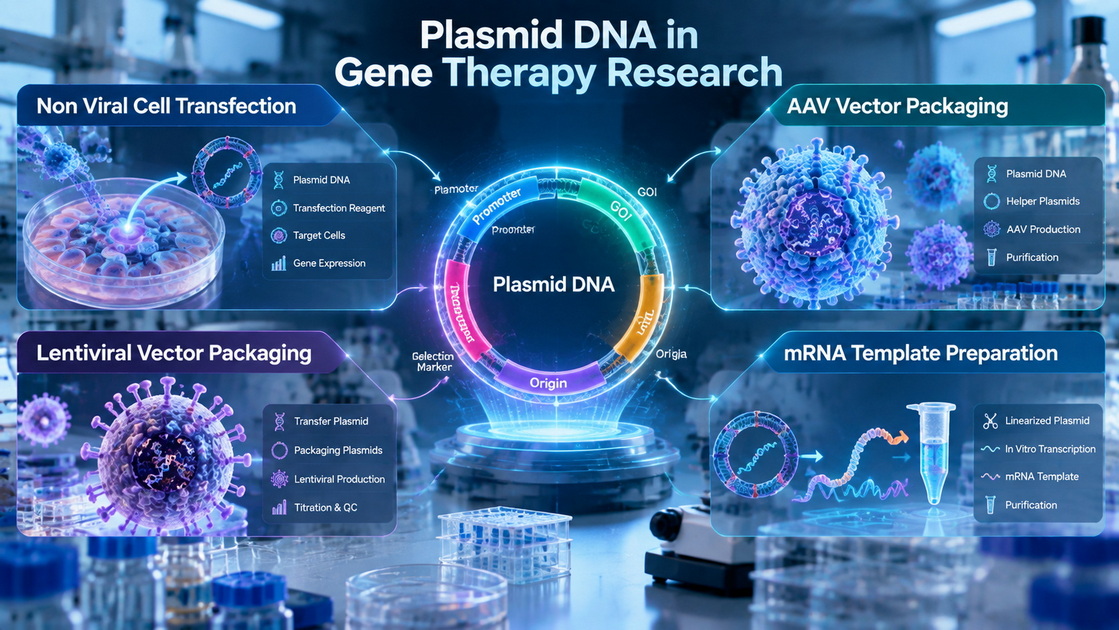
What Is Plasmid DNA?
A plasmid is generally a small, circular, double-stranded DNA molecule capable of independent propagation in a suitable bacterial host.
Researchers engineer plasmids to carry an expression cassette that may contain:
- A promoter
- A coding sequence or other sequence of interest
- Untranslated regions
- An intron, when required
- A transcription termination or polyadenylation signal
- Reporter genes or purification tags
- Regulatory elements controlling expression
The bacterial backbone commonly contains an origin of replication and a selectable marker that allow the plasmid to be amplified and maintained.
In gene therapy research, plasmids usually perform one of two broad roles.
Direct Research Vectors
The plasmid itself can be introduced into cells or research models to study:
- Transient gene expression
- Delivery methods
- Promoter activity
- Cellular responses
- Protein function
- Genome-editing systems
- Vaccine concepts
Production Inputs
One or more plasmids can provide the genetic components needed to generate another research material, including:
- Adeno-associated viral vectors
- Lentiviral vectors
- Adenoviral vectors
- In vitro-transcribed RNA
- Genome-editing reagents
- Recombinant proteins
This distinction is important. A plasmid suitable for routine cloning may not be appropriate for primary-cell transfection, viral packaging, or sensitive preclinical research.
The intended application should determine the construct architecture, production scale, purification strategy, and quality-control panel.
How Plasmid DNA Supports Gene Delivery Research
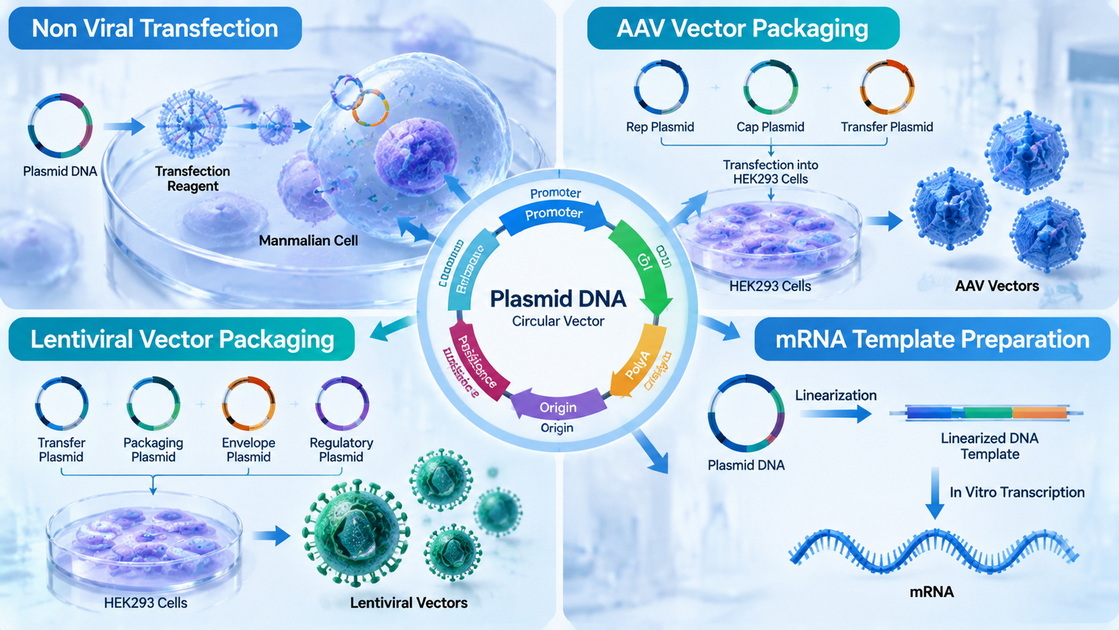
Direct Non-Viral Gene Transfer
Naked plasmid DNA or plasmid–carrier complexes can be introduced into cells through chemical transfection, electroporation, lipid-based systems, or other physical delivery methods.
Non-viral systems offer several research advantages:
- Design flexibility: Expression cassettes can be modified relatively quickly.
- Large cargo capacity: Plasmids can accommodate sequences that may exceed the packaging limits of some viral vectors.
- Simplified exploratory studies: Researchers can compare promoters, coding sequences, and regulatory elements before committing to more complex delivery systems.
- Straightforward production: Bacterial amplification supports plasmid preparation at different research scales.
However, plasmid DNA must cross multiple cellular barriers and reach the nucleus before transcription can occur. Expression is often transient, and results can vary with the cell type, delivery method, construct size, sequence composition, topology, dose, and transfection reagent.
Transfection success is therefore a system-level result rather than a property of the plasmid alone.
AAV Vector Packaging Research
Transient AAV production commonly relies on a multi-plasmid system.
A transfer plasmid carries the expression cassette between inverted terminal repeats. Separate plasmids provide replication, capsid, and helper functions. Although some workflows combine selected functions, every plasmid must remain correctly identified, structurally intact, and compatible with the complete system.
AAV has a limited packaging capacity. Researchers must therefore evaluate the entire sequence between the inverted terminal repeats—not only the coding region.
The sequence calculation should include:
- Promoter
- Enhancer
- Intron
- Coding sequence
- Tags
- Untranslated regions
- Regulatory elements
- Polyadenylation signal
Oversized designs can reduce packaging consistency and complicate interpretation. Every additional element consumes space and should have a clear experimental purpose.
For reliable packaging comparisons, researchers should also keep plasmid lot, DNA ratio, transfection reagent, cell density, incubation time, and sampling conditions consistent.
A change in the concentration, identity, topology, or endotoxin burden of one plasmid can affect the performance of the entire packaging experiment.
Lentiviral Vector Packaging Research
Lentiviral packaging systems generally distribute vector functions across multiple plasmids.
The transfer plasmid carries the sequence of interest, while packaging and envelope plasmids provide the required components in trans. This separation is useful for controlled research systems, but it introduces additional variables.
Researchers must manage:
- Plasmid identity
- DNA concentration
- Molar ratios
- Backbone compatibility
- Transfection conditions
- Lot-to-lot consistency
- Sequence version control
- Endotoxin burden
For comparative studies, it is important to avoid changing several variables simultaneously. If a new plasmid preparation is introduced together with a different cell density or reagent ratio, identifying the cause of a performance change becomes difficult.
Template DNA for mRNA Workflows
Plasmid DNA can also serve as the template for in vitro transcription.
In this application, researchers should verify:
- Sequence accuracy
- Promoter orientation
- Linearization site
- Template endpoint
- Restriction enzyme compatibility
- Absence of unwanted downstream sequence
- Template homogeneity
- RNase-controlled handling
Incomplete linearization, residual RNase, or a mixture of plasmid forms can affect RNA yield, length, and integrity. The template strategy should therefore be planned during construct design rather than immediately before transcription.
Why Supercoiled Plasmid DNA Matters
A plasmid preparation may contain three major topological forms:
- Supercoiled DNA
- Open-circular DNA
- Linear DNA
Covalently closed circular DNA becomes supercoiled because of torsional strain. A single-strand break relaxes the plasmid into an open-circular form. A double-strand break generates a linear molecule.
Supercoiled plasmid DNA is compact and widely used as an indicator of structural integrity. Published mammalian-cell studies have demonstrated that plasmid topology can influence transfection and transgene expression.
However, the effect is not identical in every system. Cell type, plasmid sequence, delivery method, carrier chemistry, dose, and experimental endpoint can alter the relationship between topology and biological performance.
The practical conclusion is not that one supercoiled percentage guarantees successful transfection. Instead, topology should be measured, controlled, and interpreted in the context of the application.
Factors That Can Change Topology
Plasmid topology can shift after purification because of:
- Repeated freeze–thaw cycles
- Aggressive vortexing
- Mechanical shearing
- Nuclease contamination
- Unsuitable buffer composition
- Inappropriate storage temperature
- Extended storage without monitoring
- Multiple transfers between containers
Aliquoting, gentle mixing, nuclease-controlled handling, and suitable storage conditions can help maintain consistency.
Critical Plasmid Quality Attributes
An acceptable absorbance ratio does not establish sequence identity, topology, low endotoxin, or freedom from residual host-cell material.
Fit-for-purpose plasmid DNA requires complementary tests that answer different quality questions.
| Quality attribute | Why it matters | Common assessment | Potential research impact |
|---|---|---|---|
| Sequence identity | Confirms the intended insert and junctions | Sanger or full-plasmid sequencing | Reduces the risk of testing an incorrect construct |
| Restriction profile | Checks expected structure and gross rearrangement | Diagnostic digestion and gel analysis | Helps identify structural discrepancies |
| Concentration | Supports accurate dosing and plasmid mixing | Fluorescence- or absorbance-based measurement | Improves transfection reproducibility |
| Purity | Screens for protein and chemical carryover | A260/A280 and A260/A230 ratios | Flags possible assay interference |
| Topological forms | Indicates the structural state of the plasmid | Agarose gel or another validated analytical method | May influence transfection and expression |
| Endotoxin | Can stress sensitive mammalian cells | Appropriate endotoxin assay | Protects viability and data interpretation |
| Residual RNA | Can inflate nucleic acid concentration readings | Gel or analytical assay | Improves dosing confidence |
| Residual genomic DNA | Indicates host-derived contamination | Gel, qPCR, or another suitable method | Supports cleaner downstream experiments |
| Microbial status | Addresses contamination risks in selected workflows | Appropriate microorganism testing | Important for sensitive preclinical research |
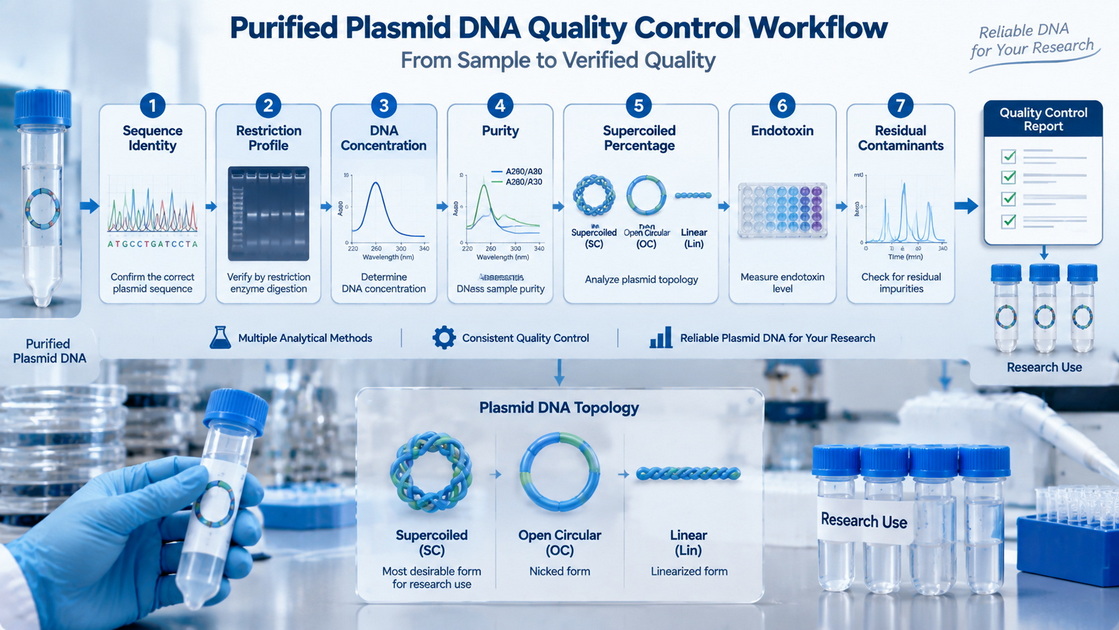
Acceptance targets should be established before production begins. A complete request should describe the cell model, delivery method, quantity, concentration, buffer, endotoxin target, topology expectation, and required documentation.
Match Quality to Use
A common procurement mistake is treating plasmid grades as universal quality rankings. In practice, they are better viewed as application categories.
| Intended use | Main priorities | Practical preparation approach |
|---|---|---|
| Cloning, sequencing, and PCR templates | Correct identity and adequate purity | Research-grade preparation |
| Protein-expression screening | Sequence confirmation, concentration, and restriction profile | Research-grade or application-matched preparation |
| Mammalian-cell transfection | Low endotoxin, intact topology, and accurate concentration | Transfection-grade preparation |
| AAV or lentiviral packaging studies | Identity across all plasmids, topology, low endotoxin, and lot consistency | Transfection-grade or fit-for-purpose research material |
| Sensitive cell or animal studies | Expanded contaminant testing and stronger documentation | Preclinical research support |
| In vitro transcription | Sequence accuracy, linearization strategy, template homogeneity, and RNase control | Customized template preparation |
Selecting the most extensively tested category for every routine experiment can unnecessarily increase costs. Using an underspecified preparation for a sensitive assay can waste weeks of work.
The most appropriate specification is the least burdensome option that adequately controls the known experimental risks.
A Seven-Step Plasmid Planning Workflow
1. Define the Final Assay
Begin with the biological question rather than the desired preparation scale.
Document:
- Cell type
- Delivery method
- Assay duration
- Expected expression pattern
- Required DNA dose
- Sensitivity to endotoxin
- Buffer limitations
- Planned analytical readout
These details determine which plasmid attributes deserve the most attention.
2. Review the Complete Construct
Examine the entire plasmid rather than focusing only on the coding sequence.
Review:
- Promoter
- Coding sequence
- Untranslated regions
- Polyadenylation signal
- Replication origin
- Selection marker
- Repetitive regions
- GC-rich sequences
- Cloning junctions
- Restriction sites
For AAV research, calculate the complete sequence located between the inverted terminal repeats.
3. Assess Propagation Risk
Large inserts, repetitive elements, toxic genes, unstable sequences, or cryptic bacterial promoters can affect plasmid propagation.
These constructs may require:
- A specialized bacterial host
- Lower culture temperature
- Reduced incubation time
- Modified amplification conditions
- Lower-copy propagation
- Additional clone screening
A high-copy backbone is not always the safest option for an unstable construct.
4. Establish Quality Targets
Define the required tests before purification.
Targets may include:
- Sequence coverage
- DNA concentration
- Purity ratios
- Endotoxin level
- Supercoiled fraction
- Restriction profile
- Residual RNA
- Residual genomic DNA
- Microbial status
- Buffer and aliquot format
- Required project documentation
Testing requirements should not be decided only after the DNA has been prepared.
5. Confirm a Small-Scale Clone
Confirm plasmid identity and structure before committing to a larger preparation.
This step is especially important for multi-plasmid systems. One incorrectly labeled, rearranged, or sequence-mismatched component can invalidate the complete experiment.
6. Standardize Storage and Handling
Use consistent:
- Aliquot sizes
- Storage temperatures
- Thawing procedures
- Mixing methods
- Dilution buffers
- Container types
Record plasmid lot numbers in transfection and packaging experiments. This makes unexpected performance changes easier to investigate.
7. Evaluate Functional Performance
Review analytical quality data together with biological results, such as:
- Transfection efficiency
- Cell viability
- Expression level
- Reporter activity
- Protein yield
- Viral vector yield
- Editing efficiency
A certificate documents tested attributes. It does not replace application-specific functional evidence.
Design Considerations Beyond Purity
Purification cannot rescue a poorly designed construct. Sequence-level features may influence expression, innate sensing, stability, propagation, and downstream usability.
Backbone Size
A smaller bacterial backbone may reduce unnecessary sequence burden in selected systems. However, backbone modification must preserve reliable propagation and plasmid recovery.
CpG Content
Unmethylated CpG motifs can influence innate immune sensing. Their importance varies with the delivery platform, target cells, experimental model, and study objective.
CpG reduction should therefore be treated as an application-specific design choice rather than a universal requirement.
Promoter Selection
A strong ubiquitous promoter is not automatically the best promoter.
Researchers should also consider:
- Cell-type specificity
- Expression duration
- Silencing risk
- Cassette size
- Potential toxicity
- Experimental endpoint
The best promoter is the one that generates the required expression pattern in the intended model.
Repeats and Secondary Structures
Repetitive or highly structured sequences can complicate:
- Gene synthesis
- Clone screening
- DNA sequencing
- Bacterial propagation
- Restriction analysis
- Long-term stability
These risks should be identified during sequence review.
Selection System
The selectable marker, replication origin, bacterial strain, and culture conditions function as a connected system. Choosing each element independently can produce unexpected stability or yield problems.
Sequence Traceability
Multi-plasmid systems require strict version control.
Each physical sample should be linked to:
- A unique plasmid name
- A version number
- A verified sequence file
- A vector map
- A preparation lot
- A quality-control report
This prevents silent mismatches between digital records and physical DNA samples.
Early construct review is generally faster and less expensive than troubleshooting an inconsistent downstream assay.
Plasmid DNA Preparation at Gene Universal
Gene Universal supports research laboratories, biotechnology teams, and pharmaceutical research groups with plasmid DNA preparation from microgram to gram scale.
Available options include:
- Research-grade plasmid preparation
- Transfection-grade plasmid preparation
- Preclinical research support
- Low-endotoxin preparation
- Customized concentration and buffer
- DNA normalization
- Aliquoting
- Sequence confirmation
- Sample storage
- Project-specific quality testing
Depending on the selected service level, quality controls may include:
- Appearance
- Insert sequencing
- Restriction analysis
- A260/A280 assessment
- DNA concentration
- Supercoiled percentage
- Endotoxin
- Residual RNA
- Residual genomic DNA
- Microorganism detection
Standard deliverables may include the prepared plasmid DNA, a certificate of analysis, and a quality-control report.
Projects can begin from:
- Existing plasmid DNA
- A fresh bacterial colony
- A glycerol stock
- A sequence requiring synthesis and cloning
If a construct requires a specialized bacterial host or presents a stability concern, that information should be shared before production.
Service Scope
Gene Universal provides:
- Research-use plasmid DNA
- Early discovery and characterization
- Fit-for-purpose research-grade materials
- Preclinical research support
- Integrated services from DNA and RNA to proteins and antibodies
Gene Universal does not provide GMP manufacturing, CDMO programs, or IND submission support.
Teams planning a later development transition should discuss material-transfer expectations, sequence records, analytical requirements, and documentation with the organization responsible for the subsequent stage.
Start With the Application
A plasmid request should begin with the downstream experiment rather than the preparation size.
Share the following information when requesting a project evaluation:
- Sequence file
- Vector map
- Bacterial host requirements
- Intended application
- Required quantity
- Desired concentration
- Preferred buffer
- Endotoxin target
- Topology expectation
- Quality-control requirements
- Aliquoting and delivery preferences
Contact Gene Universal to discuss a project-specific plasmid preparation plan aligned with your construct design, research application, quality requirements, and delivery workflow.
Frequently Asked Questions
1. What is plasmid DNA used for in gene therapy research?
Plasmid DNA can function as a direct non-viral expression vector, a component in AAV or lentiviral packaging, a template for in vitro transcription, or a donor and expression construct in genome-editing research.
Its required quality depends on the role it performs.
2. Is supercoiled plasmid DNA always better for transfection?
A high supercoiled fraction is commonly associated with intact plasmid DNA and can support effective transfection in many systems.
However, published findings show that the effect of topology varies with the cell type, plasmid, carrier, and delivery method. Topology should be controlled as a quality attribute rather than treated as a universal performance guarantee.
3. Why is low-endotoxin plasmid DNA important?
Endotoxin originates from Gram-negative bacterial hosts. It can activate inflammatory signaling, reduce viability, and interfere with data interpretation in sensitive mammalian cells.
The appropriate endotoxin target should be selected according to the cell model, delivery method, DNA dose, and experimental objective.
4. Is an A260/A280 ratio enough to confirm plasmid quality?
No. The ratio is a useful screening measurement, but it does not confirm sequence identity, supercoiled fraction, endotoxin level, or the absence of residual RNA and genomic DNA.
Sensitive workflows require complementary analytical tests.
5. Which plasmid preparation category should researchers choose?
Research-grade DNA may be appropriate for cloning, sequencing, PCR templates, and routine screening. Transfection-grade material is better suited to many mammalian-cell transfection and viral packaging experiments.
Sensitive cell or animal studies may require expanded fit-for-purpose testing and preclinical research support.
6. Can one plasmid specification be used for every cell type?
Not necessarily. Primary cells, immortalized cell lines, stem cells, and immune cells can respond differently to DNA concentration, endotoxin, buffer components, and transfection conditions.
Specifications should reflect the most sensitive and decision-critical model in the planned workflow.
7. Can Gene Universal support plasmid projects for formal submissions?
No. Gene Universal's scope covers research-use materials, early discovery and characterization, and preclinical research support.
It does not include GMP manufacturing, CDMO programs, or IND submission support.
References
1. [Wang D, Tai PWL, Gao G. "Adeno-associated virus vector as a platform for gene therapy delivery." *Nature Reviews Drug Discovery*. 2019;18:358–378.] [nature]
2. [U.S. Food and Drug Administration. "Considerations for Plasmid DNA Vaccines for Infectious Disease Indications." Guidance for Industry.] [fda]
3. [U.S. Food and Drug Administration. "Chemistry, Manufacturing, and Control Information for Human Gene Therapy Investigational New Drug Applications." Guidance for Industry.] [fda]
4. [European Medicines Agency. "Guideline on the Quality, Non-clinical and Clinical Aspects of Gene Therapy Medicinal Products."] [ema.europa]
5. [Cherng JY, Schuurmans-Nieuwenbroek NME, Jiskoot W, et al. "Effect of DNA topology on the transfection efficiency of poly((2-dimethylamino)ethyl methacrylate)-plasmid complexes." *Journal of Controlled Release*. 1999.] [pubmed.ncbi.nlm.nih]
6. [Remaut K, Sanders NN, De Geest BG, et al. "New insights in the gene electrotransfer process: evidence for the involvement of the plasmid DNA topology." *Current Gene Therapy*. 2012.] [pubmed.ncbi.nlm.nih]
7. [Weintraub H, Cheng PF, Conrad K. "Expression of transfected DNA depends on DNA topology." *Cell*. 1986;46(1):115–122.] [pubmed.ncbi.nlm.nih]
8. [Merten OW, Hebben M, Bovolenta C. "Production of lentiviral vectors." *Molecular Therapy—Methods & Clinical Development*. 2016;3:16017.] [pubmed.ncbi.nlm.nih]
9. ["Production and Purification of Adeno-Associated Viral Vectors Using Orbitally Shaken HEK293 Cells." *Methods in Molecular Biology*. 2024.] [pubmed.ncbi.nlm.nih]
10. [Prather KJ, Sagar S, Murphy J, Chartrain M. "Industrial scale production of plasmid DNA for vaccine and gene therapy: plasmid design, production, and purification." Enzyme and Microbial Technology. 2003.] [pubmed.ncbi.nlm.nih]