 +1 302-235-9792
 SIGN IN
 CONTACT US


- News
- Plasmid Preparation: A Practical Guide to High-Quality DNA for Modern Research
share


Plasmid Preparation: A Practical Guide to High-Quality DNA for Modern Research
Content Menu
● What Is Plasmid DNA?
● Why Plasmid Preparation Quality Matters
● Main Types of Plasmid Preparation
>> Miniprep Plasmid DNA
>> Midiprep and Maxiprep Plasmid DNA
>> Transfection-Grade Plasmid DNA
● How Plasmid Preparation Works
>> 1: Bacterial Culture and Plasmid Amplification
>> 2: Cell Harvesting
>> 3: Alkaline Lysis
>> 4: Clarification and Purification
>> 5: Elution, Quantification, and Storage
● Practical Quality-Control Checklist
>> Recommended Checks Before Transfection
● Choosing the Right Plasmid Preparation for Your Experiment
● Plan Quality Around Experimental Risk
● Support Your Next Plasmid DNA Project
● FAQs
>> 1. What is plasmid preparation?
>> 2. Why is supercoiled plasmid DNA important?
>> 3. What is the difference between a miniprep and a maxiprep?
>> 4. Why should endotoxin be tested in plasmid DNA?
>> 5. Can A260/A280 ratio alone confirm plasmid DNA quality?
>> 6. How can I confirm that my plasmid is correct?
>> 7. Can Gene Universal support GMP production or IND submission?
● References
Plasmid preparation is the process of isolating, purifying, and verifying plasmid DNA for molecular biology workflows. For researchers working in cloning, gene expression, cell transfection, antibody discovery, or early-stage genetic engineering, the right plasmid preparation strategy can directly influence reproducibility, cell health, and experimental confidence.
At Gene Universal, we support researchers worldwide with end-to-end life-science solutions spanning DNA/RNA, proteins, and antibodies. Our plasmid DNA support is designed for research-use applications, including construct amplification, sequencing confirmation, transfection studies, protein expression, and early discovery and characterization. We do not provide GMP manufacturing, CDMO services, or IND submission support.
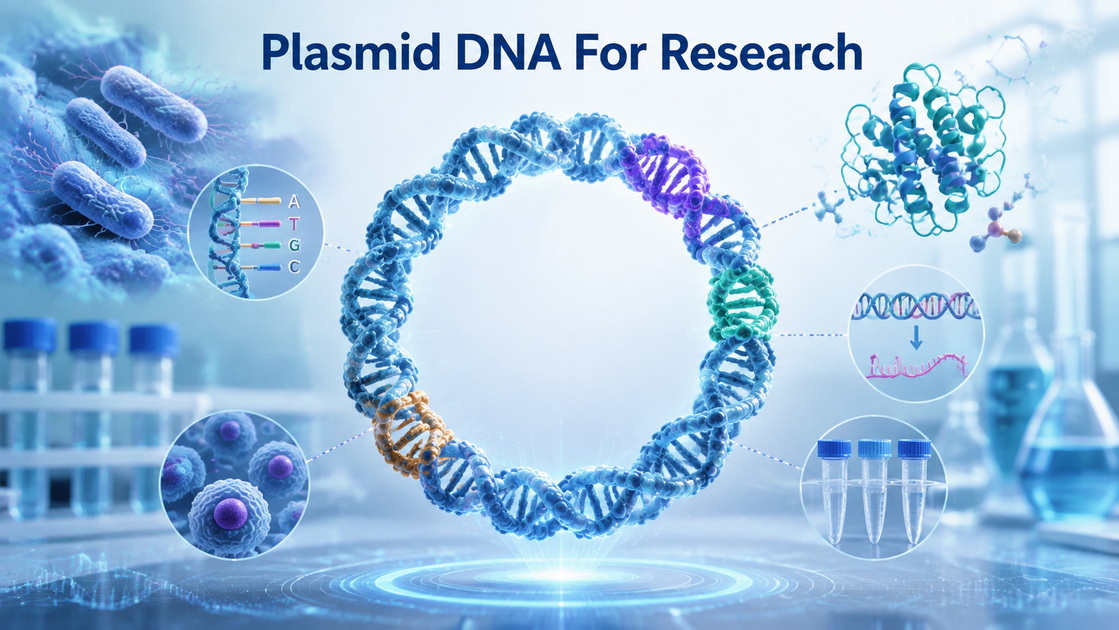
What Is Plasmid DNA?
A plasmid is a relatively small DNA molecule that can replicate independently from bacterial chromosomal DNA. Most laboratory plasmids are double-stranded, circular DNA molecules. In their preferred structural state, they are covalently closed circular and supercoiled.
Plasmids occur naturally in many bacteria, but engineered plasmids are essential laboratory tools. Scientists use them to carry, clone, amplify, modify, or express a target DNA sequence.
A typical engineered plasmid vector contains three core components:
- Origin of replication: Enables the plasmid to replicate in a suitable host cell.
- Selectable marker: Helps researchers identify cells that contain the plasmid, often through antibiotic selection.
- Multiple cloning site or insertion region: Provides locations for introducing a target gene or DNA fragment.
Depending on the experimental goal, plasmids may also include promoters, enhancers, affinity tags, reporter genes, secretion signals, gene-editing elements, or regulatory sequences.
Why Plasmid Preparation Quality Matters
Plasmid DNA is not simply a DNA sequence in solution. Its usefulness depends on measurable physical and biochemical characteristics.
A plasmid sample may have the correct sequence but still produce poor experimental results if it contains excessive RNA, genomic DNA, endotoxin, salts, proteins, or damaged plasmid forms. These impurities may complicate restriction digestion, cloning, sequencing, transformation, transfection, and protein-expression workflows.
For many laboratory applications, researchers should evaluate the following quality attributes:
| Quality Attribute | Why It Matters | Common Evaluation Method |
|---|---|---|
| DNA identity | Confirms the construct matches the intended plasmid | DNA sequencing, restriction digest |
| Concentration | Determines whether enough DNA is available for the experiment | UV spectrophotometry, fluorometry |
| Purity | Indicates the relative presence of protein, phenol, salts, or other contaminants | A260/A280 and A260/A230 ratios |
| Supercoiled percentage | Helps assess plasmid topology and structural integrity | Agarose gel electrophoresis |
| RNA residue | RNA may affect concentration estimates and downstream analysis | Agarose gel electrophoresis |
| Genomic DNA residue | May interfere with analysis and cellular experiments | Agarose gel electrophoresis, qPCR |
| Endotoxin level | Important for sensitive mammalian-cell workflows | Endotoxin assay |
| Sterility or microbial contamination | Helps protect sensitive research cultures | Microbial culture-based testing |
The supercoiled form is particularly important because plasmid topology can influence how DNA behaves in downstream workflows. Published studies have found that highly supercoiled plasmid preparations can support stronger transfection performance than less structurally intact preparations in certain experimental settings.
Main Types of Plasmid Preparation
Plasmid preparation is commonly described by scale and intended use. The ideal option depends on the amount of DNA needed, the host strain, plasmid size, construct complexity, and downstream experiment.
Miniprep Plasmid DNA
A miniprep generally produces a small quantity of plasmid DNA from a bacterial culture. It is widely used for clone screening, sequence verification, restriction digestion, and routine molecular cloning.
Minipreps are useful when researchers need to compare multiple colonies quickly. They are not always the best choice for sensitive cell transfection or larger protein-expression projects.
Typical uses include:
- Screening bacterial colonies after transformation
- Checking insert orientation
- Restriction enzyme analysis
- Sanger sequencing preparation
- Small-scale cloning workflows
Midiprep and Maxiprep Plasmid DNA
Midiprep and maxiprep workflows produce more plasmid DNA from larger bacterial cultures. These preparations are appropriate when multiple experiments require the same construct or when the downstream workflow needs higher DNA input.
Researchers often select larger-scale preparations for:
- Mammalian-cell transfection
- Transient protein expression
- Antibody-expression studies
- Repeated cell-based assays
- Library preparation
- Larger research projects requiring consistent plasmid lots
Transfection-Grade Plasmid DNA
Transfection-grade plasmid preparation focuses on DNA purity, structural integrity, and low endotoxin levels. Endotoxin is a bacterial cell-wall component that can co-purify with plasmid DNA and may affect cell viability or experimental responses, particularly in sensitive mammalian, primary, or stem-cell systems.
For research involving difficult-to-transfect cells, primary cells, immune cells, or sensitive cell lines, low-endotoxin DNA should be planned early rather than treated as a last-minute requirement. Published technical and scientific literature consistently identifies endotoxin, topology, and residual contaminants as meaningful plasmid quality considerations for transfection-oriented applications.
How Plasmid Preparation Works
While specific protocols vary, plasmid DNA preparation generally follows a predictable workflow. The process is designed to separate plasmid DNA from bacterial cells, chromosomal DNA, RNA, proteins, endotoxin, and other cellular components.
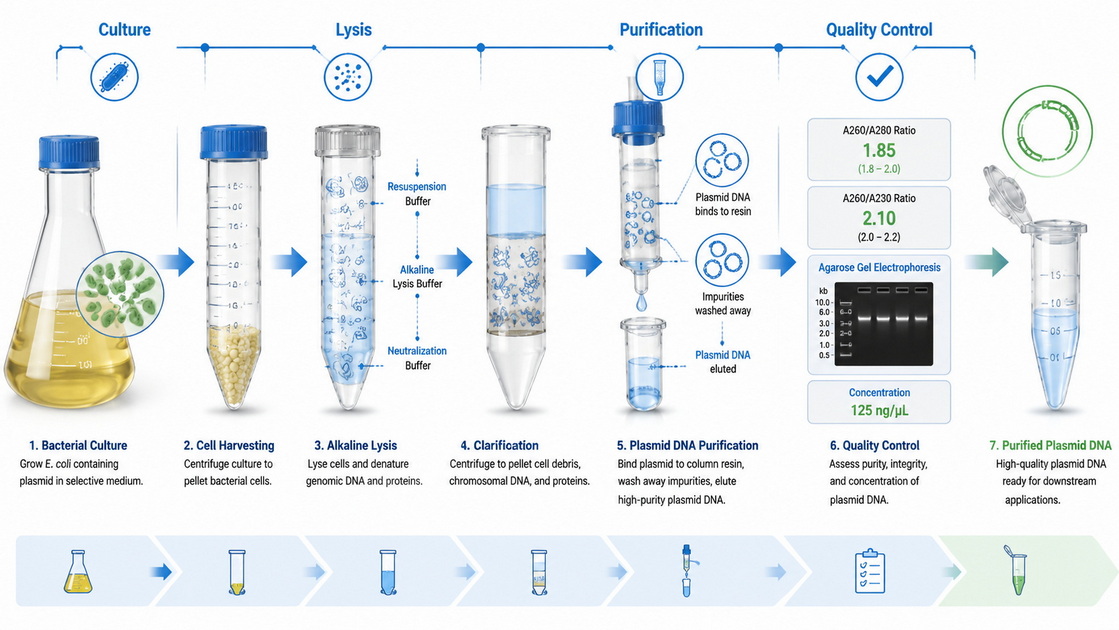
1: Bacterial Culture and Plasmid Amplification
The selected bacterial clone is cultured under appropriate conditions to amplify the plasmid. Culture conditions should be appropriate for the bacterial host, plasmid backbone, selection marker, and plasmid stability profile.
Before scaling up, it is good practice to verify the clone identity. A sequence-confirmed colony can help prevent wasted time, unexpected mutations, or propagation of an incorrect construct.
2: Cell Harvesting
Bacterial cells are collected from the culture, typically by centrifugation. The resulting pellet contains the cells carrying the plasmid DNA.
At this stage, consistency matters. Variability in culture duration, cell density, and harvesting conditions can affect yield and may influence plasmid quality.
3: Alkaline Lysis
Alkaline lysis is one of the most widely used methods for plasmid extraction. In this approach, bacterial cells are resuspended, lysed using an alkaline detergent solution, and then neutralized.
The scientific principle is selective separation. Under controlled alkaline conditions, bacterial chromosomal DNA becomes denatured. After neutralization, the larger chromosomal DNA and cellular debris form an insoluble aggregate, while smaller covalently closed circular plasmid DNA can remain in the clarified solution.
Handling during lysis should be gentle. Excessive mixing can shear chromosomal DNA, making it more difficult to remove and potentially increasing genomic DNA carryover.
4: Clarification and Purification
After neutralization, the lysate is clarified to remove precipitated cellular debris. The plasmid-containing fraction is then purified through an appropriate method, such as silica-based purification, anion-exchange chromatography, precipitation-based methods, or other fit-for-purpose workflows.
The purification approach should match the intended use. A rapid clone-screening workflow and a sensitive transfection experiment do not require the same quality profile.
5: Elution, Quantification, and Storage
Purified plasmid DNA is recovered in a suitable buffer and assessed for concentration and purity. Storage buffer, storage temperature, freeze-thaw frequency, and physical handling can all influence DNA integrity over time.
For valuable constructs, researchers should retain a traceable record including plasmid name, map version, host strain, culture date, purification batch, concentration, storage location, and sequencing results.
Practical Quality-Control Checklist
A well-designed plasmid preparation project should include quality checks that are relevant to the actual experiment. Not every study requires the same level of analysis, but skipping critical checks can introduce avoidable uncertainty.
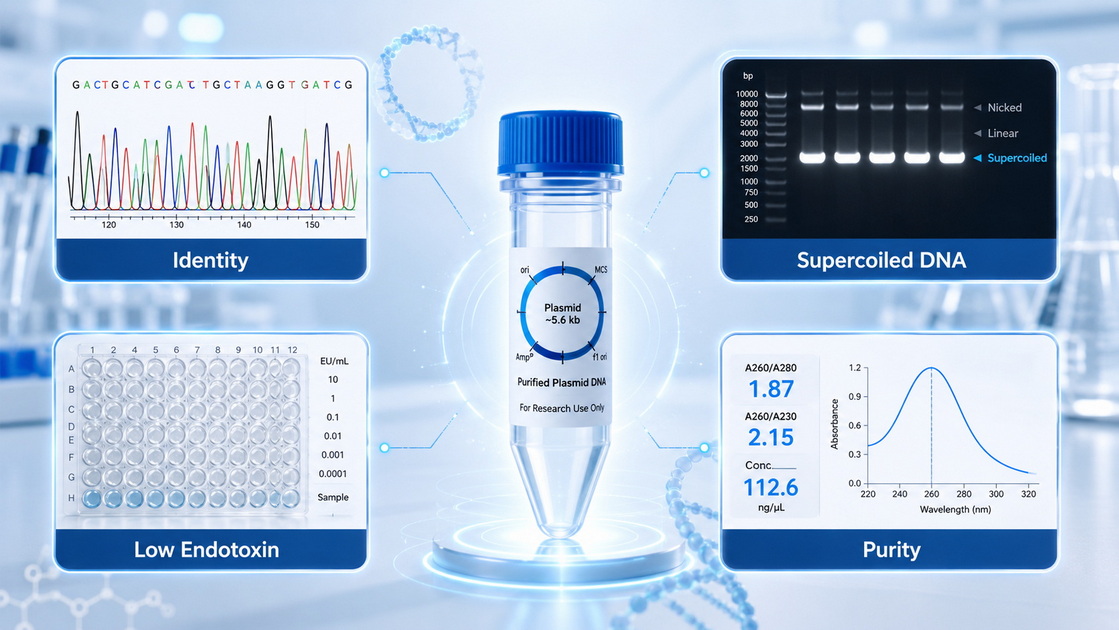
Recommended Checks Before Transfection
1. Confirm plasmid identity through sequencing or an appropriate restriction-enzyme digest.
2. Measure DNA concentration using a suitable quantification method.
3. Review purity ratios to identify potential protein or chemical contamination.
4. Assess plasmid topology by agarose gel electrophoresis.
5. Check for RNA and genomic DNA residue when the workflow is sensitive to contamination.
6. Evaluate endotoxin levels for sensitive mammalian-cell applications.
7. Use an appropriate buffer that is compatible with the planned downstream workflow.
8. Document batch information so results can be traced if experimental performance changes.
A260/A280 values are often used as a quick purity indicator, but they should not be treated as the only quality decision point. A good absorbance ratio does not independently confirm sequence accuracy, low endotoxin, intact topology, or the absence of all downstream-interfering contaminants.
Choosing the Right Plasmid Preparation for Your Experiment
The most efficient preparation is not always the largest or most highly purified option. It is the option that matches the research question.
| Research Goal | Recommended Preparation Focus | Key Considerations |
|---|---|---|
| Clone screening | Miniprep-scale DNA | Fast turnaround, identity confirmation |
| Restriction digest or sequencing | High-purity routine DNA | Concentration, insert verification |
| Mammalian-cell transfection | Low-endotoxin, high-purity DNA | Supercoiled form, endotoxin, residual contaminants |
| Transient protein expression | Consistent transfection-grade DNA | Batch consistency, identity, concentration |
| Antibody discovery experiments | Fit-for-purpose plasmid DNA | Multiple constructs, sequence accuracy, transfection quality |
| Large research campaign | Scalable preparation plan | Reproducibility, documentation, storage strategy |
For example, an antibody discovery team may need to compare dozens of heavy-chain and light-chain plasmid pairs in mammalian cells. In that setting, sequence-verified constructs and consistent transfection-oriented plasmid quality help reduce the risk that variable DNA preparation becomes confused with a true difference in antibody expression.
Plan Quality Around Experimental Risk
Experienced researchers often make one useful distinction: not every plasmid needs the same quality profile, but every plasmid should be fit for its intended use.
For early cloning work, speed and identity confirmation may be the priority. For sensitive cell studies, endotoxin control and plasmid integrity may be more important. For multi-construct expression projects, consistency across plasmid batches can become the decisive factor.
A practical planning framework is:
- Use routine plasmid DNA for early construct screening.
- Upgrade purity specifications when moving into sensitive cellular workflows.
- Confirm sequence identity before committing to larger-scale preparation.
- Define the minimum acceptable quality criteria before the experiment begins.
- Keep one verified reference batch when comparing results over time.
This approach helps research teams control variables, improve interpretability, and avoid repeating experiments because of preventable plasmid-quality issues.
Support Your Next Plasmid DNA Project
High-quality plasmid preparation starts with a clear understanding of the construct, the downstream application, and the quality attributes that matter most for the experiment.
Gene Universal provides global research support for plasmid DNA, gene synthesis, RNA, protein, and antibody workflows. Whether you need sequence-confirmed plasmids for cloning, fit-for-purpose research-grade materials for transfection, or coordinated support across a broader molecular biology project, our team can help you define a practical path from DNA design to downstream research use.
Contact Gene Universal to discuss your plasmid DNA requirements, target quantity, preferred quality checks, and downstream research workflow.
FAQs
1. What is plasmid preparation?
Plasmid preparation is the isolation and purification of plasmid DNA from host cells, usually bacteria. The resulting DNA can be used for cloning, sequencing, transfection, protein expression, and other molecular biology applications.
2. Why is supercoiled plasmid DNA important?
Supercoiled plasmid DNA is a compact, covalently closed circular form of plasmid DNA. A high proportion of supercoiled DNA is commonly used as an indicator of structural integrity and may be important for transfection-oriented research workflows.
3. What is the difference between a miniprep and a maxiprep?
The main difference is scale. A miniprep produces a relatively small amount of plasmid DNA for screening and routine analysis, while a maxiprep produces a larger amount for repeated experiments, transfection, or protein-expression studies.
4. Why should endotoxin be tested in plasmid DNA?
Endotoxin can be released from bacterial cells during plasmid extraction and may affect sensitive mammalian-cell experiments. Low-endotoxin plasmid DNA is particularly valuable for transfection of primary cells, stem cells, and other sensitive cell systems.
5. Can A260/A280 ratio alone confirm plasmid DNA quality?
No. The A260/A280 ratio is a useful preliminary purity measurement, but it does not confirm sequence identity, endotoxin level, supercoiled percentage, genomic DNA carryover, or complete RNA removal.
6. How can I confirm that my plasmid is correct?
DNA sequencing is the most direct method for confirming plasmid sequence identity. Restriction enzyme digestion and agarose gel electrophoresis can provide an additional structural check.
7. Can Gene Universal support GMP production or IND submission?
No. Gene Universal supports research-use projects and early discovery and characterization workflows. We do not provide GMP manufacturing, CDMO services, or IND submission support.
References
1. [Birnboim HC. A rapid alkaline extraction procedure for screening recombinant plasmid DNA. Nucleic Acids Research.](https://pmc.ncbi.nlm.nih.gov/articles/PMC342324/)
2. [Horn NA, et al. A modified alkaline lysis method for the preparation of highly purified plasmid DNA. Biotechnology Techniques.](https://pubmed.ncbi.nlm.nih.gov/8214582/)
3. [Prazeres DMF, et al. Extraction of plasmid DNA using reactor-scale alkaline lysis and selective precipitation. Biotechnology and Bioengineering.](https://pmc.ncbi.nlm.nih.gov/articles/PMC3449708/)
4. [Schleef M, et al. Improvement of transfection efficiency by using supercoiled plasmid DNA. Journal of Gene Medicine.](https://pubmed.ncbi.nlm.nih.gov/19021136/)
5. [U.S. Food and Drug Administration — Chemistry, Manufacturing, and Control Information for Human Gene Therapy Investigational New Drug Applications](https://www.fda.gov/media/113760/download)
6. [Thermo Fisher Scientific — Understanding Plasmid DNA Purity for Transfection](https://www.thermofisher.com/us/en/home/life-science/dna-rna-purification-analysis/plasmid-isolation/transfection-grade-dna.html)