 +1 302-235-9792
 SIGN IN
 CONTACT US


- News
- Shuttle Vector: A Comprehensive Guide to Design, Host Compatibility, and Protein Expression
share


Shuttle Vector: A Comprehensive Guide to Design, Host Compatibility, and Protein Expression
Content Menu
● What Is a Shuttle Vector?
● Essential Shuttle Vector Components
>> Dual Origins and Markers
>> Expression Cassette Architecture
● How a Shuttle Vector Works
● Shuttle Vector Types
>> E. coli–Yeast Shuttle Vectors
>> Bacterial–Bacterial Shuttle Vectors
>> Bacterial–Mammalian Shuttle Vectors
● Choosing the Right Vector
● Protein Expression Trade-Offs
● Failure Modes and Fixes
● Research Support from Gene Universal
● Frequently Asked Questions
>> 1. What is the main advantage of a shuttle vector?
>> 2. Can one promoter work in both hosts?
>> 3. Is a shuttle vector always an expression vector?
>> 4. Does higher plasmid copy number always improve protein yield?
>> 5. How should researchers choose between episomal and integrating vectors?
>> 6. What information is needed for a custom shuttle-vector project?
● References
A shuttle vector is a plasmid engineered to function in two or more host systems. It lets researchers assemble and amplify DNA in a convenient host—often Escherichia coli—and then transfer the same construct into yeast, another bacterial species, or mammalian cells for functional analysis or protein expression. This dual-host strategy can reduce repeated cloning, preserve construct continuity, and make complex experimental workflows easier to manage.
Yet host compatibility is not automatic. A successful shuttle vector requires the correct origins of replication, selection markers, expression control elements, and sequence architecture for every intended host. This guide explains how shuttle vectors work, how they differ from conventional plasmids, and how to choose and troubleshoot one for research use.
What Is a Shuttle Vector?
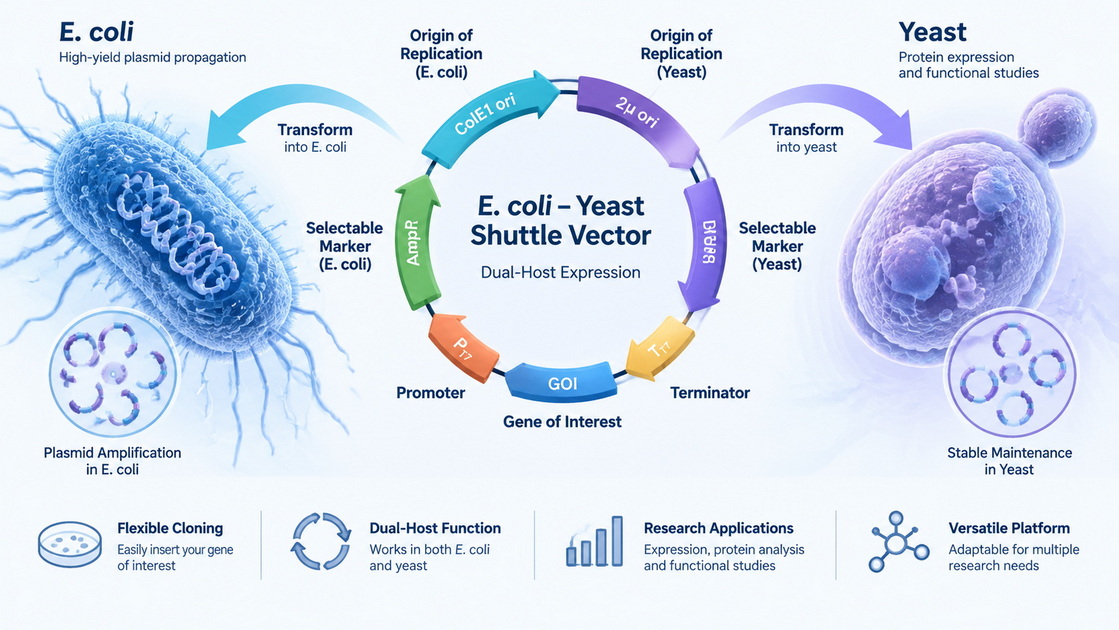
A shuttle vector is usually a circular DNA molecule that can be maintained or recovered across at least two biological hosts. A classic example is an E. coli–Saccharomyces cerevisiae shuttle vector. Researchers perform efficient cloning and plasmid preparation in *E. coli*, then introduce the verified construct into yeast to study expression, localization, metabolism, or gene function.
The word "shuttle" describes movement between systems, not guaranteed expression in both. Some vectors replicate in both hosts but express the inserted gene in only one. Others include separate regulatory modules for each host. Therefore, the first design question should be: Does the project require replication, selection, expression, or all three in each host?
Essential Shuttle Vector Components
A dependable vector map should show which element works in which host. Treating every feature as universally functional is a common design error.
| Component | Why it matters |
|---|---|
| Origin of replication | Maintains the plasmid and influences copy number in a compatible host |
| Selectable marker | Identifies cells that retain the construct |
| Promoter and translation elements | Control host-specific transcription and protein synthesis |
| Terminator/polyadenylation signal | Supports transcript termination and processing |
| Cloning or assembly region | Provides defined junctions for the gene of interest |
| Tag or signal peptide | Supports detection, purification, localization, or secretion |
| Stability element | Improves inheritance or enables integration |
Dual Origins and Markers
Each host generally needs a compatible maintenance mechanism. For example, the bacterial module may contain a ColE1-family origin and an antibiotic-resistance marker, while the yeast module may use an autonomously replicating sequence, a centromeric element, a 2-micron-derived sequence, and a nutritional or drug-selection marker.
More copies do not always mean more usable protein. High copy number can increase gene dosage, but it can also increase metabolic burden, destabilize the construct, slow cell growth, or intensify aggregation. The useful target is balanced performance: sufficient DNA maintenance and transcription without overwhelming the host.
Expression Cassette Architecture
The expression cassette should match the biology of the final host. Bacterial expression may require a promoter, operator, ribosome-binding site, coding sequence, and terminator. A mammalian cassette generally needs a mammalian promoter, a suitable translation-initiation context, and a polyadenylation signal. Secreted proteins may also require an N-terminal signal peptide.
How a Shuttle Vector Works
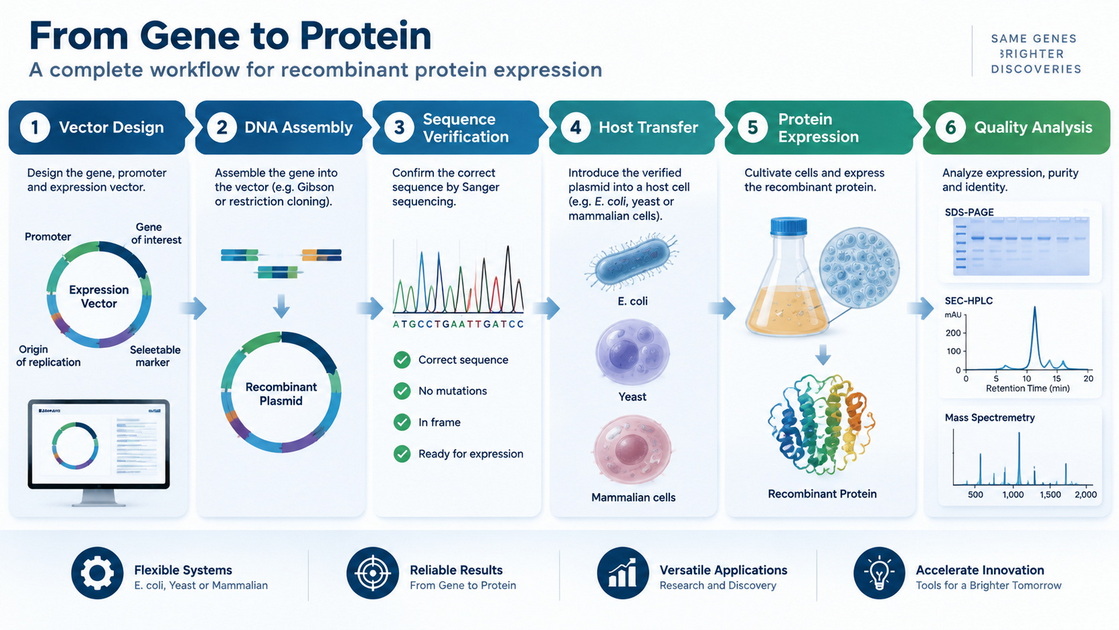
A practical shuttle-vector workflow typically follows six stages:
1. Define both hosts and the endpoint: state where replication, selection, and expression must occur.
2. Design the construct: choose compatible origins, markers, promoters, tags, signals, and assembly junctions.
3. Build in the cloning host: assemble and amplify the plasmid in *E. coli* or another tractable system.
4. Verify sequence and structure: confirm the insert, junctions, frame, and critical regulatory regions.
5. Transfer to the destination host: apply the appropriate transformation or transfection and selection method.
6. Measure the output: assess retention, transcript, total and soluble expression, secretion, purity, or function.
This sequence creates a valuable checkpoint before the most expensive experimental stage. Sequence confirmation before transfer helps prevent a cloning error from being mistaken for an expression failure.
Shuttle Vector Types
E. coli–Yeast Shuttle Vectors
These vectors combine efficient bacterial cloning with eukaryotic research in yeast. In *S. cerevisiae*, common formats include centromeric, episomal, and integrating vectors. Centromeric designs generally emphasize controlled copy number and inheritance; episomal designs are often selected when higher gene dosage is useful; integrating designs support chromosomal insertion rather than autonomous plasmid maintenance.
They are widely used for promoter analysis, pathway reconstruction, protein interaction studies, metabolic engineering, and recombinant protein research. However, plasmid architecture can influence mitotic stability even when the selectable marker and measured copy number appear comparable.
Bacterial–Bacterial Shuttle Vectors
An E. coli–Bacillus, E. coli–Staphylococcus, or E. coli–Mycobacterium shuttle vector allows construction in a familiar bacterial host followed by testing in a less convenient species. These systems are useful for microbial genetics, promoter analysis, secretion studies, and heterologous protein expression.
The second bacterium may differ substantially in promoter recognition, ribosome-binding preferences, plasmid replication, cell-envelope biology, and selectable-marker performance. A bacterial promoter is not necessarily portable across bacterial species.
Bacterial–Mammalian Shuttle Vectors
These plasmids are commonly assembled and amplified in bacteria, then used in mammalian cells. Some are designed mainly as mammalian expression plasmids with bacterial propagation features. Other shuttle systems support plasmid recovery from mammalian cells for studies of DNA repair, recombination, and mutagenesis.
Choosing the Right Vector
Experienced vector designers start with the protein and assay rather than a preferred backbone. Use the following decision sequence:
- Define the protein: size, domains, disulfide bonds, cofactors, toxicity, and modification requirements.
- Choose the host: balance speed and simple handling against folding, secretion, and modification needs.
- Set expression mode: transient or stable, inducible or constitutive, intracellular or secreted.
- Choose copy-number behavior: high-copy, low-copy, centromeric, episomal, or integrating.
- Plan selection: verify each marker against the strain, medium, and project constraints.
- Plan detection and purification: choose the tag—or a tag-free route—around the downstream assay.
- Define quality controls: cover sequence, identity, purity, aggregation, concentration, and activity as needed.
Protein Expression Trade-Offs
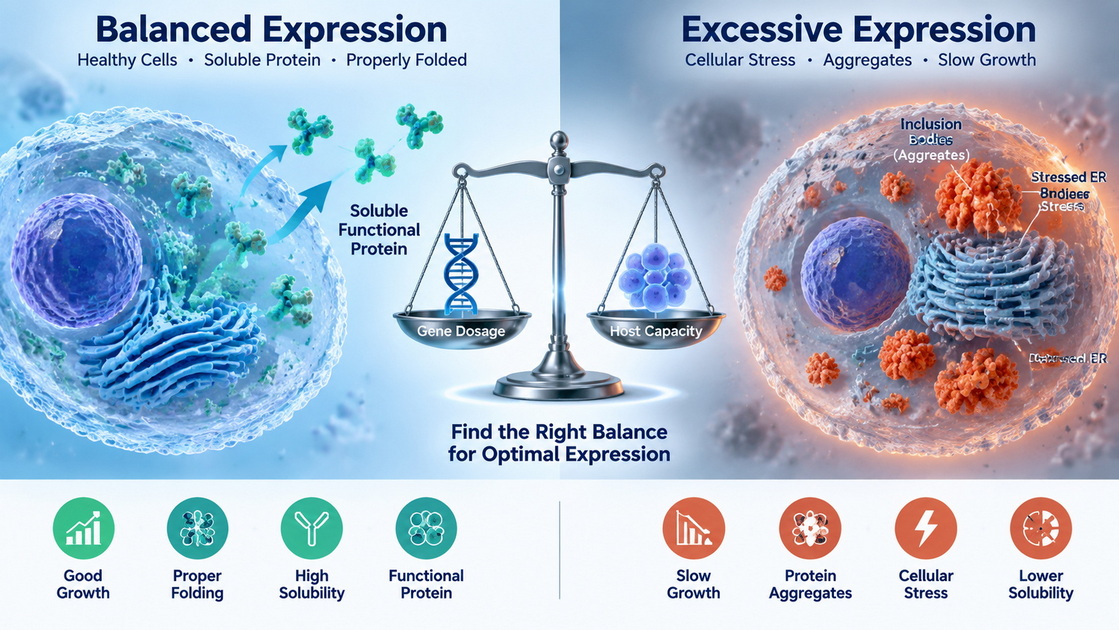
The strongest promoter and highest-copy origin are not automatically the best combination. Recombinant expression competes with the host for energy, ribosomes, amino acids, folding machinery, and membrane or secretion capacity. Excessive transcription can therefore reduce growth while yielding more insoluble or incomplete product.
A better optimization plan changes one variable class at a time:
1. Vector variables: promoter strength, copy number, tag position, signal peptide, and untranslated regions.
2. Host variables: strain background, protease status, chaperone capacity, secretion pathway, and modification capability.
3. Culture variables: temperature, induction point, inducer concentration, medium, feeding, and harvest time.
4. Product variables: soluble yield, monomer percentage, identity, activity, and batch-to-batch consistency.
Small-scale parallel screening is often more informative than committing immediately to one "maximum expression" condition. Measure both total and soluble protein. A strong whole-cell band with little soluble material is an optimization signal, not a successful endpoint.
Failure Modes and Fixes
| Observation | Likely causes | Practical next step |
|---|---|---|
| Few colonies in the second host | Incompatible replicon, poor DNA quality, weak transformation, or incorrect selection | Confirm host compatibility and include positive transformation and selection controls |
| Plasmid loss after growth | Weak partitioning, unsuitable selection, structural instability, or high burden | Compare selective and nonselective retention; consider lower copy number or integration |
| Correct plasmid but no protein | Inactive promoter, translation-context problem, frameshift, transcript instability, or host mismatch | Verify the full cassette sequence; test transcript and a positive expression control |
| High total expression but low solubility | Overexpression, rapid translation, poor folding, or unsuitable tag | Reduce induction strength or temperature; test alternative tags, hosts, or secretion routes |
| Unexpected protein size | Processing, degradation, alternative initiation, glycosylation, or construct error | Compare predicted and observed mass; use orthogonal identity testing |
| Variable results between clones | Copy-number variation, integration-site effects, rearrangement, or culture inconsistency | Screen multiple clones and confirm construct integrity before scale-up |
A useful troubleshooting principle is to separate DNA maintenance, RNA production, protein accumulation, solubility, and function. Testing these layers in order prevents unfocused changes and reveals where performance is actually lost.
Research Support from Gene Universal
Gene Universal supports research teams with coordinated services spanning DNA/RNA design and synthesis, cloning, protein expression, antibody expression, purification, and research-stage characterization. Available expression routes include bacterial, yeast, insect-cell, and mammalian systems, allowing the construct and host strategy to be aligned with the target protein.
For shuttle-vector and expression projects, support can begin with sequence review and codon optimization, continue through gene synthesis and subcloning, and extend to expression screening, purification, and fit-for-purpose quality analysis. This integrated approach reduces handoffs and helps researchers compare host or construct options within one connected workflow.
Service scope: Gene Universal provides research-focused services and fit-for-purpose research-grade materials for early discovery and characterization. It does not provide GMP manufacturing, CDMO services, or IND submission support.
Have a shuttle-vector or difficult protein-expression project? Share the target sequence, intended hosts, required protein format, scale, purity goal, and downstream assay. Gene Universal can help develop a practical research workflow from sequence to purified protein or antibody.
Frequently Asked Questions
1. What is the main advantage of a shuttle vector?
Its main advantage is construct continuity across hosts. Researchers can build and amplify DNA in a convenient system, then use the same verified construct in a second host for expression or functional studies.
2. Can one promoter work in both hosts?
Sometimes, but it should never be assumed. Promoter recognition differs across organisms. Many shuttle vectors use separate host-specific regulatory elements or reserve expression for only one of the hosts.
3. Is a shuttle vector always an expression vector?
No. A vector may replicate and be selected in two hosts without containing a complete expression cassette. Confirm whether the backbone supports replication, selection, and expression in each intended system.
4. Does higher plasmid copy number always improve protein yield?
No. Higher copy number may increase gene dosage, but it can also increase metabolic burden, plasmid instability, and protein aggregation. Soluble or functional yield is more informative than total expression alone.
5. How should researchers choose between episomal and integrating vectors?
Choose according to the experimental endpoint. Episomal vectors can simplify recovery and may provide flexible copy number, while integrating vectors can support stable chromosomal maintenance. Host biology, clone variability, and study duration should guide the decision.
6. What information is needed for a custom shuttle-vector project?
Provide the gene sequence, both host strains or cell lines, desired expression location, promoter preference, tag or signal peptide, selection constraints, required protein amount and purity, and the downstream assay. These details allow rational backbone and workflow selection.
References
1. Gnügge R, Rudolf F. "Saccharomyces cerevisiae Shuttle Vectors." *Yeast*. 2017;34(5):205–221. [PubMed] [pubmed.ncbi.nlm.nih]
2. Sarasin A. "Shuttle Vectors for Studying Mutagenesis in Mammalian Cells." *Journal of Photochemistry and Photobiology B*. 1989;3(2):143–155. [PubMed] [pubmed.ncbi.nlm.nih]
3. Fernández FJ, Vega MC. "Choose a Suitable Expression Host: A Survey of Available Protein Production Platforms." *Advances in Experimental Medicine and Biology*. 2016;896:15–24. [PubMed] [pubmed.ncbi.nlm.nih]
4. Tang SR, Somasundaram B, Lua LHL. "Protein Expression Optimization Strategies in E. coli: A Tailored Approach in Strain Selection and Parallelizing Expression Conditions." *Methods in Molecular Biology*. 2022;2406:93–111. [pubmed.ncbi.nlm.nih]
5. Karim AS, Curran KA, Alper HS. "Characterization of Plasmid Burden and Copy Number in Saccharomyces cerevisiae for Optimization of Metabolic Engineering Applications." *FEMS Yeast Research*. 2013;13(1):107–116. [pmc.ncbi.nlm.nih]
6. Gnügge R, Liphardt T, Rudolf F. "A Shuttle Vector Series for Precise Genetic Engineering of Saccharomyces cerevisiae." *Yeast*. 2016;33(3):83–98. [pubmed.ncbi.nlm.nih]
7. Mattanovich D, et al. "Recombinant Protein Production in Yeasts." *Methods in Molecular Biology*. 2012;824:329–358. [pubmed.ncbi.nlm.nih]