 +1 302-235-9792
 SIGN IN
 CONTACT US


- News
- SUMO Tag vs GST Tag: Choosing the Best Fusion Partner for Enhancing the Solubility of Recalcitrant Inclusion Body Proteins
share


SUMO Tag vs GST Tag: Choosing the Best Fusion Partner for Enhancing the Solubility of Recalcitrant Inclusion Body Proteins
Content Menu
● Why Recalcitrant Proteins Form Inclusion Bodies
● SUMO Tag vs GST Tag at a Glance
● Strengths for Difficult Protein Expression
>> SUMO Can Improve Solubility Without Adding a Large Burden
>> SUMO Protease Cleavage Is a Major Practical Advantage
>> SUMO Is Not a Universal Rescue Strategy
● When It Remains the Better Choice
>> GST Combines Solubility Support With Affinity Capture
>> GST Is Valuable for Interaction Research
>> GST May Be Less Reliable for Highly Recalcitrant Targets
● Choosing SUMO or GST for Inclusion Body Proteins
● A Practical Construct-Screening Workflow
>> 1: Review the Target Before Cloning
>> 2: Build a Minimal Parallel Expression Panel
>> 3: Screen Expression Conditions Systematically
>> 4: Measure Solubility Before Purifying at Scale
>> 5: Verify the Protein After Tag Removal
● Variables That Often Matter More
>> Domain Boundaries
>> Expression Location
>> Refolding Feasibility
● When to Escalate Beyond SUMO and GST
● Request a Protein Expression Strategy
● FAQ
>> 1. Is SUMO better than GST for protein solubility?
>> 2. Can a SUMO tag prevent inclusion body formation?
>> 3. Why is GST useful if SUMO may offer better soluble expression?
>> 4. Does GST need to be removed before a functional assay?
>> 5. Does SUMO cleavage leave extra amino acids on the target protein?
>> 6. What should I do if both SUMO and GST fusions are insoluble?
>> 7. Can SUMO and GST tags be used for antibody fragments?
● References
For difficult recombinant proteins, the choice between a SUMO tag vs GST tag can determine whether an expression campaign produces soluble, functional material or repeatedly ends in inclusion bodies. Both fusion partners can support recombinant protein expression and purification, but they solve different experimental problems—and neither is guaranteed to rescue every recalcitrant protein.
In our experience supporting protein and antibody research workflows, the most effective choice is usually driven by the target's folding behavior, disulfide-bond requirements, downstream assay needs, purification strategy, and whether a native N-terminus is essential after tag removal. For many challenging intracellular targets, SUMO is often the stronger first option for soluble expression and precise tag removal, while GST remains highly useful when glutathione-based affinity purification or pull-down functionality is a priority.
Why Recalcitrant Proteins Form Inclusion Bodies
Inclusion bodies are dense intracellular protein aggregates that commonly appear when recombinant proteins are expressed faster than they can fold correctly in E. coli. High-level cytoplasmic expression can overwhelm the host's folding capacity, exposing hydrophobic regions that drive self-association and precipitation.
This problem is especially common for proteins with:
- Hydrophobic surfaces or membrane-associated regions
- Multiple cysteines or disulfide bonds
- Large multidomain architectures
- Intrinsically disordered segments
- Eukaryotic post-translational modification requirements
- Toxicity toward bacterial host cells
- Fast translation rates that outpace productive folding
Inclusion bodies are not always unusable. They can be isolated, solubilized with denaturants, and subjected to refolding workflows. However, recovery of an active monomeric protein can be time-consuming and target-specific. Refolding may require optimization of denaturant removal, protein concentration, pH, redox conditions, salts, additives, and temperature.
For this reason, many research teams first try to prevent aggregation upstream by redesigning the expression construct. Selecting an appropriate solubility-enhancing fusion partner is often one of the highest-value early experiments.
SUMO Tag vs GST Tag at a Glance
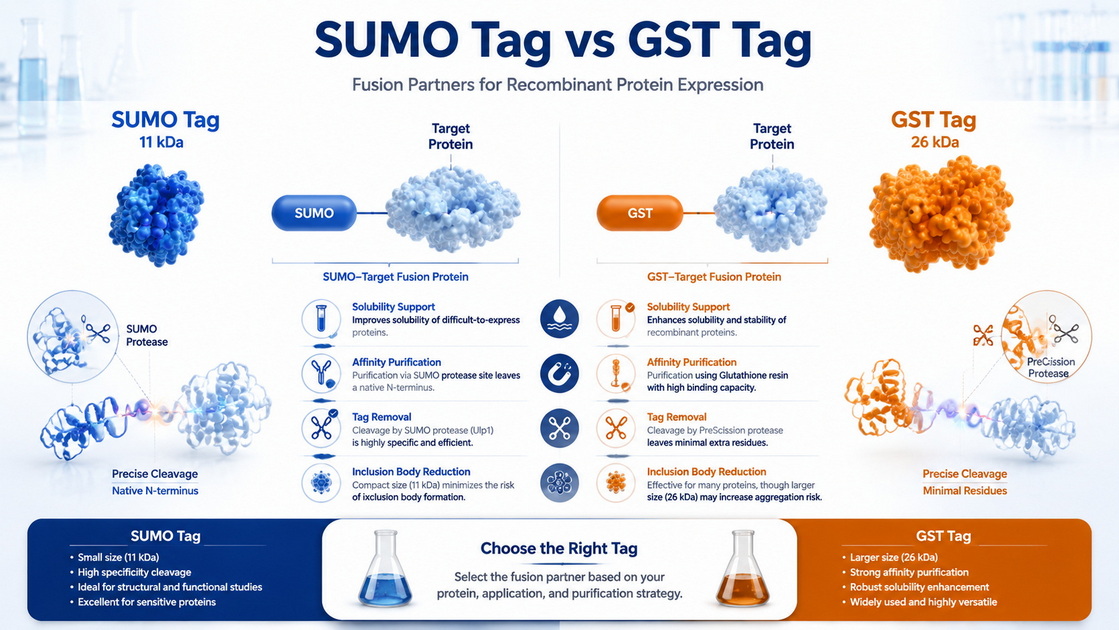
SUMO and GST are both commonly used N-terminal fusion partners, but they differ substantially in size, biochemical behavior, purification options, and cleavage characteristics.
| Feature | SUMO Tag | GST Tag |
|---|---|---|
| Full name | Small ubiquitin-like modifier | Glutathione S-transferase |
| Approximate tag size | About 11–12 kDa | About 26–27 kDa |
| Primary strengths | Solubility support, folding assistance, highly specific cleavage | Affinity purification, pull-down assays, practical soluble expression support |
| Common affinity method | Often combined with His-tag and immobilized metal affinity chromatography | Glutathione resin affinity chromatography |
| Tag removal | SUMO protease recognizes the folded SUMO structure | Usually requires an engineered protease cleavage site |
| Native target N-terminus after cleavage | Often achievable | Depends on cleavage-site design and protease selection |
| Typical concern | Requires suitable SUMO protease workflow | Larger tag may affect target behavior or remain insoluble for difficult targets |
| Best initial use case | Recalcitrant soluble-expression targets requiring a native product sequence | Targets requiring GST capture, pull-down studies, or rapid glutathione-resin purification |
SUMO is a compact ubiquitin-like protein frequently used to improve expression and solubility. GST is a larger enzyme tag derived from Schistosoma japonicum that binds glutathione and can simplify affinity purification.
A direct comparison study of several fusion partners found that SUMO and NusA produced the most substantial improvements in expression and solubility among the constructs evaluated. The same work emphasized a key practical benefit of SUMO technology: cleavage can generate a target protein with a native sequence at its N-terminus.
Strengths for Difficult Protein Expression
SUMO Can Improve Solubility Without Adding a Large Burden
The SUMO tag is relatively small, approximately 100 amino acids or 11–12 kDa. Its compact, stable structure can help some target proteins remain in a more tractable expression state while adding less molecular mass than GST.
This matters when the target itself is small. A 27 kDa GST fusion can substantially outweigh a 10–15 kDa peptide, domain, cytokine, or antibody fragment. In such cases, the fusion partner may affect migration on SDS-PAGE, purification behavior, binding assays, and analytical interpretation.
SUMO may be especially attractive when:
- The protein is small and difficult to detect or purify.
- A near-native N-terminus is important for downstream activity.
- The target has formed inclusion bodies with GST or untagged expression.
- The construct will be evaluated across several host strains or induction conditions.
- The project needs a compact fusion architecture for screening.
SUMO Protease Cleavage Is a Major Practical Advantage
SUMO proteases recognize the three-dimensional structure of SUMO rather than relying only on a short linear amino-acid sequence. This specificity can enable efficient cleavage at the SUMO–target junction and can preserve the target's native N-terminus.
For researchers studying proteins whose N-terminal residues affect activity, localization, folding, or binding, this can be a meaningful advantage over conventional engineered cleavage sites.
For example, a short signaling protein may appear soluble as a GST fusion but lose activity after cleavage because the final product contains extra residues introduced by the linker or protease recognition sequence. A SUMO design can reduce that risk when the construct is planned correctly.
SUMO Is Not a Universal Rescue Strategy
Although SUMO often performs well in soluble-expression screens, the result remains target-dependent. A tag cannot fully compensate for inappropriate host biology, incorrect subcellular localization, missing cofactors, incompatible redox conditions, or intrinsic instability of the protein sequence.
A protein containing multiple disulfide bonds may still express poorly in the reducing bacterial cytoplasm. In those cases, researchers may need to assess periplasmic expression, engineered oxidative bacterial strains, yeast, insect cells, or mammalian expression platforms. Cytoplasmic expression of disulfide-bonded proteins in *E. coli* frequently leads to inclusion bodies, while an oxidative periplasmic environment can better support native disulfide formation.
When It Remains the Better Choice
GST Combines Solubility Support With Affinity Capture
GST remains widely used because it provides a convenient purification handle. GST-tagged proteins can be captured using glutathione-based affinity media, creating a straightforward path from bacterial lysate to enriched fusion protein.
This is particularly useful for exploratory research where the fusion protein itself is suitable for the planned assay.
GST is often a practical option for:
- Protein–protein interaction experiments.
- Pull-down assay development.
- Early binding assays where the tag does not disrupt function.
- Rapid purification of soluble fusion proteins.
- Projects with established glutathione-resin workflows.
- Targets where a larger N-terminal fusion is well tolerated.
GST Is Valuable for Interaction Research
A GST fusion can be immobilized on glutathione resin and used as bait in a pull-down format. This makes GST especially useful when the immediate objective is to identify or validate molecular interactions rather than to produce a tag-free final target.
However, controls are essential. GST can dimerize, and the tag itself can contribute to background binding. Every pull-down workflow should include an appropriate GST-only negative control and orthogonal validation of any putative interaction.
GST May Be Less Reliable for Highly Recalcitrant Targets
GST can improve solubility for some recombinant proteins, but evidence from comparative reviews indicates that it can be less effective than certain other fusion partners for difficult expression targets. In some cases, GST fusion proteins still accumulate in inclusion bodies.
This does not mean GST should be avoided. It means that a GST construct should not be the only construct tested when the target has a known history of aggregation, low soluble yield, or instability.
A 2022 study also noted that GST can improve soluble expression in *E. coli*, with reported yields of 10–50 mg/L in relevant applications, while acknowledging that target-specific sequence properties can still lead to inclusion-body formation.
Choosing SUMO or GST for Inclusion Body Proteins
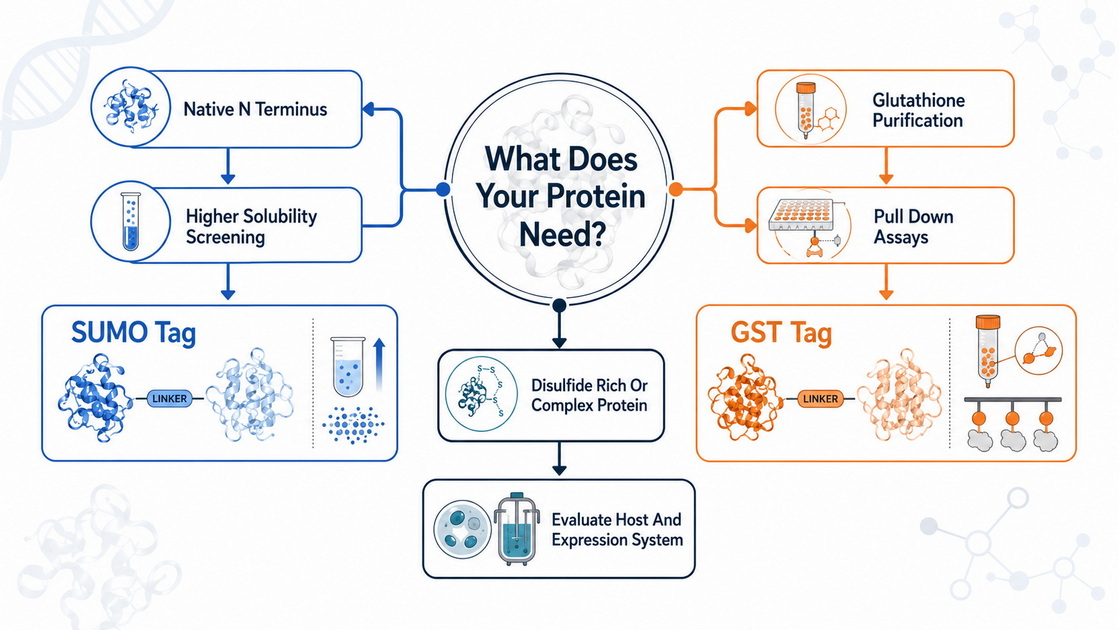
The best decision is not "Which tag is universally superior?" It is "Which construct gives this target the greatest chance of producing soluble, active, and assay-appropriate material?"
| Experimental question | More suitable starting point | Why |
|---|---|---|
| The target repeatedly forms inclusion bodies | SUMO | Often a strong solubility-oriented screening option with lower tag size |
| A native N-terminus is important after cleavage | SUMO | Specific SUMO protease cleavage can preserve native sequence |
| A glutathione pull-down assay is planned | GST | Enables direct affinity capture and immobilization |
| The fusion protein can remain tagged for the assay | GST | Tag may add purification and assay convenience |
| The target is a very small peptide or domain | SUMO | Lower molecular burden may simplify construct behavior |
| The protein has multiple disulfide bonds | Neither tag alone | Consider expression compartment and host system first |
| The target is membrane-associated or highly hydrophobic | SUMO plus broader construct screen | Tag selection should be paired with truncation and host-condition screening |
| Tag removal is required before functional testing | SUMO | Often offers a cleaner path to a native N-terminus |
Expert recommendation: For a truly recalcitrant protein, do not choose between SUMO and GST as a single irreversible decision. Design a focused construct panel and compare them in parallel.
A Practical Construct-Screening Workflow
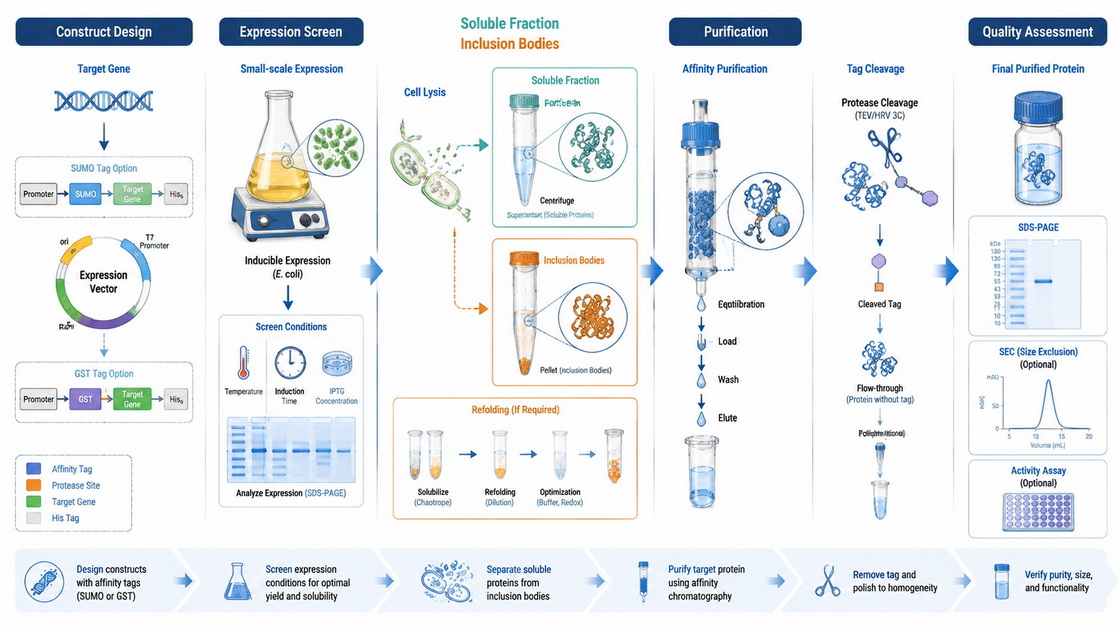
A small, disciplined screen is more informative than repeatedly optimizing one underperforming fusion construct.
1: Review the Target Before Cloning
Assess the protein sequence and research objective.
Key questions include:
- Does the target contain predicted transmembrane helices?
- Are disulfide bonds likely to be required?
- Is the native N-terminus functionally important?
- Is the target expected to bind nucleic acids, lipids, or metal ions?
- Does the final assay require tag-free protein?
- Is the target a full-length protein, domain, fragment, antibody fragment, or engineered variant?
For antibody fragments and other cysteine-rich proteins, construct design should account for folding environment, chain pairing, aggregation tendency, and functional screening. Protein aggregation is influenced by both sequence-linked properties and environmental variables such as pH, temperature, ionic strength, agitation, and formulation conditions.
2: Build a Minimal Parallel Expression Panel
For a challenging target, a practical initial panel may include:
1. His-SUMO-target
2. GST-target
3. His-tagged target without a solubility partner
4. One alternative construct, such as a truncated domain boundary or a different terminal orientation
This approach lets the team distinguish a true tag effect from a general expression limitation.
3: Screen Expression Conditions Systematically
Evaluate multiple induction variables rather than changing one condition at a time without a plan.
Useful variables include:
- Host strain
- Induction temperature
- Inducer concentration
- Post-induction duration
- Media composition
- Expression density at induction
- Co-expression with folding-support factors where appropriate
A lower-temperature induction may reduce the rate of target synthesis and give folding pathways more time to compete against aggregation. However, the best condition must be established experimentally for each target.
4: Measure Solubility Before Purifying at Scale
Analyze total lysate, soluble fraction, and insoluble fraction by SDS-PAGE. Where possible, assess identity using immunodetection or mass spectrometry.
Do not define success only by band intensity. A highly expressed fusion can still be unsuitable if it is mostly insoluble, proteolyzed, oligomeric, or inactive.
5: Verify the Protein After Tag Removal
For a SUMO fusion, confirm cleavage efficiency and assess whether the released target remains soluble. For GST constructs, confirm that the tag does not alter assay performance or create unwanted interaction background.
Recommended analytical checks include:
- SDS-PAGE for apparent purity and cleavage.
- SEC for aggregation or oligomeric species.
- Mass spectrometry for identity and expected molecular mass.
- Functional assay matched to the target's intended research use.
- Binding assay where applicable.
- Thermal or colloidal stability assessment when aggregation risk is central.
Variables That Often Matter More
Fusion tags can help, but they are only one component of an effective expression strategy. For difficult proteins, the following variables often have equal or greater impact.
Domain Boundaries
Many full-length proteins contain flexible linkers, disordered tails, transmembrane segments, or regulatory regions that are unnecessary for a specific assay and detrimental to soluble expression.
Testing rationally selected domains or truncated constructs can be more productive than repeatedly changing tags on the full-length sequence.
Expression Location
The reducing bacterial cytoplasm may be unsuitable for proteins requiring disulfide-bond formation. Periplasmic export, oxidative bacterial hosts, or eukaryotic expression systems may provide a better folding environment for such targets.
Refolding Feasibility
If inclusion-body production cannot be avoided, the project may move toward denaturation and refolding. This route requires a controlled strategy because protein aggregation can occur during refolding from partially folded intermediates.
Important refolding variables include:
- Protein concentration during dilution or dialysis
- Denaturant type and removal rate
- Redox-pair composition for disulfide-containing proteins
- Buffer pH and ionic strength
- Additives that suppress aggregation
- Capture or solid-phase refolding methods
Fusion partners can sometimes improve recovery after refolding, but they do not automatically guarantee native refolding or biological activity.
When to Escalate Beyond SUMO and GST
Move beyond a SUMO-versus-GST comparison when data show that both fusions fail to produce adequate soluble and functional protein.
Escalation triggers may include:
- More than 80% of expressed target remains insoluble across screened conditions.
- The target is extensively proteolyzed.
- Tag removal causes immediate precipitation.
- The recovered target is strongly aggregated by SEC.
- The fusion expresses but lacks expected biological activity.
- The protein requires eukaryotic folding, glycosylation, assembly, or secretion.
At that point, a broader protein expression strategy may include construct redesign, alternative fusion partners, secretion approaches, oxidative expression conditions, or mammalian cell expression for research-use candidates and early discovery and characterization studies.
For antibodies and antibody fragments, expression strategy should be selected according to the molecule format, intended assay, folding complexity, and required quality attributes. Aggregation must be evaluated as a developability-oriented property rather than inferred solely from expression yield.
Request a Protein Expression Strategy
If your protein repeatedly forms inclusion bodies, start with a rational construct screen rather than a single-tag trial-and-error cycle. Gene Universal can support research workflows spanning DNA/RNA through recombinant protein and antibody expression, helping teams evaluate construct architecture, expression strategy, purification approaches, and fit-for-purpose research-grade materials.
Contact Gene Universal to discuss your recalcitrant protein, antibody fragment, or fusion-expression project and build a practical SUMO and GST screening plan.
FAQ
1. Is SUMO better than GST for protein solubility?
Not universally. SUMO has performed strongly in comparative studies of difficult recombinant proteins and offers highly specific cleavage that can preserve a native N-terminus. GST can also improve solubility, but it may be less reliable for some highly aggregation-prone targets. The right answer depends on the target sequence, host system, and downstream application.
2. Can a SUMO tag prevent inclusion body formation?
It can reduce aggregation for some targets, but it cannot guarantee soluble expression. Inclusion-body formation may also result from inappropriate expression temperature, excessive induction, poor domain boundaries, disulfide-bond requirements, or intrinsic instability of the target protein.
3. Why is GST useful if SUMO may offer better soluble expression?
GST provides a convenient glutathione-based affinity handle and is especially useful for protein interaction studies, pull-down experiments, and workflows in which the fusion protein can remain tagged.
4. Does GST need to be removed before a functional assay?
It depends on the assay. GST may alter steric access, oligomerization, binding behavior, molecular mass, or background interactions. If native target behavior is important, test both tagged and cleaved forms.
5. Does SUMO cleavage leave extra amino acids on the target protein?
A correctly designed SUMO fusion can enable cleavage that yields the native N-terminus of the target protein. This is one of the most important advantages of the SUMO system.
6. What should I do if both SUMO and GST fusions are insoluble?
Review domain boundaries, induction conditions, host strain, cellular compartment, and the need for disulfide formation or eukaryotic processing. Consider a broader construct panel and alternative expression systems before committing to inclusion-body refolding.
7. Can SUMO and GST tags be used for antibody fragments?
They can be used in exploratory bacterial expression research, but antibody fragments with disulfide bonds may require an oxidative folding environment. Periplasmic or eukaryotic expression strategies can be more appropriate when proper disulfide formation is essential.
References
1. Marblestone JG, Edavettal SC, Lim Y, et al. [Comparison of SUMO fusion technology with traditional gene fusion systems: enhanced expression and solubility with SUMO](https://pubmed.ncbi.nlm.nih.gov/16322573/).
2. Costa SJ, Almeida A, Castro A, et al. [Fusion tags for protein solubility, purification and immunogenicity in Escherichia coli: the novel Fh8 system](https://pmc.ncbi.nlm.nih.gov/articles/PMC3928792/)
3. Malakhov MP, Mattern MR, Malakhova OA, et al. [SUMO fusion technology for difficult-to-express proteins](https://pmc.ncbi.nlm.nih.gov/articles/PMC7129290/)
4. Guzzo CM, Yang DC. [Systematic analysis of fusion and affinity tags using human aspartyl-tRNA synthetase expressed in *Escherichia coli*](https://pubmed.ncbi.nlm.nih.gov/17434317/)
5. Varnado CL, et al. [Strategic optimization of conditions for the solubilization of GST fusion proteins from inclusion bodies](https://pubmed.ncbi.nlm.nih.gov/36510188/)
6. Walls AC, et al. [Protein fusion tags for efficient expression and purification of recombinant proteins in the periplasm of *Escherichia coli*](https://pubmed.ncbi.nlm.nih.gov/28330113/)
7. National Center for Biotechnology Information. [Current Bioprocess Technology, Products, and Opportunities](https://www.ncbi.nlm.nih.gov/books/NBK236005/)
8. Roberts CJ. [Prediction and Reduction of the Aggregation of Monoclonal Antibodies](https://pmc.ncbi.nlm.nih.gov/articles/PMC5397608/)
9. Hoffmann F, Rinas U. [Reassessment of inclusion body-based production as a versatile opportunity for difficult-to-express recombinant proteins](https://pubmed.ncbi.nlm.nih.gov/29124949/)
10. Han B, et al. [Refolding of a recombinant collagen-targeted TGF-beta2 fusion protein from inclusion bodies](https://pubmed.ncbi.nlm.nih.gov/9367813/)