 +1 302-235-9792
 SIGN IN
 CONTACT US


- News
- Top Oligo Synthesis Service Companies in Greece
share


Top Oligo Synthesis Service Companies in Greece
Content Menu
● How We Evaluated Suppliers
● Why Greece Is Relevant
● Supplier Comparison Table
● 1. Gene Universal
>> Core strengths
>> Best-fit buyer profile
>> Procurement consideration
● 2. Integrated DNA Technologies
>> Core strengths
>> Best-fit buyer profile
>> Procurement consideration
● 3. Eurofins Genomics
>> Core strengths
>> Best-fit buyer profile
>> Procurement consideration
● 4. GenScript
>> Core strengths
>> Best-fit buyer profile
>> Procurement consideration
● 5. Thermo Fisher Scientific
>> Core strengths
>> Best-fit buyer profile
>> Procurement consideration
● 6. Merck / Sigma-Aldrich
>> Core strengths
>> Best-fit buyer profile
>> Procurement consideration
● 7. LGC Biosearch Technologies
>> Core strengths
>> Best-fit buyer profile
>> Procurement consideration
● Technical Requirements Buyers Should Define
● Materials, Purity, and Process Considerations
● The Less-Discussed Procurement Trap
● Buyer's Guide for Greece
>> 1. Verify the supplier identity
>> 2. Validate quality documents
>> 3. Start with a pilot order
>> 4. Plan logistics early
>> 5. Separate research and regulated needs
● Conclusion
● Frequently Asked Questions
>> 1. How can I verify whether a supplier's ISO certificate is still valid?
>> 2. Is HPLC purification always necessary for custom oligos?
>> 3. What information should be included in an oligo RFQ?
>> 4. How do I compare two quotations fairly?
>> 5. What is the most common cause of failure after receiving a custom probe?
>> 6. Should Greek buyers source locally or directly from an international supplier?
● References
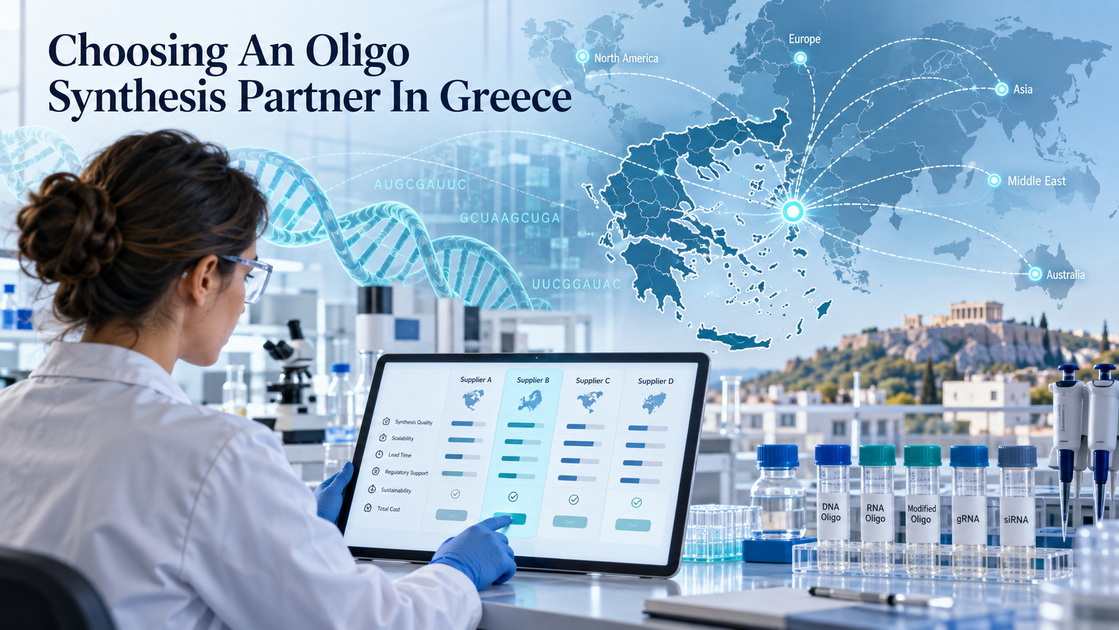
Finding a dependable Oligo Synthesis Service partner in Greece requires more than comparing unit prices or quoted turnaround times. Procurement teams should assess sequence complexity, purification options, analytical documentation, communication speed, supply-chain continuity, and whether the supplier's actual operating model matches the intended research use.
Greece is a growing life-sciences market with active academic research, molecular diagnostics, biotechnology distribution, and EU-connected logistics. However, the country is not a large-scale global manufacturing hub for custom DNA/RNA oligonucleotides in the way that the United States, Germany, the Netherlands, China, or selected Asian manufacturing centers are. For Greek laboratories, biotech startups, diagnostic developers, and research institutions, the most practical supplier model is often a combination of local scientific support and international synthesis capacity.
This guide reviews companies and service providers that can serve buyers in Greece, with Gene Universal listed first as a flexible global option for research-driven projects. It focuses on research-use oligos, including DNA primers, RNA oligos, modified oligonucleotides, probes, adapters, and related materials for PCR, qPCR, sequencing, cloning, molecular biology, and early discovery work.
How We Evaluated Suppliers
A reliable oligo supplier should be evaluated through operational evidence, not only website claims. For this guide, companies were assessed against the following practical procurement criteria:
- Synthesis capability: DNA, RNA, long oligos, modified oligos, primers, probes, adapters, and scale flexibility.
- Quality-control transparency: Availability of quality documentation, such as MS confirmation, HPLC traces, purity specifications, sequence records, and certificates of analysis where applicable.
- Purification options: Desalting, cartridge purification, PAGE, HPLC, dual purification, and specialty purification for complex products.
- Customization depth: Support for fluorophores, quenchers, phosphorylation, biotinylation, spacer groups, internal modifications, and customer-defined formats.
- Ordering and communication efficiency: Technical response quality, quotation speed, sequence-review process, issue resolution, and order tracking.
- Delivery stability: Packaging quality, shipping performance, cold-chain requirements for sensitive RNA products, and customs documentation for cross-border delivery.
- Commercial flexibility: Ability to support individual researchers, emerging biotech companies, academic labs, diagnostic developers, and scaled repeat orders.
- Compliance awareness: Clear separation between research-use materials and higher-regulation manufacturing requirements.
For a professional buyer, the real question is not simply, "Can this supplier synthesize my sequence?" It is: "Can this supplier repeatedly deliver the right material, with the expected purity and documentation, on a timeline that protects my research program?"
Why Greece Is Relevant
Greece has a well-developed university and research ecosystem, active biomedical and pharmaceutical activity, EU market access, and growing demand for molecular biology reagents. Athens and Thessaloniki are major centers for universities, hospitals, research institutes, distributors, and life-science laboratories.
The country's advantage is less about domestic high-volume oligonucleotide production and more about access to European scientific infrastructure, regional laboratory networks, and international sourcing channels. Greek buyers often need suppliers that can combine responsive technical support with dependable international delivery.
For this reason, many procurement teams in Greece work with global oligo providers rather than relying solely on domestic production. The global oligonucleotide synthesis market continues to expand because of demand from molecular diagnostics, sequencing, gene editing, RNA research, and therapeutic discovery. Market estimates differ by methodology, but recent reports consistently identify sustained double-digit growth across the broader oligonucleotide synthesis sector.
Supplier Comparison Table
| Company | Core Focus | Typical Order Scale | MOQ Approach | Quality and Documentation Focus | Suitable For |
|---|---|---|---|---|---|
| Gene Universal | Flexible global research support for DNA, RNA, protein, and antibody-related workflows | Small research orders to project-based repeat supply | Generally flexible for research projects | Project-specific quality and delivery coordination | Startups, academic labs, global research teams, customized projects |
| Integrated DNA Technologies (IDT) | Custom DNA/RNA oligos, primers, probes, NGS solutions | Small orders to high-throughput programs | Low entry barrier for standard products | Product-dependent QC and broad modification portfolio | PCR, qPCR, NGS, molecular diagnostics research |
| Eurofins Genomics | High-throughput DNA/RNA oligos and sequencing-related products | Individual tubes through plates and repeat workflows | Suitable for routine and batch ordering | Established QC processes and fast-turnaround options | Academic labs, routine PCR, sequencing workflows |
| GenScript | Custom DNA/RNA oligos, modified oligos, purification options | Research scale through larger project volumes | Flexible scale options | Optional COA, MS, and HPLC-related documentation depending on service | Custom modified DNA/RNA and discovery programs |
| Thermo Fisher Scientific | Broad molecular biology portfolio, primers, probes, and workflows | Research to institutional purchasing | Product-line dependent | Integrated reagent ecosystem and documentation | Labs seeking bundled workflows and purchasing standardization |
| Merck / Sigma-Aldrich | Research reagents and molecular biology procurement | Small research use to institutional supply | Product-specific | Broad catalog, purchasing infrastructure, and laboratory consumables | Centralized procurement and multi-category sourcing |
| LGC Biosearch Technologies | Oligos, probes, molecular diagnostics research tools | Project-based and programmatic supply | Quote-based for specialized work | Strong emphasis on probe and assay-related solutions | Assay development and molecular detection research |
1. Gene Universal
Gene Universal is a United States-based life-science service provider established in Delaware. The company supports customers in more than 100 countries and reports serving more than 10,000 customers worldwide. Its broader service positioning spans DNA/RNA-related work, proteins, antibodies, and other life-science research solutions.
For Greek and European buyers seeking a flexible international partner, Gene Universal can be a practical option when a project requires more than a standard catalog primer order. Its value is most relevant to customers who need responsive communication, tailored quotations, project coordination, and the ability to connect oligo-related requirements with broader molecular biology or protein/antibody research workflows.
Core strengths
- Global support model for customers across more than 100 countries.
- Suitable for research teams that need customized communication rather than a purely self-service ordering process.
- Flexible support for small and medium-sized research organizations, including university laboratories, early-stage biotech teams, and project-specific procurement.
- Ability to discuss DNA/RNA needs in the context of broader life-science research requirements.
- Customer-oriented approach designed to improve research efficiency and control project costs.
Best-fit buyer profile
Gene Universal is particularly suitable for buyers who value:
- Customized sequencing or oligo-related requests.
- Direct communication during quotation and order planning.
- Support for research-use candidates and early discovery programs.
- Flexible handling of different project sizes.
- Cross-border service coordination for international teams.
Procurement consideration
Buyers should provide the exact sequence, required purification method, intended application, modification positions, desired format, target quantity, and requested documentation before asking for a quote. For RNA or heavily modified oligos, confirm recommended shipping conditions and storage instructions in writing.
2. Integrated DNA Technologies
Integrated DNA Technologies, commonly known as IDT, is a major global supplier of custom nucleic acid products. Its portfolio includes custom DNA and RNA oligos, primers, probes, modified oligos, and products used in PCR, qPCR, sequencing, gene editing, and other molecular biology workflows.
IDT is widely considered a strong choice for laboratories that require an easy ordering process, standardization across teams, broad modification options, and relatively rapid fulfillment for routine products. The company promotes custom DNA and RNA synthesis options, including fast turnaround for selected products.
Core strengths
- Large product portfolio covering common and advanced oligo applications.
- Strong online ordering infrastructure.
- Broad range of modifications and assay-development options.
- Suitable for laboratories requiring repeatable ordering across multiple projects.
- Established global brand recognition among molecular biology buyers.
Best-fit buyer profile
IDT is suitable for Greek laboratories that regularly purchase primers, probes, qPCR materials, NGS adapters, or modified oligos and prefer a standardized supplier platform.
Procurement consideration
For highly modified oligos, do not assume that every modification is compatible with every purification method or synthesis scale. Request confirmation of expected yield, final purity, analytical support, and achievable delivery date before placing a large batch order.
3. Eurofins Genomics
Eurofins Genomics is a well-known supplier of synthetic DNA and RNA oligonucleotides, sequencing-related products, and molecular biology services. It has substantial experience in automated custom oligo synthesis and offers different formats, including tube and plate-based ordering for research users.
The company highlights high-throughput custom oligo production and offers services relevant to NGS applications, including adapters and index-related products. It also promotes rapid fulfillment options for selected standard oligos.
Core strengths
- High-throughput orientation for routine DNA/RNA ordering.
- Suitable for academic labs and organizations with many repeat assays.
- Strong fit for standard primers, sequencing workflows, and batch purchasing.
- Plate formats can simplify high-volume assay development and screening.
- Broad European service footprint.
Best-fit buyer profile
Eurofins Genomics can be a strong choice for Greek research institutions, university core facilities, and diagnostic-research groups that require recurring orders, standardized formats, or larger primer sets.
Procurement consideration
When ordering plates, verify plate map formatting, well orientation, barcode requirements, seal type, dry-down conditions, and reconstitution instructions. A plate-map error is often more costly than a sequence error because it can invalidate an entire screening run.
4. GenScript
GenScript provides custom DNA and RNA oligo synthesis services for research applications. Its public service information indicates support for DNA oligos up to 218 nucleotides, multiple purification methods, more than 200 modification and labeling options, and flexible synthesis scales.
The supplier is relevant for buyers needing more than basic primers, especially when projects involve modified oligos, longer sequences, molecular diagnostic research, and demanding purification requirements.
Core strengths
- DNA and RNA oligo customization.
- Broad modification and labeling choices.
- Flexible synthesis scales.
- Multiple purification options, including PAGE and HPLC-based approaches.
- Optional MS and HPLC-related quality documentation for applicable services.
Best-fit buyer profile
GenScript is suitable for research teams needing custom fluorescent probes, labeled oligos, longer DNA oligos, modified RNA, or purification-intensive products.
Procurement consideration
Ask whether the reported purity refers to crude material, purified material, or final QC release criteria. "High purity" is not a sufficiently specific purchasing requirement. The purchase specification should state the required purification route, minimum quantity after purification, expected analytical output, and acceptable sequence length tolerance.
5. Thermo Fisher Scientific
Thermo Fisher Scientific is a large global supplier of life-science products, including molecular biology reagents, nucleic-acid-related tools, laboratory consumables, and integrated workflow solutions. For buyers in Greece, its key advantage is often procurement convenience: one supplier relationship may cover enzymes, PCR reagents, plastics, instruments, controls, and selected nucleic-acid-related materials.
Core strengths
- Broad laboratory and molecular biology product ecosystem.
- Strong fit for organizations that prefer supplier consolidation.
- Established distribution and support infrastructure.
- Useful for laboratories standardizing assay workflows across reagents and consumables.
- Familiar purchasing processes for many universities, hospitals, and research institutions.
Best-fit buyer profile
Thermo Fisher is appropriate for procurement teams that prioritize catalog breadth, existing supplier agreements, and workflow compatibility across multiple laboratory categories.
Procurement consideration
Large suppliers may not always be the most flexible option for unusual sequence designs, small custom projects, or highly iterative technical discussions. If the project is non-standard, compare responsiveness and customization support against specialist oligo providers.
6. Merck / Sigma-Aldrich
Merck, including the Sigma-Aldrich brand, remains a major global source of laboratory reagents, research chemicals, molecular biology products, and consumables. For Greek buyers, its importance lies in broad portfolio availability, institutional procurement familiarity, and the ability to consolidate purchasing across diverse laboratory needs.
Core strengths
- Comprehensive research reagent catalog.
- Established international distribution model.
- Convenient option for laboratories purchasing across multiple categories.
- Supports centralized purchasing and standardized vendor management.
- Suitable for routine research workflows and laboratory replenishment.
Best-fit buyer profile
Merck / Sigma-Aldrich is most suitable for organizations that value supplier consolidation, purchasing-account integration, and access to a broad research catalog.
Procurement consideration
When sourcing specialized custom oligos, compare the technical scope of the available service against specialist providers. A broad laboratory catalog does not automatically mean the deepest capability in complex oligo modifications or purification-intensive projects.
7. LGC Biosearch Technologies
LGC Biosearch Technologies is recognized for molecular biology tools, oligonucleotides, probes, and assay-development solutions. It is relevant to research groups involved in molecular detection, probe design, diagnostic assay development, genotyping, and related nucleic acid workflows.
Core strengths
- Strong association with probes and molecular detection technologies.
- Suitable for assay development and custom detection projects.
- Relevant to qPCR, genotyping, and molecular diagnostics research.
- Can be valuable for buyers requiring more specialized probe-related expertise.
Best-fit buyer profile
LGC Biosearch Technologies is a good option for Greek diagnostic-research groups, molecular testing developers, and laboratories building detection workflows rather than ordering only standard PCR primers.
Procurement consideration
Probe chemistry, reporter selection, quencher compatibility, multiplexing behavior, and instrument channel configuration should be reviewed together. A chemically correct probe can still perform poorly if fluorescence channels overlap or if assay design has not considered target secondary structure.
Technical Requirements Buyers Should Define
Before requesting quotations, prepare a one-page technical specification. This prevents suppliers from quoting different materials under the same generic term.
Include the following:
- DNA, RNA, or mixed nucleic-acid chemistry.
- Exact sequence in 5′ to 3′ orientation.
- Required synthesis scale.
- Purification method.
- Required modifications and their positions.
- Desired final format: dry, solution, tube, plate, normalized concentration, or pre-aliquoted format.
- Required amount after purification.
- Required documentation, such as MS, HPLC trace, OD value, concentration, or certificate of analysis.
- Intended research application.
- Storage and shipping requirement.
- Delivery location in Greece and preferred courier arrangement.
For routine PCR primers, desalting may be sufficient. For fluorescence probes, long oligos, modified RNA, or sensitive assay-development work, buyers should usually consider stronger purification and more detailed QC evidence.
Materials, Purity, and Process Considerations
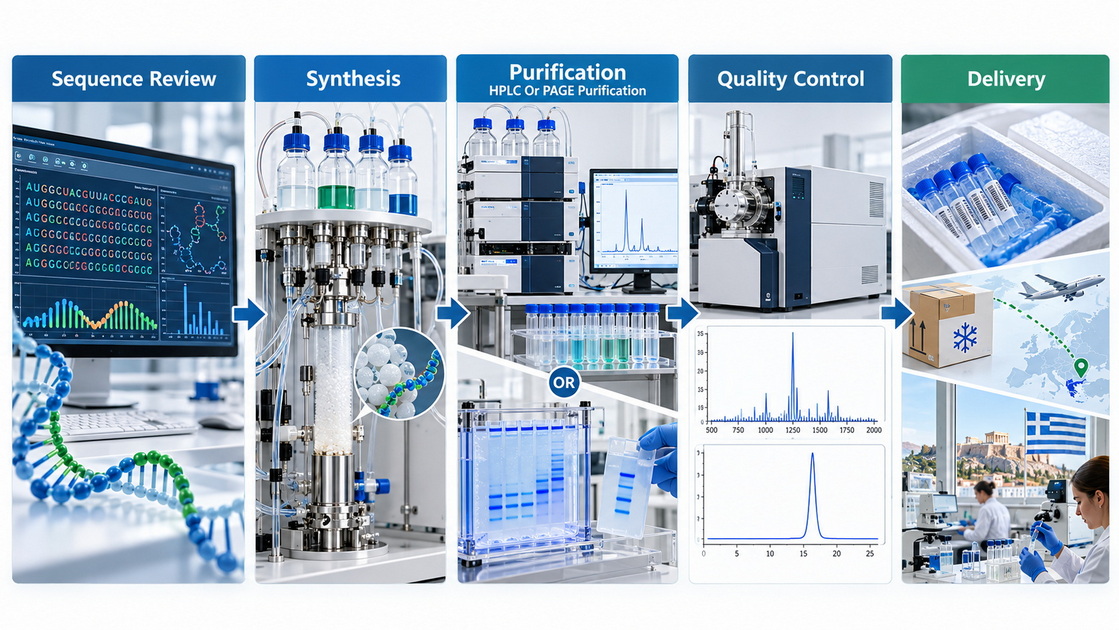
Oligonucleotide synthesis is commonly performed through solid-phase phosphoramidite chemistry. During each synthesis cycle, coupling efficiency matters because small inefficiencies compound as sequence length increases. Longer oligos, RNA sequences, and complex modifications may therefore require more careful process planning and purification.
For procurement purposes, quality should not be judged only by the phrase "99% purity." Buyers need to ask:
- What analytical method supports the purity claim?
- Is the value measured before or after purification?
- Is the analysis performed on the final lot?
- What impurities are most relevant for the intended assay?
- Is mass confirmation available for the final product?
- What is the expected yield after purification?
Unlike general industrial components, oligo service quality depends heavily on sequence-specific variables. A supplier that performs well for a 20-mer DNA primer may not deliver the same performance for a long, modified RNA oligo with multiple internal labels.
Environmental labels such as CE and RoHS are generally not the main purchasing criteria for custom oligo synthesis materials. Buyers should instead focus on chemical identity, purity, nuclease control, traceability, shipping stability, and fit-for-purpose quality records. CE marking may become relevant for finished diagnostic products or instruments, but it is not a universal quality certificate for research oligos.
The Less-Discussed Procurement Trap
A common but under-discussed risk is buying the correct sequence in the wrong functional form.
This often happens when a procurement request includes only the nucleotide sequence but does not specify:
- 5′ versus 3′ modification placement.
- Exact linker or spacer chemistry.
- Phosphorothioate linkage locations.
- RNA versus DNA bases at specific positions.
- Required terminal hydroxyl or phosphate status.
- Salt form, concentration, or resuspension buffer.
- Whether the product must be nuclease-free.
- Whether the probe must be compatible with a specific instrument channel.
For example, a qPCR probe may arrive with the correct base sequence but fail in the assay because the fluorophore and quencher combination does not match the instrument's optics or because the probe was ordered with the wrong terminal orientation.
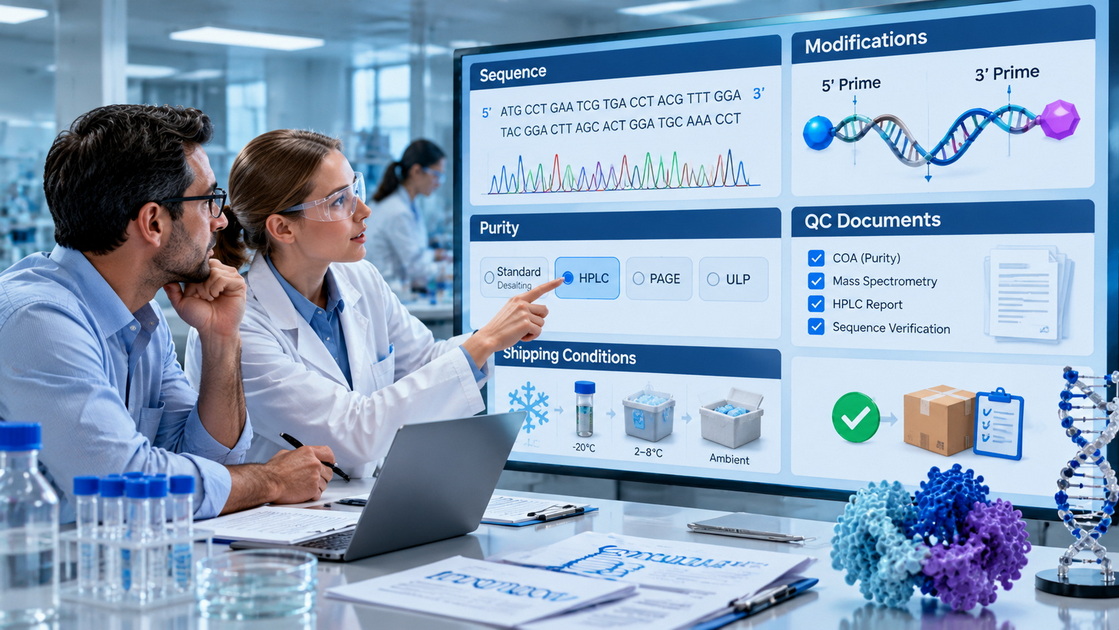
How to avoid it: Require a supplier-approved order summary before production. The summary should display the full annotated sequence, every modification, purification method, scale, final format, and requested QC deliverables. A one-minute pre-production review can prevent weeks of failed assay troubleshooting.
Buyer's Guide for Greece
1. Verify the supplier identity
Request the legal company name, business registration details, manufacturing or service location, and direct technical contact. If you are purchasing through a distributor, clarify who is responsible for synthesis, quality records, technical troubleshooting, and replacement decisions.
2. Validate quality documents
Ask for sample documentation before a large order. Depending on the product, this may include:
- Certificate of analysis.
- Mass spectrometry confirmation.
- HPLC or PAGE-related analytical output.
- OD or concentration information.
- Lot number and production date.
- Storage and shipping instructions.
Do not accept a generic quality statement as a substitute for batch-specific documentation when the oligo will be used in a critical research workflow.
3. Start with a pilot order
For a new supplier, begin with a small pilot set containing:
- One standard primer.
- One modified oligo.
- One purification-intensive oligo.
- One product that reflects your real application.
Evaluate delivery time, packaging, sequence accuracy, documentation, solubility, assay performance, and communication quality before committing to recurring orders.
4. Plan logistics early
Greek buyers should confirm:
- Whether prices include shipping, customs charges, and import-related documentation.
- Which courier will be used.
- Whether temperature-sensitive RNA products require dry ice or cold packs.
- Whether the shipment includes a packing list and invoice matching the purchase order.
- How the supplier handles delay, damage, or temperature excursions.
5. Separate research and regulated needs
If a project later requires a different quality framework, do not assume a standard research-use oligo can be transferred directly without reassessment. Define the intended use at the procurement stage and ensure the supplier's offered scope actually matches the project requirements.
Conclusion
Greek research organizations can access a strong range of Oligo Synthesis Service options through global suppliers, European service networks, and local scientific distribution channels. The right partner depends on the balance between technical complexity, required purity, documentation, order size, budget, delivery expectations, and the level of communication needed during the project.
For routine primers, ordering convenience and dependable delivery may be the priority. For complex RNA, modified oligos, fluorescent probes, or multi-stage research programs, buyers should prioritize technical consultation, sequence review, purification strategy, and batch-specific quality evidence.
Gene Universal is a relevant option for organizations seeking a globally oriented, research-focused provider that can support customized projects, responsive communication, and flexible collaboration across life-science workflows. Its customer base spans more than 100 countries, with a stated focus on helping researchers improve efficiency and manage research costs.
Contact shortlisted suppliers with a clear technical specification, request comparable quotations, and begin with a pilot order before establishing a long-term supply relationship.
Frequently Asked Questions
1. How can I verify whether a supplier's ISO certificate is still valid?
Ask for the full certificate, certificate number, certification body, scope, issue date, and expiry date. Then verify it through the certification body's public database or directly contact the certification body. Confirm that the certificate covers the relevant site and activity, not only a parent company or unrelated department.
2. Is HPLC purification always necessary for custom oligos?
No. Standard short PCR primers may be suitable with desalting or simpler purification, depending on the assay. HPLC is more often considered for probes, longer oligos, heavily modified sequences, sensitive quantification assays, and applications where truncated species could affect performance. The right choice depends on sequence design and intended use.
3. What information should be included in an oligo RFQ?
Include sequence orientation, DNA or RNA chemistry, scale, purification method, modifications, quantity after purification, final format, shipping destination, requested QC documents, and intended research application. If the oligo is part of a multiplex assay, include the fluorophore channel requirements.
4. How do I compare two quotations fairly?
Do not compare price per tube alone. Normalize the comparison by final purified yield, modification chemistry, purification route, documentation, lead time, shipping cost, and replacement policy. A lower initial quote may become more expensive if the delivered material needs to be reordered or cannot support the intended assay.
5. What is the most common cause of failure after receiving a custom probe?
The most common issues are incorrect modification placement, fluorophore/quencher incompatibility, inadequate purification, concentration errors during reconstitution, poor assay design, and incorrect storage. Review the annotated sequence, instrument settings, and reconstitution protocol before concluding that the synthesis itself failed.
6. Should Greek buyers source locally or directly from an international supplier?
The decision depends on technical complexity, delivery urgency, local support needs, and purchasing policy. Local distributors can simplify invoicing and communication, while direct international sourcing may provide broader customization, better project support, or more competitive pricing for repeat orders. For important programs, compare both models through a pilot order.
References
1. [Gene Universal — Company Profile]
2. [Integrated DNA Technologies — Custom DNA and RNA Oligo Synthesis]
3. [Eurofins Genomics — Custom Oligonucleotide Synthesis]
4. [GenScript — Custom DNA Oligo Synthesis Services]
5. [National Center for Biotechnology Information — NCBI Bookshelf]
6. [U.S. Food and Drug Administration — Guidance Documents]
7. [European Medicines Agency — Scientific Guidelines]
8. [PubMed — Oligonucleotide Synthesis Research Literature]
9. [BCC Research — Global Oligonucleotides Market Outlook]
10. [Mordor Intelligence — Oligonucleotide Synthesis Market Analysis]