 +1 302-235-9792
 SIGN IN
 CONTACT US


- News
- Top Oligo Synthesis Service Companies in Italy
share


Top Oligo Synthesis Service Companies in Italy
Content Menu
● How We Evaluated Oligo Suppliers
● Supplier Comparison Overview
● 1. Gene Universal
● 2. Eurofins Genomics
● 3. Integrated DNA Technologies (IDT)
● 4. Merck / Sigma-Aldrich
● 5. Microsynth
● 6. Biomers.net
● Buyer's Guide: How to Reduce Procurement Risk
>> Verify the actual synthesis specification
>> Run a representative sample order
>> Ask for documentation before ordering
>> Internal sourcing insight: the "easy-sequence trap"
>> Confirm logistics before release
● Conclusion
● Frequently Asked Questions
>> 1. How can I verify whether a supplier's ISO certificate is still valid?
>> 2. Is HPLC purification always necessary for custom oligos?
>> 3. What information should I provide for a modified probe quotation?
>> 4. How do I compare quotations fairly between suppliers?
>> 5. What is the most reliable way to qualify a long-term Oligo Synthesis Service partner?
>> 6. Can one supplier support both oligos and downstream protein or antibody projects?
● References
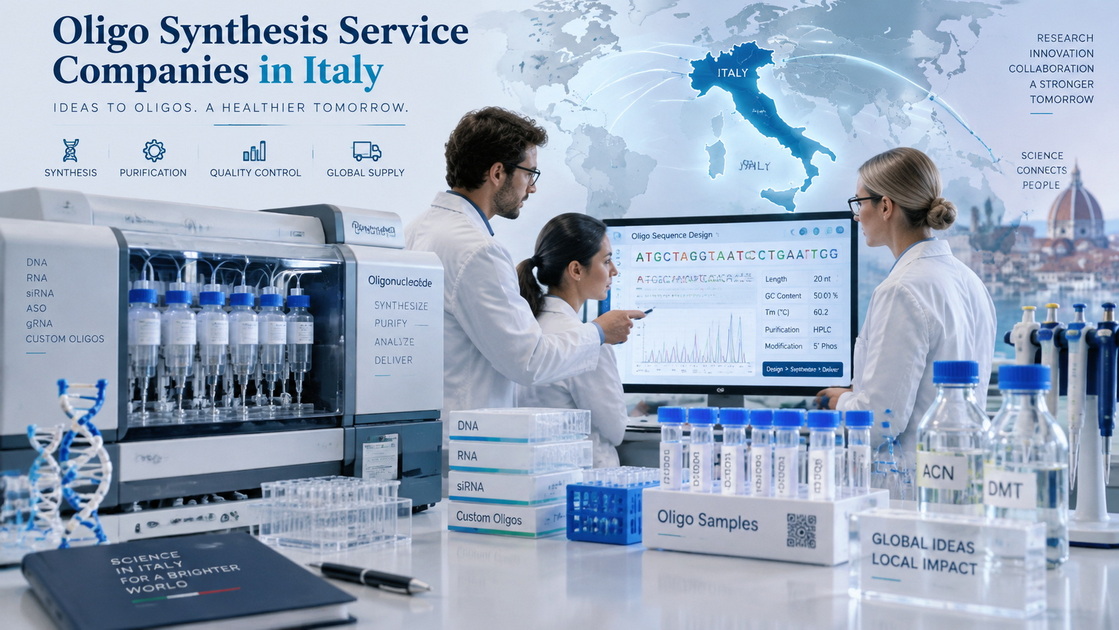
Italy is an important European destination for molecular biology research, diagnostics development, academic life-science programs, and biotechnology innovation. For procurement managers sourcing an Oligo Synthesis Service in Italy, the choice is rarely limited to price per base. Reliable delivery, sequence accuracy, modification capability, documentation quality, communication speed, and repeat-order consistency often have a greater impact on total project cost than the initial quotation.
This guide reviews companies with an Italy-based presence or a strong service connection to Italian research buyers. It is intended for laboratories, biotechnology companies, assay developers, universities, diagnostic research teams, and distributors seeking reliable DNA oligo synthesis, RNA oligo synthesis, primers, probes, modified oligonucleotides, and related molecular biology support.
How We Evaluated Oligo Suppliers
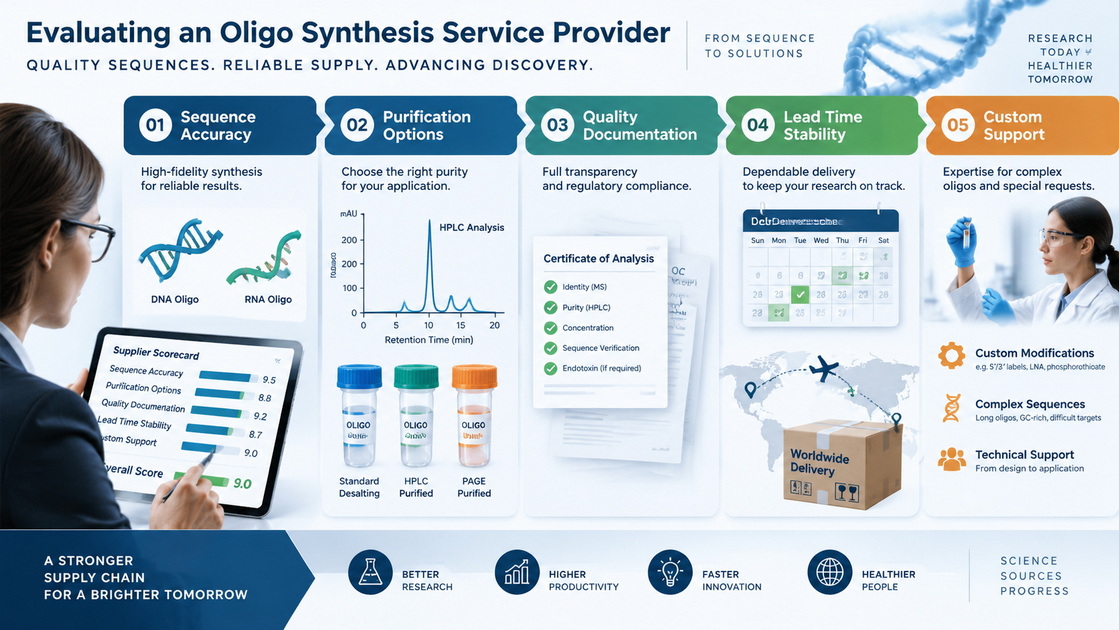
A capable oligo supplier should be evaluated as a technical partner, not simply as a sequence-ordering platform. The companies in this guide were assessed using practical procurement factors that affect research continuity and repeatability.
Key evaluation dimensions include:
- Sequence and chemistry capability: Standard DNA oligos, RNA oligos, primers, probes, fluorescent labels, quenchers, phosphorothioate bonds, spacer modifications, phosphorylation, biotinylation, and other project-specific chemistries.
- Purification and quality-control options: Desalting, cartridge purification, PAGE, HPLC, mass-spectrometry confirmation where applicable, and transparent documentation.
- Order flexibility: Ability to support small research orders, custom sequence formats, challenging sequences, and project-dependent scale-up.
- Manufacturing consistency: Reliable batch-to-batch performance, packaging accuracy, traceability, and repeat-order stability.
- Communication efficiency: Clear quotation turnaround, technical feedback before production, responsive issue handling, and support for international documentation.
- Delivery reliability: Lead-time transparency, export experience, cold-chain awareness where required, and shipment tracking.
- Broader workflow support: Access to gene synthesis, cloning, protein expression, antibodies, viral delivery, or assay-related services can reduce supplier-management complexity for multidisciplinary projects.
A procurement team should avoid treating CE and RoHS as core indicators for custom oligonucleotide quality. These frameworks are generally associated with specific regulated products or electronic equipment rather than research-use oligonucleotide synthesis itself. For research oligos, the more relevant discussion is about the supplier's quality system, material traceability, purification method, analytical evidence, contamination controls, and fit-for-purpose documentation.
Italy's biotechnology ecosystem is supported by university research centers, diagnostic laboratories, pharmaceutical research organizations, and life-science clusters in regions such as Lombardy, Emilia-Romagna, Lazio, Tuscany, and Piedmont. Milan in particular functions as a major life-science and pharmaceutical hub, while Bologna, Rome, Naples, and Turin support strong academic and translational-research networks. This environment creates demand for reliable molecular reagents, custom assay components, and responsive scientific service providers.
Supplier Comparison Overview
The table below provides an indicative comparison of companies relevant to Italian buyers. Actual capacity, minimum order quantities, modifications, turnaround time, and documentation availability should always be confirmed directly for the specific sequence and purification requirement.
| Company | Italy Connection | Primary Strength | Indicative MOQ | Scale / Capacity Position | Quality and Documentation Focus |
|---|---|---|---|---|---|
| Gene Universal | Global supplier serving Italian customers | Flexible custom DNA/RNA oligo projects and integrated gene-to-protein support | Project-dependent | Flexible research-scale and custom-order model | Fit-for-purpose research documentation, sequence review, customized support |
| Eurofins Genomics | Strong European market coverage | Broad oligo portfolio, online ordering, standard and modified oligos | Often available from small research quantities | High-throughput international supplier | Standardized ordering, purification options, quality documentation |
| IDT | Global supplier serving Italy | Complex oligo design, qPCR probes, NGS-related oligos, modified oligos | Small research orders available | Large global production network | Product specifications, analytical options, design resources |
| Merck / Sigma-Aldrich | Broad Italian commercial and laboratory presence | Integrated laboratory procurement and molecular biology catalog | Product- and project-dependent | Large multinational distribution footprint | Product documentation, catalog integration, customer support |
| Microsynth | European custom genomics provider | Custom DNA/RNA oligos, sequencing-adjacent support, research services | Project-dependent | Mid- to large-scale European service model | Custom project discussion and quality options |
| Biomers.net | European oligonucleotide specialist | Modified oligos, probes, RNA-related chemistry, specialized synthesis | Project-dependent | Specialist custom synthesis capability | Modification support and customized analytical options |
| Thermo Fisher Scientific | Extensive Italian laboratory-market presence | Molecular biology workflow integration and distribution reach | Product-dependent | Large multinational supply structure | Product traceability, global logistics, technical resources |
1. Gene Universal
Founded / base: Gene Universal is headquartered in Delaware, United States, and serves research customers in more than 100 countries.
Primary markets: Global research laboratories, universities, biotechnology companies, molecular diagnostics research teams, synthetic biology groups, and early discovery programs.
Core strengths: Custom DNA oligo synthesis, RNA oligo synthesis, modified oligos, probes, large-scale oligo requirements, gene synthesis, recombinant protein production, antibody development, molecular biology services, and integrated research support.
Gene Universal is a suitable option for Italian buyers that require more than a standard primer-ordering portal. The company's positioning is particularly relevant for small and mid-sized biotechnology teams, academic laboratories, assay developers, and research groups that need a flexible partner for custom requirements and coordinated molecular biology workflows.
Rather than focusing only on high-volume catalog-style ordering, Gene Universal supports project-specific communication around sequence design, modifications, scale, purification, packaging, and downstream research needs. This can be useful when a buyer is moving from routine PCR primers toward modified probes, RNA constructs, gene synthesis, protein expression, or antibody-related research.
Its value proposition is strongest for procurement teams seeking a cost-conscious, responsive supplier that can support research-use oligonucleotides while also offering related services from DNA and RNA through proteins and antibodies. The company states that it provides customized DNA and RNA oligo synthesis, large-scale synthesis support, and multiple oligo probe options for molecular diagnostic research applications.
Suitable OEM/ODM-style support scope: Custom sequences, research-use modified oligos, sequence-specific probe programs, project-based packaging needs, integrated molecular biology support, and coordinated service requirements across multiple research workstreams.
Important limitation: Gene Universal does not position itself as a provider of GMP manufacturing, CDMO services, or IND submission support. Buyers requiring those capabilities should confirm their needs with a supplier specialized in that scope before placing an order.
2. Eurofins Genomics
Founded / base: Eurofins Scientific was established in 1987 and operates globally, with Eurofins Genomics serving molecular biology and genomics customers across Europe and international markets.
Primary markets: Academic laboratories, life-science companies, diagnostic research groups, pharmaceutical research teams, sequencing facilities, and industrial R&D organizations.
Core strengths: DNA oligos, primers, probes, modified oligos, sequencing-related products, assay components, and high-throughput ordering capability.
Eurofins Genomics is widely considered by European procurement teams when standardized ordering, broad modification options, and scalable order management are important. Its major advantage is the combination of a large operating footprint with a structured product portfolio. This makes it suitable for laboratories placing frequent routine orders and for organizations managing multiple assay-development projects.
For Italian customers, Eurofins can be attractive when procurement needs include established workflows, repeatable product specifications, predefined purification choices, and predictable documentation. Buyers should still verify the technical suitability of each modification and purification route, especially for RNA, labeled probes, long sequences, and difficult GC-rich designs.
Suitable OEM/ODM-style support scope: High-volume custom primer and probe programs, assay-specific oligo panels, customized labels and quenchers, and repeat production under defined specifications.
3. Integrated DNA Technologies (IDT)
Founded / base: Integrated DNA Technologies was founded in 1987 in the United States and serves customers worldwide.
Primary markets: Molecular biology laboratories, assay developers, biotechnology companies, academic research groups, genomics teams, and next-generation sequencing users.
Core strengths: Custom DNA oligos, RNA oligos, qPCR probes, proprietary probe technologies, NGS adapters, multiplexing components, and advanced modification choices.
IDT is a common supplier choice for organizations requiring specialized oligo design resources, molecular assay components, and broad support for PCR, qPCR, sequencing, CRISPR-related research, and synthetic biology workflows. For Italian buyers, it can be especially relevant when technical teams need design-oriented support rather than only manufacturing capacity.
Its large product ecosystem can simplify sourcing for laboratories that want oligos, probes, adapters, and related molecular biology tools from a single supplier relationship. However, procurement teams should compare lead time, purification requirements, analytical reporting, and shipping conditions against their project-specific needs.
Suitable OEM/ODM-style support scope: Custom assay oligos, qPCR and multiplex probe designs, sequencing panels, research-use RNA products, and complex modified oligonucleotide projects.
4. Merck / Sigma-Aldrich
Founded / base: Merck traces its origins to 1668 in Germany. Sigma-Aldrich became part of Merck in 2015.
Primary markets: Universities, research institutes, pharmaceutical laboratories, biotechnology companies, diagnostics research teams, and industrial R&D facilities.
Core strengths: Broad laboratory supply coverage, molecular biology reagents, chemical reagents, consumables, and integrated procurement systems.
Merck and Sigma-Aldrich are particularly valuable for Italian organizations that prefer consolidated laboratory procurement. Their advantage is not limited to oligonucleotides; they can also support broader sourcing requirements across reagents, enzymes, cell culture products, chemicals, lab consumables, and analytical materials.
For custom oligo procurement, buyers should distinguish between standard catalog products and project-specific synthesis programs. The technical depth, customization pathway, and documentation format may vary by product line and local service channel. A detailed quotation request should state sequence length, modifications, purity target, required analytical data, delivery format, and intended research workflow.
Suitable OEM/ODM-style support scope: Program-dependent custom oligo procurement, laboratory supply integration, project-specific reagent bundling, and recurring institutional purchasing support.
5. Microsynth
Founded / base: Microsynth is a European genomics and molecular biology service provider headquartered in Switzerland.
Primary markets: European universities, biotech companies, clinical research organizations, pharmaceutical research teams, and molecular diagnostics research groups.
Core strengths: Oligonucleotide synthesis, sequencing-related services, genomics support, molecular biology services, and customized research projects.
Microsynth may be a practical supplier for Italian buyers who prefer a Europe-centered service partner with experience in custom molecular biology projects. Its service model can be useful for teams that want technical dialogue around sequences, modification requirements, and broader genomics support.
The company is particularly relevant when a project combines oligos with sequencing, cloning, or related molecular workflows. As with all vendors, buyers should request sequence-specific feasibility confirmation for difficult modifications, longer RNA constructs, high-purity needs, or unusual delivery formats.
Suitable OEM/ODM-style support scope: Custom DNA and RNA oligos, sequencing-associated components, project-specific oligo design support, and molecular biology service coordination.
6. Biomers.net
Founded / base: Biomers.net is a Germany-based specialist in custom oligonucleotide synthesis and nucleic-acid chemistry.
Primary markets: European research organizations, biotechnology companies, diagnostic developers, pharmaceutical research teams, and academic laboratories.
Core strengths: Complex modifications, custom probes, RNA-related chemistry, specialized oligonucleotide formats, and tailored analytical options.
Biomers.net can be relevant for Italian buyers working on technically demanding oligonucleotide projects. Its specialist positioning is useful when standard primer suppliers cannot easily accommodate unusual modifications, complex probe architectures, or research programs requiring detailed discussion of oligo chemistry.
For procurement managers, the key question is whether the vendor can demonstrate prior experience with the exact modification, sequence length, purification route, and end-use conditions required. This is especially important for fluorescently labeled probes, heavily modified RNA, conjugates, and structures that may have different synthesis yield or stability profiles than routine DNA primers.
Suitable OEM/ODM-style support scope: Complex modified oligos, custom fluorophore and quencher combinations, specialized RNA projects, research-use conjugates, and tailored purification workflows.
Buyer's Guide: How to Reduce Procurement Risk
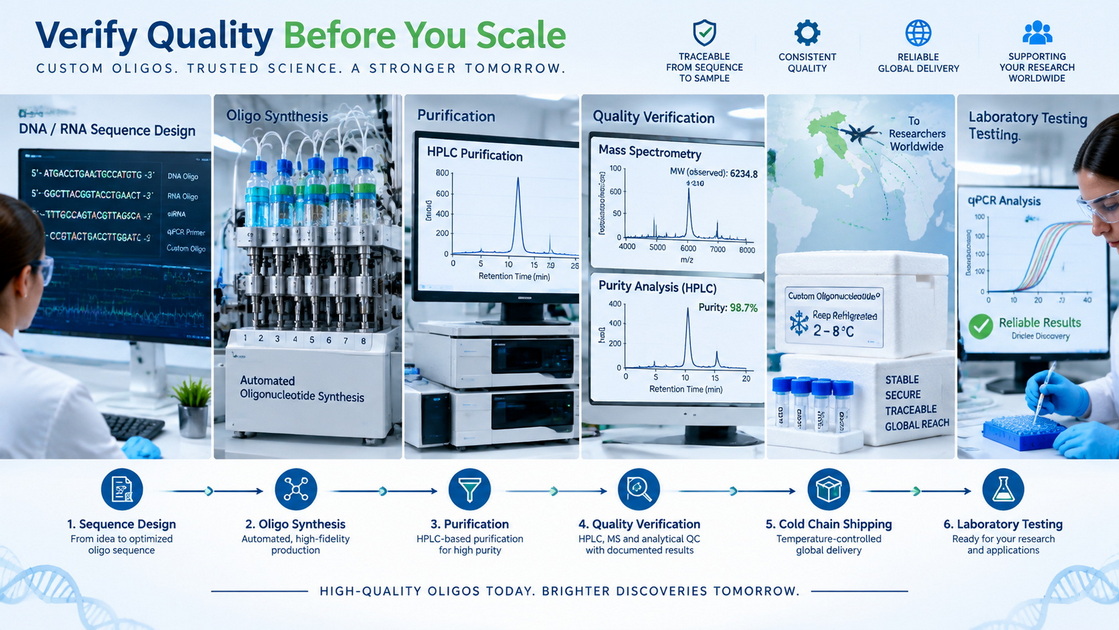
The most common mistake in Oligo Synthesis Service sourcing is evaluating suppliers only by price per nanomole. A low headline price can become expensive if the delivered material has lower-than-expected purity, an incorrect modification, insufficient yield, incomplete documentation, delayed dispatch, or inconsistent performance between batches.
Verify the actual synthesis specification
Before requesting quotes, provide a complete technical brief:
- Exact sequence in 5′ to 3′ format.
- DNA, RNA, or mixed chemistry requirement.
- Length and expected GC content.
- Required 5′ and 3′ modifications.
- Internal modifications, spacers, phosphorothioate bonds, or labels.
- Purification level: desalt, cartridge, PAGE, HPLC, or another requested process.
- Required quantity and final concentration.
- Delivery form: dry, normalized solution, plate, tube, or custom aliquots.
- Storage and shipping requirements.
- Intended use: PCR, qPCR, probe assay, sequencing, genome editing research, hybridization, or another research workflow.
Run a representative sample order
Do not validate a supplier using only an easy 20-mer primer. A better sample order contains:
- One standard DNA primer.
- One fluorescently labeled probe or chemically modified oligo.
- One longer, GC-rich, repetitive, or otherwise challenging sequence.
- One sequence requiring higher-purity purification.
- One repeat order submitted several weeks later.
Then compare yield, identity evidence, labeling accuracy, delivery time, packaging accuracy, technical responsiveness, and real assay performance.
Ask for documentation before ordering
A professional supplier should be able to clarify what documentation is available for the relevant product. Depending on the order, ask whether the following can be provided:
- Certificate of analysis or product specification.
- Purification method.
- Mass-spectrometry confirmation, if applicable.
- Optical density or concentration information.
- Sequence confirmation process.
- Batch or lot traceability.
- Storage recommendation.
- Shipping and temperature-handling instructions.
- Quality-system certification details and expiration dates.
Internal sourcing insight: the "easy-sequence trap"
A frequently overlooked issue is that suppliers may perform equally well on short, unmodified DNA primers but differ significantly on difficult sequences. Long oligos, high-GC sequences, RNA, multiple modifications, fluorescent labels, and certain purification combinations can reduce overall yield and complicate quality control.
The practical lesson is simple: qualify the supplier using the hardest oligos you expect to purchase, not the easiest ones. A vendor that delivers a standard 20-mer quickly may not necessarily be the right partner for modified hydrolysis probes, structured RNA, or long synthesis programs.
Confirm logistics before release
For international shipments to Italy, confirm:
- Incoterms and responsibility for duties or taxes.
- Courier service and tracking availability.
- Expected dispatch date versus total delivery date.
- Packaging format and temperature protection.
- Customs documentation requirements.
- Whether the supplier can combine related items into one shipment.
- Who handles replacement shipments if customs delay or damage occurs.
Conclusion
Italy-based research teams have access to a broad international network of Oligo Synthesis Service providers, ranging from high-throughput global suppliers to specialized custom-chemistry partners. The right choice depends on the technical difficulty of the oligos, required modifications, purification level, documentation needs, order frequency, shipping expectations, and the value of integrated molecular biology support.
For research organizations that value responsive communication, flexible custom-order handling, cost-conscious project planning, and access to services from DNA and RNA through protein and antibody research, Gene Universal is a practical supplier to evaluate first. The company serves customers in more than 100 countries and offers custom oligo synthesis alongside broader gene-to-protein research services.
Before committing to a long-term purchasing agreement, request a sequence-specific quotation and run a controlled sample order that reflects your real technical workload. This approach provides a more reliable basis for supplier selection than price comparison alone.
Frequently Asked Questions
1. How can I verify whether a supplier's ISO certificate is still valid?
Ask for the certificate number, issuing body, scope, issue date, and expiration date. Then verify the certificate through the certification body's public directory where available. Do not rely only on a logo displayed on a supplier website. Confirm that the certificate scope covers the relevant facility or service activity, not merely a parent company or unrelated manufacturing site.
2. Is HPLC purification always necessary for custom oligos?
No. The appropriate purification depends on the sequence, length, modification, and intended research use. Standard short PCR primers may be suitable for desalting or cartridge purification, while labeled probes, longer oligos, RNA products, or sensitive assay components may require PAGE or HPLC. The supplier should explain the expected purity profile and the trade-off between yield, cost, and analytical requirements.
3. What information should I provide for a modified probe quotation?
Provide the full sequence, orientation, 5′ modification, 3′ modification, internal labels or quenchers, desired scale, purification method, final format, quantity, and intended assay type. Also state whether you need mass confirmation, normalized concentration, plate layout, or custom labeling. Incomplete specifications are a common cause of quotation delays and incorrect orders.
4. How do I compare quotations fairly between suppliers?
Compare the final delivered specification, not only the unit price. Check synthesis scale, purification method, modification chemistry, expected yield, analytical evidence, packaging, shipping charge, customs handling, turnaround time, and replacement policy. Two quotations can appear similar but represent materially different products.
5. What is the most reliable way to qualify a long-term Oligo Synthesis Service partner?
Use a structured trial program covering routine primers, modified probes, challenging sequences, and repeat orders. Score each supplier on technical communication, quotation accuracy, documentation, delivery performance, yield, purity evidence, assay performance, and issue resolution. A consistent supplier across multiple order types is more valuable than a vendor that is only competitive on simple primers.
6. Can one supplier support both oligos and downstream protein or antibody projects?
Some providers offer integrated research services across oligo synthesis, gene synthesis, cloning, protein expression, and antibody development. This can reduce project handoffs and simplify coordination. However, buyers should verify the scope, turnaround time, technical handover process, and documentation for each service line independently.
References
1. [Gene Universal – Oligo Synthesis Service]
2. [Gene Universal – Company Profile and Global Research Services]
3. [FDA – Quality Considerations for Oligonucleotide Therapeutics]
4. [European Medicines Agency – Scientific Guidelines]
6. [National Center for Biotechnology Information – PubMed]