 +1 302-235-9792
 SIGN IN
 CONTACT US


- News
- Top Oligo Synthesis Service Companies in Poland
share


Top Oligo Synthesis Service Companies in Poland
Content Menu
● Poland's Position in Oligonucleotide Synthesis
● Selection Criteria: What Buyers Should Verify
● Supplier Comparison: Scale, MOQ, and Certification
● 1. Gene Universal: Flexible Research Procurement and Integrated Services
>> Company Profile and Market Focus
>> Core Strengths and Customization
● 2. Genomed: A Local Option for Routine Molecular Biology Orders
>> Company Profile and Market Focus
>> Core Strengths and Customization
● 3. FutureSynthesis: Specialized DNA/RNA Chemistry in Poznań
>> Company Profile and Market Focus
>> Core Strengths and Customization
● 4. metabion: An International Option for Structured Supply Programs
>> Company Profile and Market Focus
>> Core Strengths and Customization
● 5. Eurofins Genomics: Broad Genomics Services and Customized Oligos
>> Company Profile and Market Focus
>> Core Strengths and Customization
● Buyer's Guide: Quality, Samples, and Logistics
>> Specify Materials and Acceptance Criteria
>> Apply the Right Compliance Framework
>> Run a Representative Pilot Order
>> Clarify Shipping Responsibilities
● Insider Pitfall: Correct Mass Does Not Resolve Every Impurity
● Conclusion
● Frequently Asked Questions
>> 1. How Can We Verify Whether an ISO Certificate Is Expired or Irrelevant?
>> 2. Why Can Two Equally Scaled Orders Deliver Different Quantities?
>> 3. Can a Correct Mass Spectrum Replace Chromatographic Purity Testing?
>> 4. When Should We Request More Than Standard Purification?
>> 5. How Should We Qualify a Backup Supplier?
● References
Choosing an Oligo Synthesis Service partner requires more than comparing prices per nucleotide. Procurement teams must evaluate delivered yield, analytical quality, customization, production capacity, and delivery reliability.
For buyers in Poland, the practical shortlist includes both Polish synthesis specialists and international suppliers. These categories should not be confused: a company accepting Polish orders does not necessarily manufacture oligonucleotides in Poland.This guide compares five relevant suppliers, with Gene Universal presented first as an international research-focused option. The sequence is editorial, not a independently audited performance ranking. Publicly undisclosed founding dates, capacity figures, and certifications are identified rather than estimated.
The central purchasing principle is traceability: buyers should know what was synthesized, how it was tested, where production occurred, and what quantity they will actually receive.
Poland's Position in Oligonucleotide Synthesis
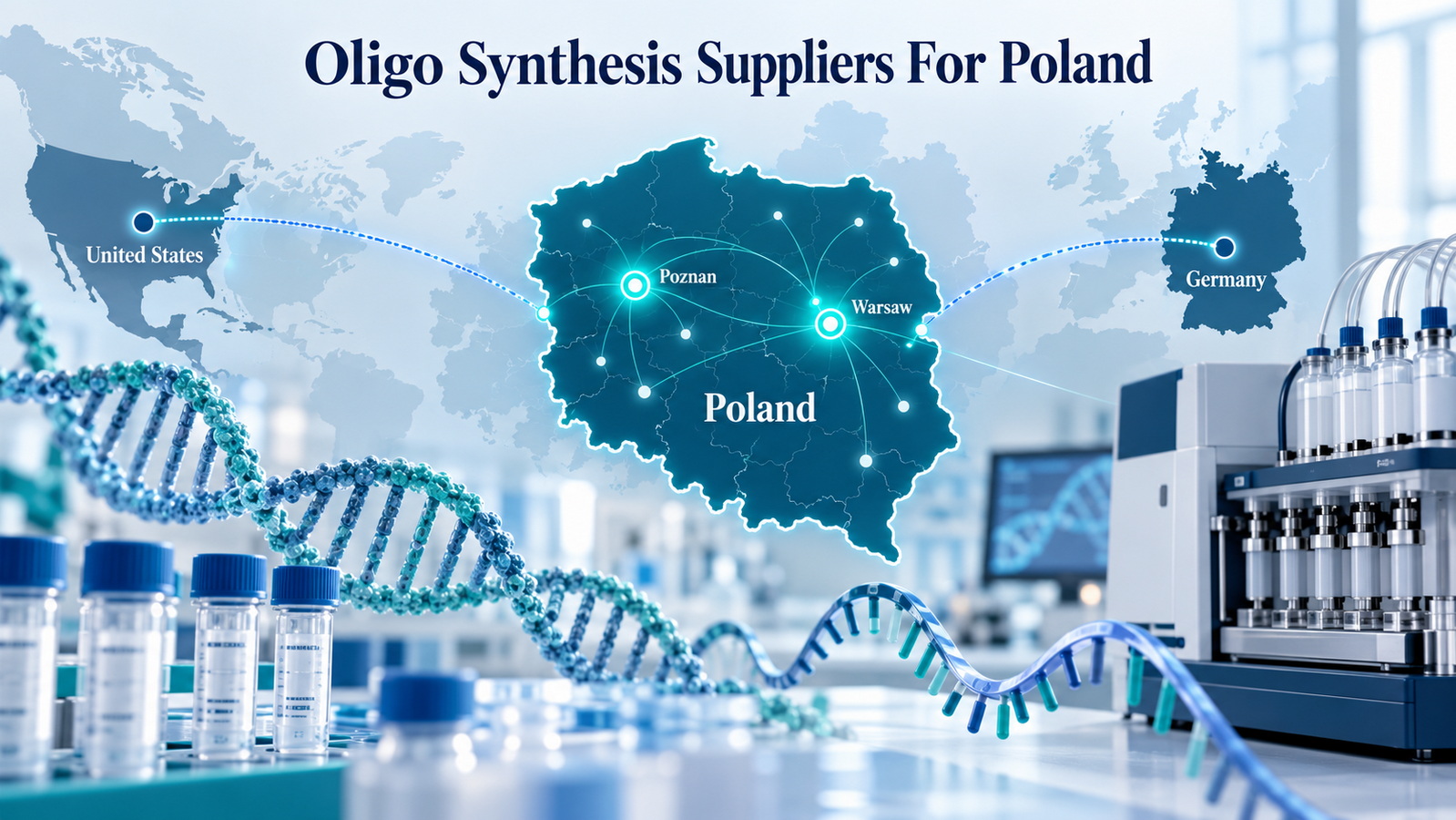
Poland has an established base of molecular biology services and specialist nucleic-acid synthesis expertise. Warsaw provides an example through Genomed and the Institute of Biochemistry and Biophysics of the Polish Academy of Sciences, whose sequencing and oligonucleotide facility supports institutions across Poland. Poznań contributes specialized synthesis capabilities through FutureSynthesis, located at the Poznań Science and Technology Park. These examples demonstrate a research-linked supplier ecosystem, rather than evidence of a dominant global manufacturing cluster.
Local suppliers can simplify communication, domestic purchasing, and routine replenishment. International suppliers broaden the comparison for modified sequences, larger programs, integrated research services, and specialized quality requirements.
No verified 2025–2026 Poland-specific market-size or oligonucleotide export report was established from the permitted literature. Consequently, this guide does not present an unsupported market value or growth forecast. Recent technical literature instead highlights a procurement-relevant trend: increasingly complex oligonucleotides require more sophisticated impurity separation and characterization.
Selection Criteria: What Buyers Should Verify
A credible supplier assessment should cover six areas:
1. Technical scope: DNA, RNA, sequence length, modifications, and purification options.
2. Quality control: identity testing, purity methods, quantification, and batch documentation.
3. Production suitability: delivered quantity, sequence complexity, repeat-order capacity, and scale-up feasibility.
4. Delivery consistency: realistic production windows, shipping arrangements, and remake procedures.
5. Quality-system scope: certificates covering the actual manufacturing entity, site, and relevant activities.
6. Customization: labeling, formulation, packaging, confidentiality, and change control.
For an Oligo Synthesis Service, OEM usually means manufacturing to buyer-defined specifications. ODM may involve design assistance or assay-development input. Neither term automatically implies validated assay performance, exclusive intellectual property, or private-label packaging.
Buyers should also separate three different numbers: synthesis scale, delivered yield, and order MOQ. They describe different purchasing commitments and should not be compared as though they were interchangeable.
Supplier Comparison: Scale, MOQ, and Certification
Published figures below describe product offerings, not independently audited annual throughput. Polish delivery eligibility, freight charges, and site-specific documentation should be confirmed before ordering.
| Supplier | Location and role | Published scale or production information | MOQ or ordering condition | Certification information |
|---|---|---|---|---|
| Gene Universal | U.S.-headquartered international research-service provider | Standard DNA offerings include 10–100 nmol final scales; larger options require quotation | Some plate products list 2 nmol final quantities; these are not confirmed order MOQs | Relevant site certificates should be requested |
| Genomed | Polish company; Warsaw | Custom DNA/RNA synthesis, modifications, and HPLC purification; total throughput undisclosed | Confirm per-sequence and order minimums | Oligo-site certification not established from reviewed service information |
| FutureSynthesis | Polish specialist; Poznań | Published RNA synthesis scales of 0.1–300 µmol; milligram-to-gram offerings | A separately described outsourced plate service requires at least 24 oligos | Request current certificates and manufacturing-site details |
| metabion | German manufacturer; international option | Published capabilities from nanomoles to millimoles and micrograms to grams | Product- and project-dependent | Publishes ISO 9001:2015 and ISO 13485:2016 quality-system claims |
| Eurofins Genomics | International genomics provider with European services | Standard and customized DNA/RNA, modifications, and large-scale services; total throughput undisclosed | Product-dependent | Obtain certificates for the contracted production site |
The comparison draws on published service descriptions. Current certificate validity, available capacity, and shipment terms require supplier confirmation.
1. Gene Universal: Flexible Research Procurement and Integrated Services
Company Profile and Market Focus
Gene Universal was established in Delaware, United States. Its company profile does not disclose a founding year. It reports operations spanning more than 100 countries and service to more than 10,000 customers worldwide. Its positioning emphasizes research efficiency, cost management, and tailored life-science services.
For Polish procurement teams, Gene Universal should be evaluated as an international provider—not a Polish factory.
Core Strengths and Customization
Its published custom DNA oligo synthesis offering includes HPLC purification, several final scales, dry or solution delivery, a Certificate of Analysis, and optional HPLC/MS reports. For listed 5–60 nucleotide DNA products, the stated delivery window is two to three business days; buyers should clarify whether this includes transportation to Poland.
This combination makes it a relevant candidate for smaller biotechnology businesses seeking a cost-conscious research partner. However, comparative savings should be established through matched quotations rather than assumed from marketing language.
Customization discussions can cover sequence requirements, modifications, purification, concentration, and delivery format. Gene Universal also publishes consultation support from sequence design through purification strategy, making technical communication a useful point to test during quotation. Private labeling, kit assembly, and standing-order arrangements require separate confirmation.
Gene Universal does not provide GMP manufacturing, CDMO services, or IND submission support. Its role here is fit-for-purpose research-grade materials and related discovery support.
2. Genomed: A Local Option for Routine Molecular Biology Orders
Company Profile and Market Focus
Founded in 2007, Genomed is based in Warsaw. Its founders previously operated a DNA sequencing and synthesis core facility between 2000 and 2007. Its service background makes it a relevant domestic option for Polish academic and biotechnology purchasing. A detailed oligonucleotide export-market breakdown was not established.
Core Strengths and Customization
Genomed publishes DNA and RNA oligonucleotide synthesis, fluorescent and other modifications, and HPLC purification. Listed processing times are two to three working days for standard oligos, up to five working days for HPLC-purified standard oligos, and up to ten working days for labeled products. RNA timing requires consultation.
Its strongest purchasing fit is straightforward local replenishment where sequence specifications and purification requirements are already defined.
OEM-style scope includes custom sequences and selected modifications. Buyers should not assume that this extends to formulation, private-label kits, or guaranteed large-volume supply. Request a framework quotation covering recurring orders, batch documents, and accepted remake conditions.
3. FutureSynthesis: Specialized DNA/RNA Chemistry in Poznań
Company Profile and Market Focus
FutureSynthesis specializes in custom chemical synthesis of biomolecules, primarily DNA and RNA. It operates in Poznań and is identified with the Poznań Science and Technology Park. A founding year and complete geographic market breakdown were not verified in the reviewed material.
Core Strengths and Customization
Its published portfolio includes mixed DNA/RNA sequences, fluorescent labeling, and modifications such as 2′-O-methyl, 2′-fluoro, 2′-MOE, LNA, and phosphorothioate linkages. Published offerings extend from laboratory quantities to grams, although achievable length depends on scale and chemistry.
This makes FutureSynthesis particularly relevant for buyers whose main challenge is chemical customization rather than routine primer ordering.
An important distinction is that its website also describes a high-throughput service performed by Biosearch Technologies. That offering lists a minimum of 24 oligonucleotides and 5 nmol delivered material. Buyers should establish whether their specific order uses in-house synthesis or an external partner; the distinction affects audit scope and documentation responsibility.
OEM-style work centers on buyer-defined molecular structures and analytical requirements. Sequence-specific feasibility should be confirmed before treating published upper scale limits as universally available.
4. metabion: An International Option for Structured Supply Programs
Company Profile and Market Focus
Founded at the end of 1997, metabion is headquartered in Munich/Planegg, Germany. Its published positioning includes custom oligonucleotides for research, diagnostics, and international supply programs. It is not a Polish manufacturer.
Core Strengths and Customization
metabion publishes small-, medium-, and large-scale DNA/RNA production capabilities. Its quality-management information identifies ISO 9001:2015 and ISO 13485:2016, while its OEM description includes synthesis, formulation, labeling, kit assembly, and logistics.
It is therefore a relevant comparison point for buyers needing more than individually packaged research oligos.
Procurement teams should still verify the current certificates, covered sites, and contractual acceptance criteria. An organizational quality-system certificate does not establish the purity or suitability of a particular sequence.
For Polish buyers, quotation review should include shipment eligibility, repeat-order reservations, packaging specifications, and procedures for approving changes to chemistry or analytical methods.
5. Eurofins Genomics: Broad Genomics Services and Customized Oligos
Company Profile and Market Focus
Eurofins Scientific was founded in 1987. That date describes the parent group, not necessarily the origin of the specific genomics manufacturing entity fulfilling an order. Eurofins Genomics offers services for academic, governmental, and industrial research users.
Core Strengths and Customization
Its European research portfolio includes application-oriented primers, customized DNA and RNA oligos, modifications, and special services such as design and large-scale synthesis. This breadth makes it relevant to laboratories purchasing several genomics services through one supplier.
Customization can support buyer-defined sequences and research programs. However, design assistance should not be equated with a validated finished assay.
For procurement in Poland, confirm the legal contracting entity, synthesis location, promised dispatch date, and available lot documentation. Group-wide capabilities should not substitute for evidence about the particular product and site.
Buyer's Guide: Quality, Samples, and Logistics
Specify Materials and Acceptance Criteria
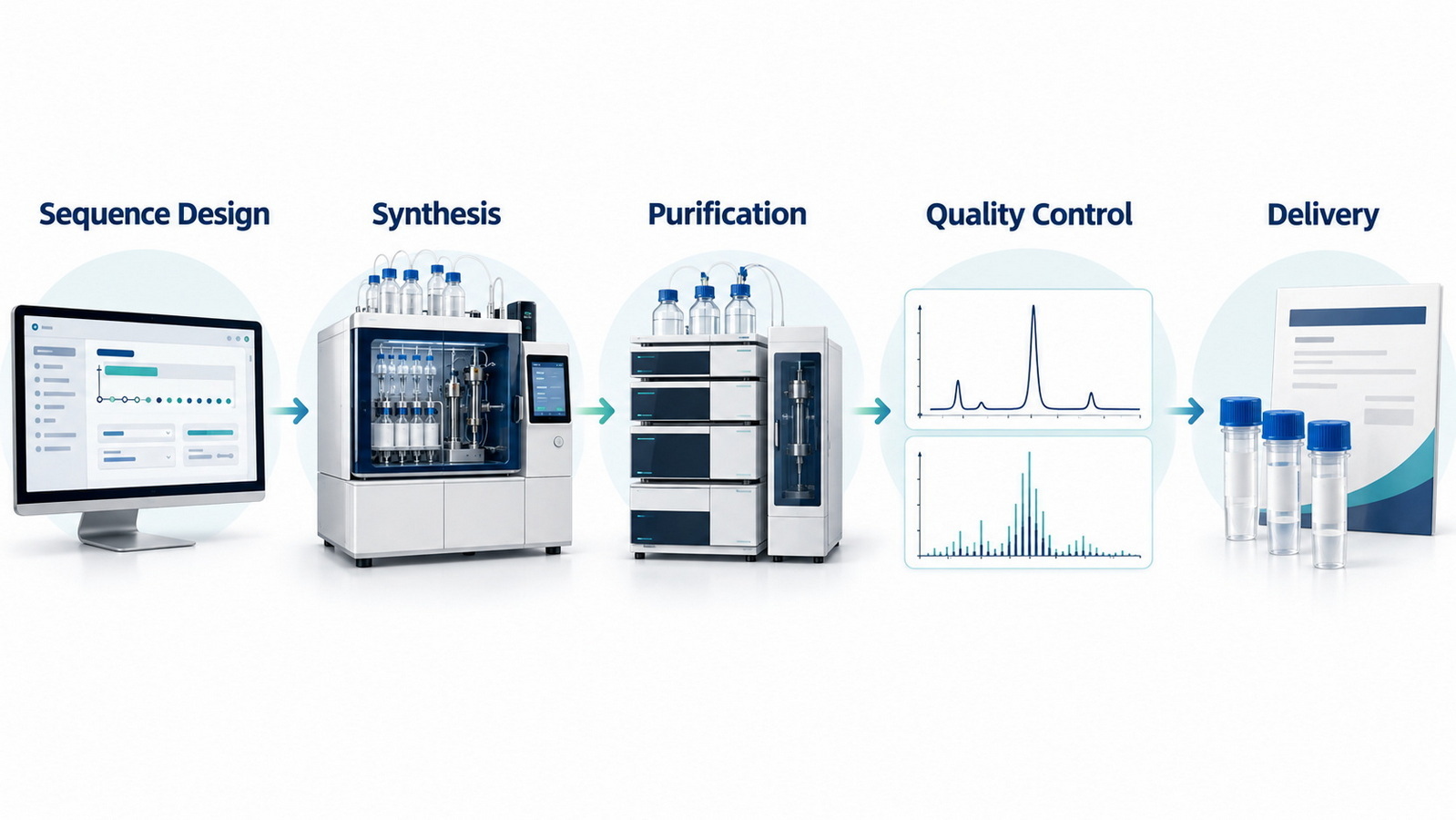
Most conventional synthetic oligonucleotides use solid-phase phosphoramidite chemistry. Incomplete reactions and side reactions can generate unwanted products, making purification and analytical characterization central to supplier comparison.
A purchase specification should define:
- Sequence, length, terminal groups, and modification positions.
- Purification method and agreed purity measurement.
- Minimum delivered quantity and quantification method.
- Identity-testing requirements.
- Delivery concentration, format, and buffer.
- Required batch documentation and rejection conditions.
Do not treat "HPLC purified" as a numerical purity guarantee. It describes a processing approach; the acceptance threshold and analytical method still need agreement.
Apply the Right Compliance Framework
CE and RoHS are not general environmental or quality certificates for research oligos. CE marking applies only where relevant European product legislation requires it. RoHS addresses hazardous substances in electrical and electronic equipment. A finished diagnostic product may introduce obligations that do not apply in the same way to a research-use oligonucleotide component.
Ask suppliers to identify the rules applicable to the actual supplied product, rather than collecting unrelated logos.
Run a Representative Pilot Order
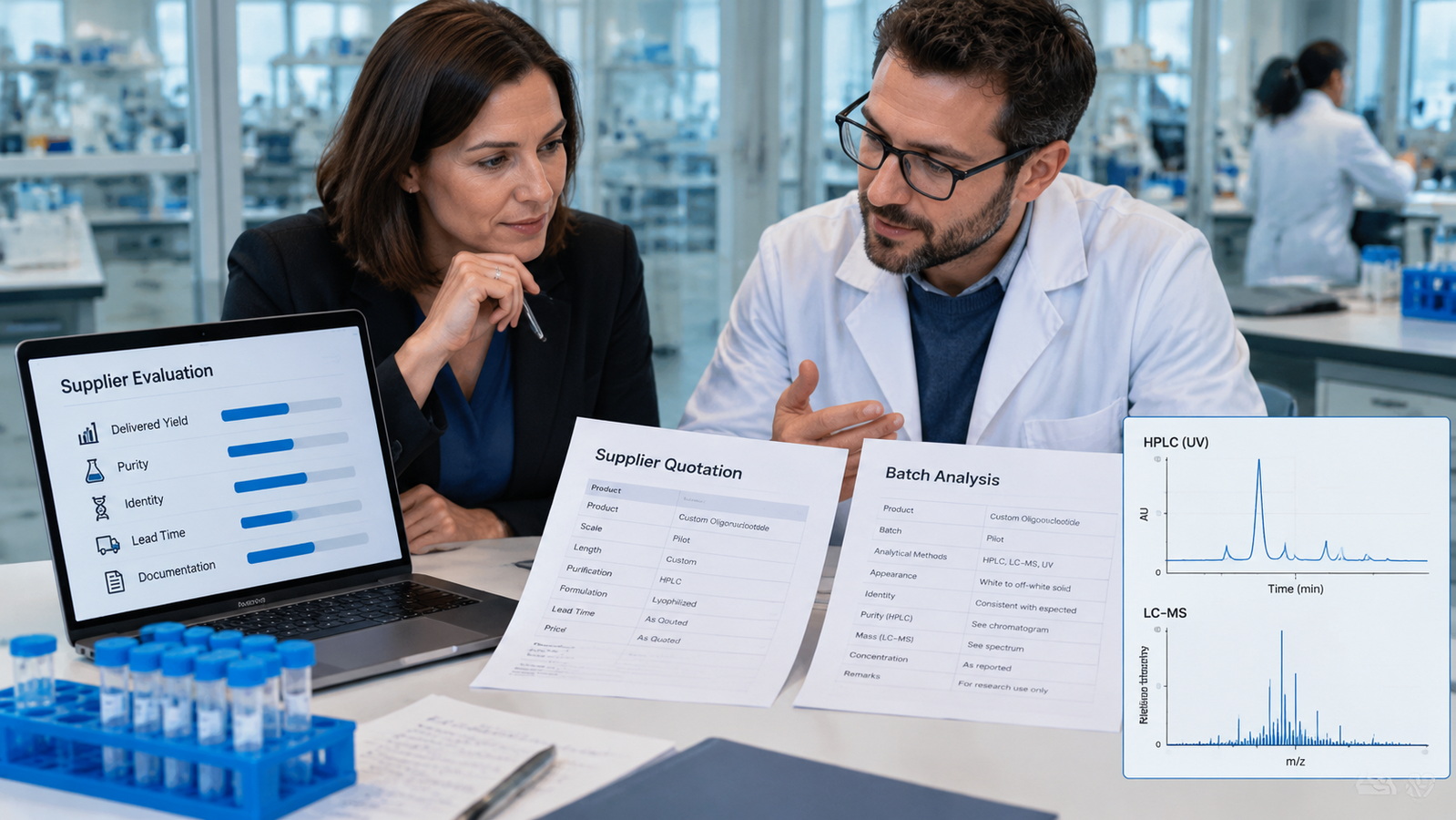
A useful pilot includes routine sequences and at least one challenging item from the intended purchasing program. Review analytical documents, delivered quantity, dissolution behavior, application performance, and communication quality.
Define remake criteria before testing. Otherwise, a disagreement about assay performance may become a disagreement about whether the material met the original specification.
Clarify Shipping Responsibilities
Request product-specific storage and transportation instructions. Do not assume every oligo needs the same temperature conditions.
The quotation should distinguish production time from dispatch and transit. For imports, confirm invoice wording, customs responsibilities, Incoterms, and who handles replacement if a package is delayed or damaged.
Insider Pitfall: Correct Mass Does Not Resolve Every Impurity
One easily overlooked problem is excessive confidence in a mass-spectrum result.
A 2025 study demonstrated that certain n−1 positional impurities could not be distinguished by high-resolution mass spectrometry alone because they were isobaric—different structures with the same mass. Orthogonal methods were needed to resolve them.
The purchasing lesson is not to demand advanced analysis for every routine primer. It is to match testing to risk.
For modified or demanding sequences, ask which impurities the method can resolve, whether the reported purity peak may include co-eluting species, and whether the chromatographic profile is available. A correct principal mass is useful evidence, but not a complete impurity assessment.
Conclusion
Polish buyers can compare local specialists with international providers without confusing delivery availability with domestic manufacturing.
Genomed offers a local routine-service option; FutureSynthesis emphasizes custom chemistry; metabion supports structured OEM programs; and Eurofins Genomics offers a broad research portfolio. Gene Universal provides an international, research-focused alternative with customizable DNA oligos and integrated life-science services.
For a Gene Universal quotation, submit your sequences, modifications, minimum delivered quantities, analytical expectations, and required arrival date. Ask for a clearly scoped research-use proposal and evaluate a representative pilot before committing to recurring supply.
Frequently Asked Questions
1. How Can We Verify Whether an ISO Certificate Is Expired or Irrelevant?
Request the complete certificate, including certificate number, issuing body, legal entity, site address, scope, and validity dates. Confirm status with the issuing certification body and check whether the scope covers the activities relevant to your order.
A certificate for an unrelated group company or laboratory activity should not be accepted as evidence for the synthesis site.
2. Why Can Two Equally Scaled Orders Deliver Different Quantities?
Synthesis scale describes the starting process commitment, not necessarily the final recoverable material. Sequence length, modifications, synthesis efficiency, and purification can affect the finished product.
Require minimum delivered quantity separately from synthesis scale, and compare quotations using that commitment.
3. Can a Correct Mass Spectrum Replace Chromatographic Purity Testing?
No. Identity and impurity separation answer different questions. Some positional impurities share the same mass, while chromatographic methods also have limitations. Complex sequences may require complementary methods rather than one universal test.
4. When Should We Request More Than Standard Purification?
Base the decision on the application, sequence complexity, and consequences of impurities. Discuss demanding modified sequences and long oligos with the supplier before ordering. Recent analytical reviews emphasize that oligonucleotide characterization often requires molecule-specific methods.
5. How Should We Qualify a Backup Supplier?
Transfer the complete specification—not just the sequence. Include modification notation, purification requirements, quantity, formulation, analytical methods, and acceptance limits.
Compare representative lots and application performance before approving routine substitution. Agree in advance which changes require written authorization.
References
The following technical references are indexed in PubMed. Supplier-specific facts above were checked against the corresponding published service and company information; those pages are not included as scientific references.
1. [Recent advances in analytical separation techniques for therapeutic oligonucleotides]. *Bioanalysis*, 2025;17(18):1165–1180. DOI: 10.1080/17576180.2025.2565141. Discusses chromatography, electrophoresis, and analytical challenges. [pubmed.ncbi.nlm.nih]
2. [Differentiation of n−1 Positional Isomers in Antisense Oligonucleotides with Orthogonal LCMS Methods]. *Journal of the American Society for Mass Spectrometry*, 2025;36(8):1803–1811. DOI: 10.1021/jasms.5c00157. Supports the discussion of isobaric positional impurities. [pubmed.ncbi.nlm.nih]
3. [A versatile two-dimensional liquid chromatography coupled to high-resolution mass spectrometry platform for unraveling chromatographic profiles of large synthetic oligonucleotides]. *Analytica Chimica Acta*, 2025;1364:344218. DOI: 10.1016/j.aca.2025.344218. Explains characterization challenges and lot-comparison applications. [pubmed.ncbi.nlm.nih]