 +1 302-235-9792
 SIGN IN
 CONTACT US


- News
- Top Oligo Synthesis Service Companies in Sweden
share


Top Oligo Synthesis Service Companies in Sweden
Content Menu
● Why Sweden Matters for Oligo Sourcing
● How We Selected Suppliers
● Top Companies at a Glance
● 1. Gene Universal
● 2. QIAGEN DNA Synthesis AB
● 3. BioNordika
● 4. OligoNova Hub at SciLifeLab
● 5. Eurofins Genomics
● 6. Thermo Fisher Scientific
● Technical Considerations That Affect Oligo Quality
>> Material Grade and Building Blocks
>> Purification Is Not a Cosmetic Upgrade
>> Analytical Documentation
● Buyer's Guide: Avoiding Common Procurement Failures
>> 1. Do Not Treat All "ISO" Claims as Equivalent
>> 2. Confirm the Actual Manufacturer
>> 3. Use a Controlled Sample Order
>> 4. Plan Shipping and Storage Early
>> 5. The Less-Discussed Internal Trap: "Same Sequence" Does Not Mean Same Product
● Conclusion
● Frequently Asked Questions
>> 1. How can I verify whether a supplier's ISO certificate has expired?
>> 2. What purification should I choose for a qPCR probe?
>> 3. Can a supplier provide both DNA and RNA oligos with the same QC approach?
>> 4. How do I compare quotations from different Oligo Synthesis Service companies fairly?
>> 5. What should I include in a supplier qualification sample order?
>> 6. Can I use one supplier for exploratory oligos and another for recurring assay supply?
● References
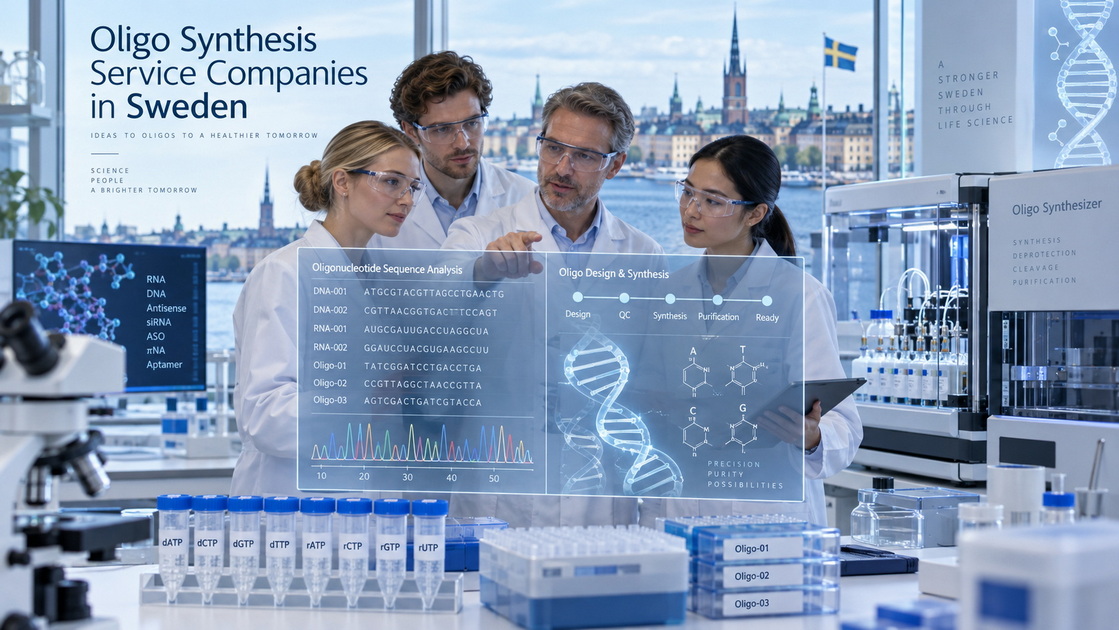
Sweden is a strong Northern European life-science market for research-focused oligonucleotide sourcing, particularly for PCR/qPCR, molecular diagnostics, NGS workflows, assay development, RNA research, and specialized conjugate work. Its supplier landscape is not defined by a large number of domestic high-volume oligo factories; instead, it combines a highly capable Swedish manufacturing site, experienced local distribution and technical-support partners, and research infrastructures connected to major biotech clusters.
For procurement teams, the practical question is not simply "Which company can synthesize an oligo?" Most qualified providers can make a standard DNA primer. The real distinction lies in sequence-review capability, modification availability, purification consistency, lot documentation, communication speed, repeat-order reproducibility, and the supplier's ability to support custom formats without forcing every project into a rigid catalog workflow.
Gene Universal is included first as a global research-service option for Swedish buyers seeking flexible, cost-conscious sourcing and integrated support spanning DNA/RNA, proteins, and antibodies. It is not positioned as a provider of GMP, CDMO, or IND-submission support. Instead, it is suited to research-use projects requiring responsive communication, customized configurations, and fit-for-purpose research-grade materials.
Why Sweden Matters for Oligo Sourcing
Sweden's strength comes from its concentration of life-science research, diagnostics expertise, academic infrastructure, and cross-border collaboration with Denmark and the broader Nordic region. Important ecosystems include Stockholm–Uppsala Life Science, Gothenburg's biotechnology community, Umeå's biotechnology environment, and the Medicon Valley region spanning southern Sweden and Denmark.
The country also benefits from a mature culture of quality systems, laboratory automation, diagnostic development, and research collaboration. For buyers, this creates a sourcing environment where technical consultation, traceability expectations, and application-specific documentation are often given more attention than in purely transactional primer-ordering channels.
Recent market estimates also illustrate why supplier qualification is becoming more important. One 2025 estimate valued the global oligonucleotide synthesis market at approximately USD 3.6 billion, with projected growth to USD 10.9 billion by 2033. Demand is being supported by molecular testing, genomics, synthetic biology, sequencing, gene editing, and RNA-focused discovery programs.
However, Sweden-based procurement should distinguish between:
- Swedish-headquartered or Swedish-manufacturing suppliers.
- Sweden-facing distributors offering local technical support.
- Global service providers that ship to Swedish laboratories.
- Academic or shared research infrastructures designed for specialized projects rather than routine commercial purchasing.
- Suppliers capable of research-use materials versus providers claiming broader quality-system capabilities.
How We Selected Suppliers
This list is designed for professional buyers looking for a reliable Oligo Synthesis Service partner rather than a one-time low-price purchase. Companies were assessed using a transparent set of commercial and technical criteria.
| Selection Area | What Buyers Should Examine | Why It Matters |
|---|---|---|
| Manufacturing and quality systems | ISO status, site-specific certificates, batch documentation, change-control practices | Prevents sourcing decisions based on expired, generic, or unrelated certifications |
| Oligo chemistry range | DNA, RNA, LNA, 2′-O-methyl, 2′-MOE, PNA, dyes, quenchers, linkers, conjugates | Determines whether the supplier can support future assay and research expansion |
| Purification and analytical options | Desalting, cartridge purification, PAGE, HPLC, LC-MS, UV analysis, identity and purity reporting | The same sequence can behave very differently depending on purification and analytical release criteria |
| Scale and repeatability | Available synthesis scales, batch-to-batch consistency, re-order controls, capacity planning | Critical for validation work and long-term assay supply |
| Custom support | Design review, feasibility assessment, pooling, aliquoting, normalization, plate formats | Reduces internal handling time and lowers transcription or formatting risk |
| Commercial fit | MOQ, quotation speed, delivery terms, international shipping, account support | Often decides whether a technically qualified supplier is operationally usable |
| Research capability | Difficult sequences, high-GC designs, long oligos, modified nucleotides, conjugation | Important for projects that move beyond routine primers |
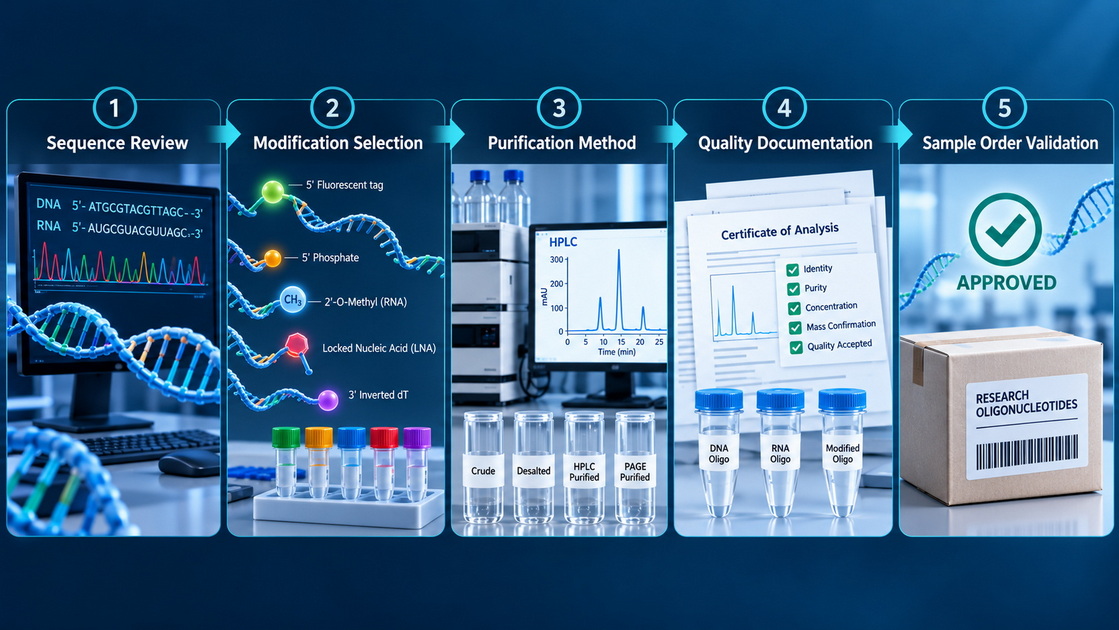
A strong provider should be willing to answer specific questions about the actual site producing the oligo, the purification method used for each SKU, expected QC outputs, storage and shipment conditions, and how it manages sequence confidentiality.
Top Companies at a Glance
| Company | Sweden Connection | Primary Strength | Indicative MOQ | Scale / Capacity Position | Quality / Documentation Focus |
|---|---|---|---|---|---|
| Gene Universal | Global supplier serving Sweden | Flexible custom research support and integrated life-science services | Project-dependent | Flexible research-scale ordering | Fit-for-purpose research documentation |
| QIAGEN DNA Synthesis AB | Manufacturing site in Västerås | Custom DNA oligos, primers, probes, OEM supply | Quote-dependent | Established production site; approximately 85 FTE reported for Västerås | ISO 9001, ISO 13485 and site-specific quality systems |
| BioNordika | Swedish local supplier and technical partner | Custom DNA/RNA and modified oligos for Nordic researchers | Quote-dependent | µg to larger-scale ordering | Application-oriented specification and ordering support |
| OligoNova Hub | Gothenburg national research infrastructure | Complex chemistry, conjugates, libraries, design and analysis | Project-dependent | Specialized project capacity | Scientific collaboration and advanced analytical workflows |
| Eurofins Genomics | Global supplier serving Swedish users | Broad routine-to-specialty DNA/RNA oligo portfolio | Product-dependent | High-throughput international supply | Supply, process, product, and performance controls |
| Thermo Fisher Scientific | Global supplier serving Swedish laboratories | Broad assay, primer, probe, and custom oligo ecosystem | Product-dependent | Large global production network | ISO 9001 and ISO 13485 quality-system frameworks |
1. Gene Universal
Founded / base: Established in Delaware, United States
Primary markets: Global; serving customers in more than 100 countries
Core focus: Research-oriented DNA/RNA services, proteins, antibodies, and integrated life-science support
Best fit: Small and mid-sized biotech companies, academic laboratories, assay developers, and research teams requiring flexible project communication
Gene Universal is a practical option for Swedish organizations that prefer a global research-service partner with broad molecular biology coverage rather than a narrowly defined oligo-only vendor. The company reports serving more than 10,000 customers globally and supports customers in more than 100 countries. Its positioning centers on efficient, cost-conscious, customized life-science services and collaboration with research teams on project-specific requirements.
For oligo projects, Gene Universal is particularly relevant when procurement teams need more than a standard catalog primer order. Examples include custom DNA or RNA sequences, modified oligos, sequence-dependent troubleshooting, multi-format order management, and projects that may later require related gene, protein, or antibody research services. This can reduce the administrative burden of managing multiple vendors for separate discovery-stage workflows.
Its main commercial advantages are flexibility, communication efficiency, and willingness to support customized research workflows. Rather than assuming every customer needs a large, standardized manufacturing program, Gene Universal can be a useful fit for smaller research brands, early discovery groups, and laboratories that need responsive technical discussions before placing repeat orders.
Buyers should request a written scope covering sequence format, oligo chemistry, purification, QC method, reporting package, target amount, aliquoting requirements, shipment format, and repeat-order controls. Gene Universal should be evaluated as a research-use service provider; it does not offer GMP, CDMO, or IND-submission support.
2. QIAGEN DNA Synthesis AB
Founded / origin: Previously Scandinavian Gene Synthesis AB; now operating as QIAGEN DNA Synthesis AB
Location: Västerås, Sweden
Primary markets: Global OEM, molecular testing, diagnostics, research, and life-science customers
Core focus: Custom DNA oligos, primers, probes, and OEM-oriented production
Best fit: Buyers seeking a Sweden-based manufacturing connection with formalized quality-system expectations
QIAGEN DNA Synthesis AB is the most direct Swedish manufacturing-site option in this comparison. The Västerås operation produces oligonucleotide products under the OEM by QIAGEN umbrella, following the rebranding of Scandinavian Gene Synthesis AB.
QIAGEN states that custom DNA oligos can be manufactured under ISO 9001, ISO 13485 quality-management systems, or according to GMP principles, depending on the service configuration. Its custom oligo information also indicates DNA oligonucleotide lengths below 170 bases for the cited offering. A QIAGEN quality document identifies the Västerås site as an oligonucleotide-synthesis facility of approximately 3,160 m² with roughly 85 full-time employees.
For procurement teams, QIAGEN's value is not merely the brand name. It is the combination of manufacturing discipline, OEM orientation, traceability expectations, and an established production environment. This makes the site especially relevant for diagnostic assay developers, private-label reagent companies, and buyers whose internal quality teams need clear answers about quality-system scope.
The trade-off is that highly structured suppliers may have more formal onboarding, quotation, documentation, and change-control processes than small research-service providers. That can be an advantage for repeatability but may be less convenient for very small, exploratory orders with frequently changing specifications.
3. BioNordika
Founded: Established Scandinavian supplier; specific corporate founding year should be confirmed directly for formal supplier records
Location: Sweden
Primary markets: Sweden, Nordic research, diagnostics, and life-science laboratories
Core focus: Custom reagents, assay support, custom oligos, proteins, antibodies, enzymes, and laboratory services
Best fit: Swedish and Nordic buyers who value local communication and application-oriented support
BioNordika is a useful local sourcing route for laboratories that want Swedish-language or Nordic-region communication while accessing broad custom oligo capabilities. Its published custom-synthesis offering includes routine research primers as well as complex sequences from 2 to 225 bases, with DNA, RNA, LNA, 2′-O-methyl, 2′-O-MOE, and PNA among the listed chemistries. It also states that oligos can be supplied in microgram or larger scales.
The company's value is particularly clear for teams that need assistance organizing batch orders, ordering mixed panels, choosing practical delivery formats, or integrating oligos into qPCR and other assay workflows. BioNordika also describes a dispensing service for ready-to-use primer, probe, or master-mix formats, where concentration, sequence, delivery format, and enzyme inclusion can be customized to the customer's design.
This makes BioNordika suitable for applied research teams, diagnostic-development groups, and procurement managers who want help translating an assay plan into a correctly specified order. Buyers should clarify the identity of the actual synthesis partner for a given project, as well as the available analytical records, lead times, and the source of raw materials for highly modified sequences.
4. OligoNova Hub at SciLifeLab
Established: National research infrastructure; project availability should be confirmed directly
Location: Mölndal, Gothenburg, Sweden
Primary markets: Swedish academic research and eligible external collaborative users
Core focus: Oligonucleotide design, synthesis, purification, analysis, libraries, and post-synthetic conjugation
Best fit: Complex, technically demanding research projects requiring specialist scientific interaction
OligoNova Hub is not a conventional commercial catalog supplier. It is a specialized national research infrastructure focused on oligonucleotide chemistry, making it particularly relevant for advanced research collaborations, early discovery projects, and custom chemistry that may exceed the scope of routine primer vendors.
Its published service scope includes bioinformatic and chemical design, synthesis, purification, and analysis of oligonucleotides and conjugates. It also lists solid-phase synthesis and analysis of oligonucleotide libraries, organic synthesis of ligands and building blocks, and post-synthetic conjugation to small molecules, peptides, polymers, and nanoparticles.
For a procurement professional, OligoNova is most valuable when a project involves difficult chemical design questions: conjugate architecture, experimental nucleic-acid libraries, antisense candidate design, unusual linkers, or a need to connect oligo chemistry with downstream scientific validation. It is less appropriate when the buyer needs a routine, high-volume, low-administration primer supply arrangement.
The key purchasing question is not price per base. It is whether the project merits a collaborative development workflow with a specialist chemistry team. Buyers should inquire early about external-access terms, project intake, intellectual-property expectations, analytical deliverables, and scheduling.
5. Eurofins Genomics
Founded: Eurofins Scientific was founded in 1987; service and regional availability should be confirmed for the Swedish account route
Primary markets: Global genomics, pharma, diagnostics, food, agriculture, biotechnology, and research
Core focus: DNA/RNA oligos, gene synthesis, sequencing, genotyping, and bioinformatics
Best fit: Buyers seeking broad menus, structured online ordering, and an established international supply chain
Eurofins Genomics is a recognized international option for Swedish laboratories seeking routine and specialty DNA/RNA oligonucleotide services. The company states that it has more than 20 years of experience in oligo synthesis and bases its quality assurance on supply, process, product, and performance control.
Its appeal lies in breadth and operational scalability. Buyers can typically use a single supplier relationship across primers, probes, sequencing-related products, gene synthesis, and broader genomics services. Eurofins also describes gene-synthesis support through Blue Heron Bio, which is part of Eurofins Genomics.
This supplier is a strong fit for laboratories that have recurring standardized orders, multi-user ordering needs, and predictable panel designs. It can also be useful for organizations seeking to consolidate vendor management across multiple molecular-biology categories.
Before approving a supplier, buyers should verify which regional entity will receive the purchase order, where the oligos will be manufactured, expected shipping conditions to Sweden, and whether technical support is provided directly or through a distributor. For complex RNA or conjugated oligos, it is important to request feasibility confirmation before submitting large batch orders.
6. Thermo Fisher Scientific
Founded: Thermo Fisher Scientific was formed in 2006 through the merger of Thermo Electron and Fisher Scientific
Primary markets: Global research, diagnostics, biopharma, biotechnology, and laboratory markets
Core focus: Custom DNA oligos, probes, primers, assay solutions, reagents, instruments, and laboratory supply
Best fit: Large laboratories seeking vendor consolidation and extensive product integration
Thermo Fisher Scientific is a global option with an extensive life-science portfolio, making it relevant for Swedish laboratories already using Applied Biosystems, Invitrogen, or related product lines. Its published oligo information describes quality systems operating under ISO 9001 and ISO 13485 certifications and notes documentation practices such as certificates of analysis and traceability support.
The commercial advantage is ecosystem integration. A laboratory may source primers, probes, master mixes, instruments, plates, plastics, extraction products, and other workflow components from the same supplier family. This can simplify procurement, validation planning, and logistics.
For highly customized Oligo Synthesis Service projects, buyers should distinguish between catalog-like offerings and programs that genuinely support unusual chemistries, nonstandard purification, specific analytical expectations, or custom packaging. Large suppliers can be highly reliable for standardized applications, but they may not always be the fastest route for small, frequently changing, specialist research projects.
Technical Considerations That Affect Oligo Quality
Oligonucleotide synthesis is commonly performed using solid-phase phosphoramidite chemistry. In this workflow, nucleotide building blocks are added sequentially to a growing chain attached to a solid support. Each cycle includes deprotection, coupling, capping, oxidation or sulfurization, and washing. Small inefficiencies at each cycle become important as sequence length increases.
This is why a buyer should not compare suppliers only by price per nanomole.
Material Grade and Building Blocks
Ask what type of raw material and phosphoramidite supply controls are used, particularly when ordering:
- RNA oligos, which require careful protection and deprotection chemistry.
- LNA, 2′-O-methyl, 2′-O-MOE, PNA, or other modified nucleotides.
- Fluorophore- and quencher-labeled probes.
- Thiol, amine, azide, alkyne, biotin, cholesterol, peptide, or small-molecule conjugates.
- Long oligos, high-GC sequences, repetitive sequences, or self-complementary designs.
A low quote may reflect a lower synthesis scale, basic desalting instead of HPLC or PAGE purification, less comprehensive identity testing, or a different calculation method for final yield.
Purification Is Not a Cosmetic Upgrade
Desalting can be suitable for many standard primers. However, high-sensitivity qPCR probes, certain NGS adapters, long oligos, labeled probes, and complex modified sequences may require cartridge, PAGE, HPLC, or other purification approaches.
The correct question is not, "Which purification is best?" It is, "Which impurity profile is acceptable for this assay or experiment?"
For example, a 20-base standard PCR primer may perform well after desalting, while a 70-base modified oligo used in a quantitative assay may require higher purification and a more detailed QC package. The buyer should define the intended application before selecting purification.
Analytical Documentation
A useful documentation package may include:
- Sequence and modification confirmation.
- Lot number and manufacturing date.
- Measured amount or optical density.
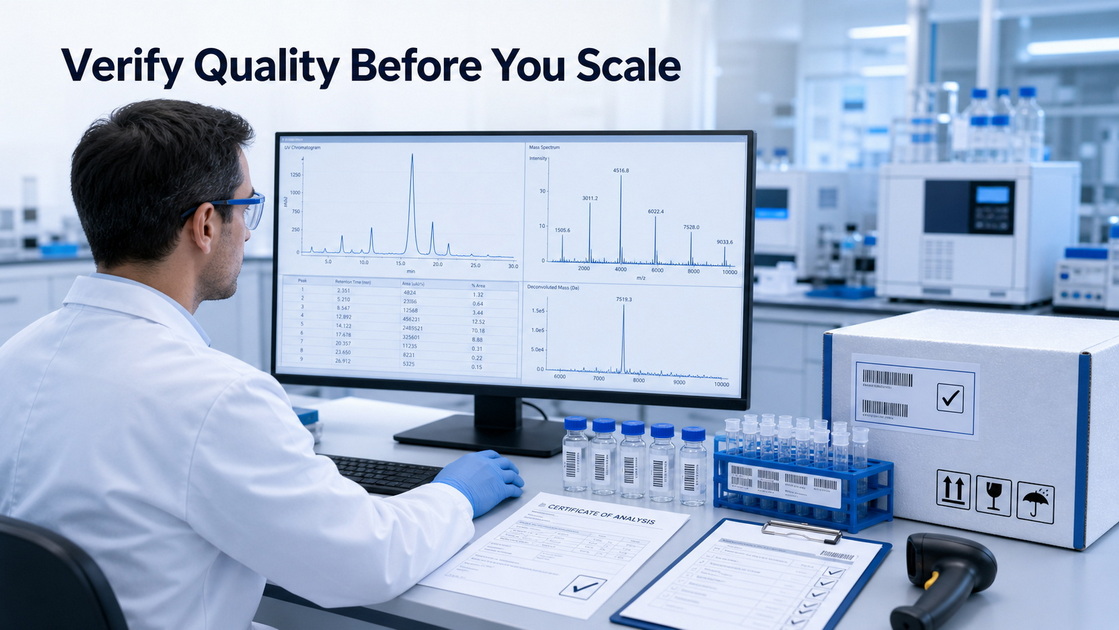
- Purity method and chromatogram, where applicable.
- Mass analysis for relevant products.
- Storage condition and resuspension guidance.
- Certificate of analysis or equivalent release documentation.
- Change notification policy for repeat orders.
Do not assume that an "HPLC-purified" label means every product receives the same analytical release standard. Ask whether HPLC is used for purification, QC, or both—and what acceptance criteria apply.
Buyer's Guide: Avoiding Common Procurement Failures
1. Do Not Treat All "ISO" Claims as Equivalent
A common procurement mistake is accepting a logo on a supplier website as proof of current certification. Request the certificate itself and check:
- Legal entity name.
- Manufacturing-site address.
- Certificate number.
- Issuing certification body.
- Scope of certification.
- Issue date and expiration date.
- Whether the scope covers oligonucleotide manufacturing rather than unrelated activities.
For example, a supplier may hold ISO 9001 certification for distribution while its actual oligo manufacturing site is elsewhere. QIAGEN's published materials identify quality-system options and a specific Västerås oligonucleotide-synthesis site, but buyers should still request documents matching their exact order and service route.
2. Confirm the Actual Manufacturer
A Swedish company may be a distributor, project manager, or local technical-support partner rather than the manufacturing site. This is not necessarily negative. A qualified local partner can add significant value through language support, order coordination, and problem resolution.
However, the buyer should know:
- Who synthesizes the oligo.
- Which country and site performs manufacturing.
- Where purification and QC occur.
- Who ships the final product.
- Which company is responsible if the product fails specification.
3. Use a Controlled Sample Order
Before moving a high-value program, place a controlled sample order containing:
- One routine DNA primer.
- One modified oligo or labeled probe.
- One longer or more difficult sequence.
- Duplicate sequences ordered under different purification requirements, if technically justified.
- A repeat order of at least one sequence after several weeks.
Evaluate delivery accuracy, packaging, labeling, documentation, solubility, concentration consistency, and performance in your intended assay. The goal is to qualify the complete service process—not merely to confirm that one oligo can be synthesized.
4. Plan Shipping and Storage Early
Most dry oligos are stable for practical shipping periods, but modified RNA, dyes, conjugates, and certain specialized reagents may have different storage and handling requirements. Confirm whether the oligo will arrive dry, in solution, in tubes, strips, plates, or normalized formats.
For international deliveries into Sweden, obtain clarity on:
- Incoterms.
- Customs and VAT handling.
- Importer-of-record responsibilities.
- Temperature requirements.
- Weekend-delivery risk.
- Documentation included in the shipment.
- Replacement policy for courier damage or temperature excursions.
5. The Less-Discussed Internal Trap: "Same Sequence" Does Not Mean Same Product
One frequently overlooked issue is that a sequence record alone does not fully define the purchased product. A repeat order can differ if the supplier changes synthesis scale, purification, salt form, final formulation, normalization method, analytical threshold, modification source, or manufacturing site.
To avoid silent variation, create an internal Oligo Master Specification for every critical sequence. It should include sequence orientation, modification notation, target amount, purification, QC requirement, salt form, final format, packaging, storage condition, and supplier part number. Require written notification before any of these elements change.
This simple control is especially valuable when multiple researchers place orders, when an assay is transferred between sites, or when a project moves from exploratory work to repeated validation studies.
Conclusion
Sweden offers a well-developed environment for sourcing research-focused oligonucleotide services, supported by local expertise, a Swedish QIAGEN manufacturing site, Nordic technical-support partners, advanced scientific infrastructure, and global suppliers serving the region.
For structured OEM-oriented DNA oligo requirements and a Swedish manufacturing connection, QIAGEN DNA Synthesis AB is a significant candidate. For local research support and customized ordering, BioNordika provides useful Nordic-facing capabilities. For complex chemistry, libraries, and conjugation-focused research, OligoNova Hub offers specialist scientific depth. Eurofins Genomics and Thermo Fisher provide broad international service ecosystems for organizations seeking scale and portfolio consolidation.
Gene Universal is a suitable partner for research teams that need flexible, cost-conscious Oligo Synthesis Service support, responsive cross-border communication, customized DNA/RNA configurations, and access to related protein and antibody services. Its value is strongest for research-use projects, early discovery workflows, and small-to-mid-sized organizations that need a supplier willing to adapt around their project requirements.
Before selecting a long-term partner, ask each provider for a written technical specification, quality-documentation example, sample-order plan, confirmed manufacturing location, and repeat-order change-control policy. The right supplier is the one that can consistently reproduce the material specification your research actually needs—not simply the one offering the lowest initial price.
Frequently Asked Questions
1. How can I verify whether a supplier's ISO certificate has expired?
Request the current certificate PDF and compare the legal entity, site address, certificate number, scope, issuing body, and expiration date. Then verify the certificate through the issuing certification body's public directory when available. Do not accept a generic ISO statement if the document does not name the site that manufactures the oligos.
2. What purification should I choose for a qPCR probe?
The answer depends on probe length, labeling chemistry, assay sensitivity, multiplexing complexity, and background-tolerance requirements. HPLC or another higher-purity approach is often considered for labeled probes, but the correct requirement should be determined through assay validation and supplier consultation. Ask for the supplier's recommended purification method and the reason for that recommendation.
3. Can a supplier provide both DNA and RNA oligos with the same QC approach?
Not automatically. RNA chemistry, protecting groups, hydrolysis risk, modification compatibility, and analytical expectations differ from standard DNA oligos. Request separate specifications for DNA and RNA products rather than assuming the same purification and release process applies to both.
4. How do I compare quotations from different Oligo Synthesis Service companies fairly?
Normalize the quote by comparing sequence length, scale, modification type, purification, QC documentation, packaging, delivery format, shipping, lead time, and currency. A lower base price may exclude purification, detailed QC, or aliquoting. Build a side-by-side specification sheet before comparing final landed cost.
5. What should I include in a supplier qualification sample order?
Use representative sequences, not only easy primers. Include standard DNA, a chemically modified oligo, a labeled probe or challenging sequence where relevant, and a repeat order. Evaluate documentation, labeling accuracy, yield, purity evidence, delivery reliability, and actual performance in the intended workflow.
6. Can I use one supplier for exploratory oligos and another for recurring assay supply?
Yes, but manage transfer risk carefully. Establish a master specification, compare material performance side by side, record supplier-specific formulation details, and validate the new source before switching. Do not assume equivalent performance solely because the nucleotide sequence is identical.
References
1. [Gene Universal — Company Profile]
2. [QIAGEN — Custom Oligos and OEM Manufacturing]
3. [QIAGEN — QIAGEN DNA Synthesis AB / Västerås Information]
4. [QIAGEN — Quality FAQs and Manufacturing Site Information]
5. [BioNordika — Custom Products and Services]
6. [SciLifeLab — OligoNova Hub: Oligonucleotide Chemistry]
7. [Eurofins Genomics — DNA and RNA Oligonucleotides]
8. [Thermo Fisher Scientific — Large-Scale Oligo Synthesis and Manufacturing Services]
9. [FDA — Q7 Good Manufacturing Practice Guidance for Active Pharmaceutical Ingredients]
10. [ICH — Q7 Good Manufacturing Practice Guide for Active Pharmaceutical Ingredients]
11. [EMA — Guideline on the Chemistry, Pharmaceutical and Biological Information for Oligonucleotides]
12. [Grand View Research — Oligonucleotide Synthesis Market Size and Share Report]