 +1 302-235-9792
 SIGN IN
 CONTACT US


- News
- What Are Monomeric Antibodies? Structure, Aggregation, and Research Stage Development
share


What Are Monomeric Antibodies? Structure, Aggregation, and Research Stage Development
Content Menu
● What Does Monomeric Antibody Mean?
● Monomeric vs. Oligomeric Antibodies
● Why Monomer Content Matters
● How Antibody Aggregates Form
● How to Measure Monomer and Aggregates
>> A Practical Orthogonal Testing Panel
● A Decision Framework for Early Screening
● Troubleshooting Low Monomer Recovery
● Custom Antibody Development at Gene Universal
● Start With a Fit-for-Purpose Plan
● Frequently Asked Questions
>> 1. Are All Monoclonal Antibodies Monomeric?
>> 2. Is IgG Always a Monomer?
>> 3. What Is a Good Monomer Percentage?
>> 4. Can SEC Alone Confirm an Antibody Is Monomeric?
>> 5. Can Antibody Engineering Reduce Aggregation?
>> 6. Does a Higher Monomer Percentage Guarantee Better Binding?
>> 7. When Should Monomer Screening Begin?
● References
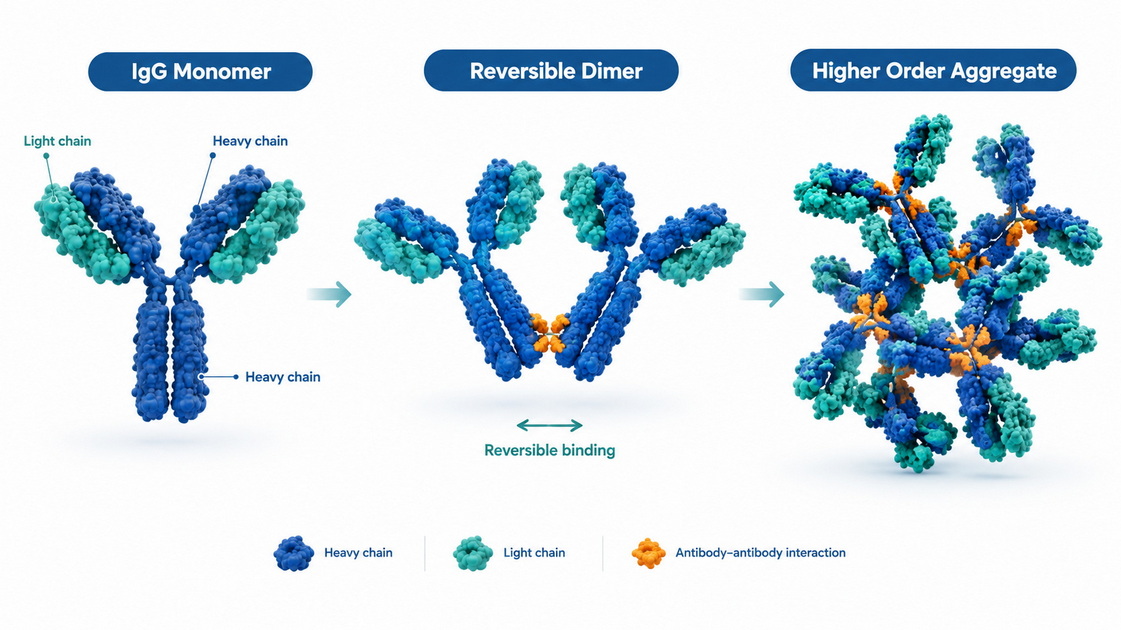
Monomeric antibodies are individual antibody molecules that remain as single, correctly assembled units rather than associating into dimers, oligomers, or larger aggregates. For most full-length recombinant IgG molecules, the intended monomer contains two identical heavy chains and two identical light chains, linked by disulfide bonds and organized into antigen-binding Fab regions plus an Fc region.
That definition sounds simple, but "monomeric" can describe two different ideas. It may refer to an antibody isotype's native architecture, or it may describe the measured molecular-size state of a purified antibody preparation. Keeping those meanings separate helps research teams interpret analytical results, compare engineered formats, and make better decisions during custom antibody development and engineering.
What Does Monomeric Antibody Mean?
An antibody monomer is one complete immunoglobulin unit. In a conventional IgG, the variable domains form the antigen-binding sites, while constant domains contribute structural support and Fc-mediated functions. The term does not mean "one polypeptide chain." A full IgG monomer is a multi-chain protein complex.
Context determines how researchers use the word:
- Structural context: IgG, IgD, and IgE are generally discussed as monomeric isotypes in their secreted form.
- Sample-quality context: "Monomer percentage" usually means the fraction of the measured sample present at the expected size rather than as fragments or high-molecular-weight species.
- Engineering context: A monomeric scFv, Fab, single-domain antibody, Fc fusion, or bispecific construct means that the intended molecular unit does not substantially self-associate under the tested conditions.
This distinction matters because an antibody can be biologically monomeric by design yet partially aggregated in solution. Conversely, an intentionally multivalent construct may be correctly assembled even though its architecture contains more binding modules than a conventional IgG.
Monomeric vs. Oligomeric Antibodies
Antibody class, molecular format, and aggregation state are related but not interchangeable. Secreted IgM commonly forms higher-order assemblies, and secretory IgA is often dimeric. Those native architectures should not be mislabeled as unwanted aggregation.
| Feature | Intended monomer | Native multimer | Unwanted aggregate |
|---|---|---|---|
| Basic meaning | One designed molecular unit | Multiple units assembled as part of normal biology or format design | Molecules associated outside the intended design |
| Typical examples | IgG, Fab, scFv, sdAb | Secretory IgA, pentameric or hexameric IgM | IgG dimer, oligomer, soluble aggregate, particle |
| Assembly | Defined chain pairing and connectivity | Defined biological or engineered organization | May be reversible or irreversible; covalent or noncovalent |
| Main research question | Is the molecule correctly assembled and active? | Is the planned multimer correctly formed? | What caused association, and does it affect the assay? |
| Useful assessment | Intact mass, electrophoresis, SEC, binding assay | Mass, stoichiometry, structural and functional testing | SEC plus orthogonal particle and stability methods |
A practical rule is to define the intended molecular species before reviewing a chromatogram. The largest peak is not automatically the correct monomer, especially for fusion proteins, bispecifics, and deliberately multivalent formats.
Why Monomer Content Matters
A high monomer fraction is often used as an early indicator of sample quality, but it should never be treated as a complete quality verdict. Aggregation can alter apparent binding, increase assay variability, reduce recoverable protein, or complicate concentration measurements. Multivalent aggregates may also create artificially strong signals in plate-based assays by increasing avidity.
For research-use candidates, monomer content helps answer three practical questions:
- Identity: Does the purified material match the intended molecular size?
- Comparability: Do variants, hosts, purification conditions, or batches show similar size profiles?
- Fitness for use: Is the sample suitable for the planned binding, structural, cell-based, or animal study?
The target acceptance range should be tied to the experiment. A reagent used for exploratory screening may have different requirements from material used in a sensitive mechanistic study. The correct approach is fit-for-purpose assessment, supported by more than one measurement when aggregation could change the interpretation.
How Antibody Aggregates Form
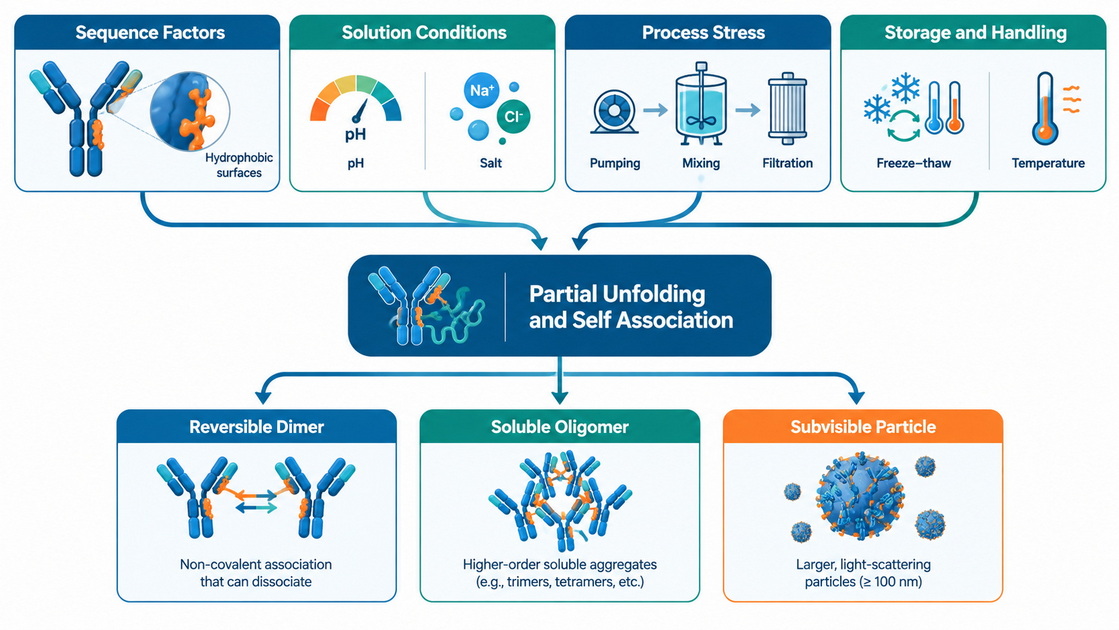
Aggregation often begins when normally buried hydrophobic or interactive surfaces become exposed. Partial unfolding, local conformational fluctuations, or unfavorable surface patches can promote molecule-to-molecule contact. Association may initially be reversible, then progress to stable oligomers, larger soluble species, or visible and subvisible particles.
Common contributors include:
- Sequence-related factors: Exposed hydrophobic residues, uneven charge distribution, unstable domains, unpaired cysteines, or self-complementary surface patches.
- Solution conditions: pH, ionic strength, protein concentration, buffer composition, and excipient choice.
- Process stress: Low-pH exposure, concentration, pumping, mixing, filtration, freeze-thaw cycles, or contact with interfaces.
- Storage and handling: Elevated temperature, light, oxidation, repeated agitation, long hold times, and unsuitable containers.
- Format complexity: Added domains, flexible linkers, chain-pairing challenges, and new interdomain contacts in engineered antibodies.
Importantly, aggregation behavior is molecule-specific. Two antibodies of the same subclass can follow different pathways under the same stress. Even a single amino-acid substitution may change self-association by altering a local interaction surface.
How to Measure Monomer and Aggregates
Size-exclusion chromatography (SEC) is a common starting point because it separates species by apparent hydrodynamic size. Under suitable conditions, an intact antibody monomer produces a principal peak, higher-molecular-weight species elute earlier, and smaller fragments elute later. Peak-area percentages can estimate the relative distribution of detected species.
SEC is powerful, but it has limitations. Interactions with the stationary phase can shift recovery or retention. Very large particles may be removed before detection, and dilution during analysis can disrupt reversible associations. For that reason, researchers should pair SEC with an orthogonal method when the decision is important.
| Method | Primary information | Key limitation |
|---|---|---|
| SEC-HPLC or SEC-UPLC | Relative monomer, high-molecular-weight species, and fragments | Method-dependent interactions and incomplete recovery can bias results |
| Dynamic light scattering | Hydrodynamic size distribution and polydispersity | A small number of large particles can dominate the signal |
| Analytical ultracentrifugation | Solution-state sedimentation and aggregate quantitation | Lower throughput and greater method complexity |
| Mass photometry | Single-particle mass distributions at low concentration | Concentration window and surface interactions require control |
| SDS-PAGE or CE-SDS | Chain integrity, fragments, and covalent species | Denaturing conditions do not preserve all solution-state associations |
| NanoDSF or DSC | Thermal transitions and unfolding behavior | Thermal stability does not directly equal storage stability |
A Practical Orthogonal Testing Panel
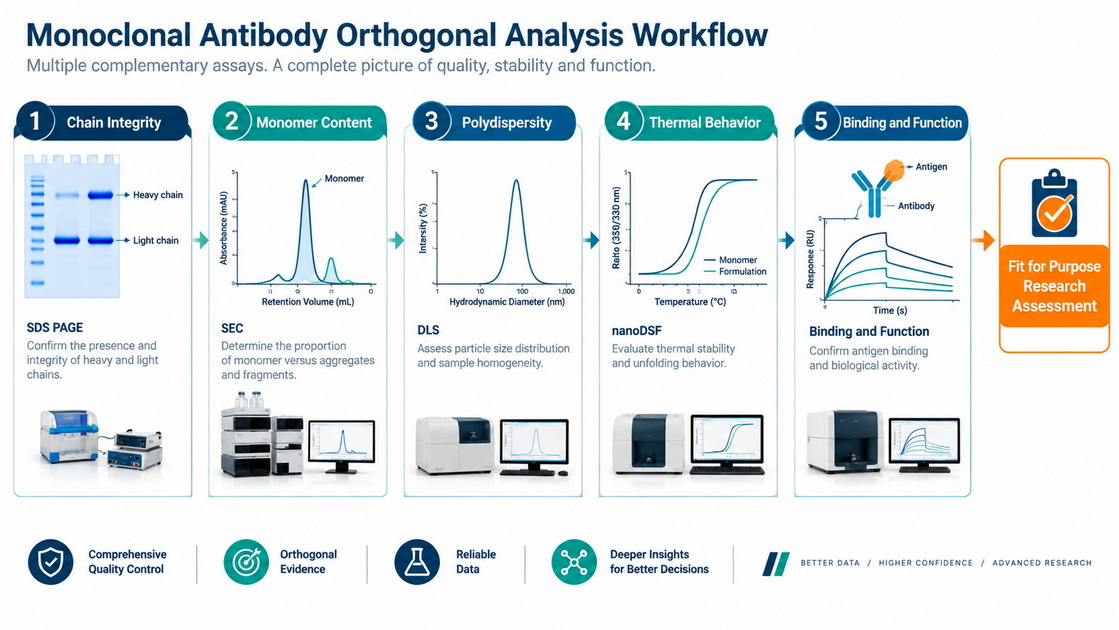
For early discovery and characterization, a compact panel can provide substantially more confidence than one assay:
1. Confirm chain integrity with reducing and nonreducing SDS-PAGE or CE-SDS.
2. Estimate monomer percentage with a qualified SEC method and review total recovery, not only peak area.
3. Check polydispersity with DLS, especially after concentration or freeze-thaw treatment.
4. Measure thermal behavior with nanoDSF or DSC to compare variants and identify unusually early transitions.
5. Retest binding or function after a defined handling stress to determine whether a physical change affects the intended assay.
This panel is not universal. The antibody format, concentration, buffer, available material, and downstream experiment should determine the final design.
A Decision Framework for Early Screening
A common mistake is to rank candidates by affinity alone and investigate physical behavior only after scale-up. A more efficient workflow introduces developability-oriented assessment while the panel is still broad enough to support sequence or format changes.
Use the following decision sequence:
1. Define the intended format and assay. Record expected molecular mass, valency, chain composition, concentration, and buffer.
2. Establish a baseline. Analyze freshly purified material by SEC and at least one orthogonal method.
3. Apply relevant stress. Choose limited freeze-thaw, short thermal exposure, agitation, or concentration stress based on the planned workflow.
4. Compare pre- and post-stress data. Track monomer loss, new species, recovery, turbidity, and functional change.
5. Investigate the cause. Separate sequence risk from host, purification, buffer, concentration, and handling effects.
6. Select the next action. Advance, reformulate, modify purification, redesign a small set of residues, or change the antibody format.
The goal is not to create one universal score. It is to identify decision-changing evidence early, before substantial resources are committed to a difficult molecule.
Troubleshooting Low Monomer Recovery
When SEC shows a low monomer percentage, avoid assuming that the sequence alone is responsible. Use a structured investigation.
| Observation | Possible explanation | Practical next check |
|---|---|---|
| Early SEC peak appears after concentration | Concentration-dependent self-association or interface stress | Test a dilution series; compare pre- and post-concentration DLS |
| Monomer loss after freeze-thaw | Ice-interface stress, cryoconcentration, or unsuitable buffer | Compare controlled freezing rates and a no-freeze control |
| High-molecular-weight species under nonreducing SDS conditions | Intermolecular disulfide linkage or incomplete chain pairing | Compare reducing analysis and review cysteine design |
| DLS detects large species but SEC does not | Large particles may be excluded, filtered, or poorly recovered in SEC | Add particle-sensitive analysis and inspect sample recovery |
| Binding signal rises as monomer falls | Aggregate-driven avidity may be inflating the assay | Normalize concentration and compare monomer-enriched fractions |
| Different host systems give different profiles | Folding, processing, or post-translational differences | Run a controlled cross-host expression comparison |
Any sequence redesign should preserve the binding interface unless evidence supports a targeted change. Parallel expression of a small variant set can reveal whether a proposed modification improves physical behavior without compromising antigen recognition.
Custom Antibody Development at Gene Universal
Gene Universal supports global research teams with custom antibody development and engineering across an integrated DNA/RNA-to-protein-and-antibody workflow. Projects can be tailored around antigen design, antibody discovery, sequencing, humanization, affinity maturation, format conversion, recombinant expression, purification, and selected research-stage characterization.
For monomer-focused projects, useful starting information includes:
- Heavy- and light-chain sequences, or the source clone
- Intended format, isotype, host, and required amount
- Target concentration and preferred buffer
- Planned assays and sample-handling conditions
- Existing SEC, electrophoresis, binding, or stability data
- Known challenges such as low expression, precipitation, or concentration-dependent self-association
This information helps define a fit-for-purpose plan for early discovery and characterization rather than applying the same workflow to every molecule.
Scope note: Gene Universal provides research-focused services and fit-for-purpose research-grade materials. It does not provide GMP manufacturing, CDMO programs, or IND submission support.
Start With a Fit-for-Purpose Plan
Need to compare antibody variants, investigate aggregation, or plan recombinant expression? Share your sequences, intended format, target amount, planned assays, and any existing analytical data with Gene Universal. The team can help define a custom, research-stage workflow from molecular design through expression, purification, and selected characterization.
Frequently Asked Questions
1. Are All Monoclonal Antibodies Monomeric?
No. "Monoclonal" describes origin from one B-cell clone or one defined sequence, whereas "monomeric" describes molecular assembly or solution state. A monoclonal antibody preparation can contain monomer, dimer, higher-order species, and fragments.
2. Is IgG Always a Monomer?
IgG is designed as a single immunoglobulin unit, but purified IgG can self-associate or aggregate depending on its sequence, concentration, buffer, processing, and storage history. Its measured monomer percentage is therefore an experimental result, not an automatic assumption.
3. What Is a Good Monomer Percentage?
There is no universal threshold for every research application. The appropriate target depends on antibody format, assay sensitivity, concentration, route of use, and the risk that aggregates could distort interpretation. Define the acceptance criterion before testing and link it to intended use.
4. Can SEC Alone Confirm an Antibody Is Monomeric?
SEC is an excellent primary method, but it should not be the only evidence for high-impact decisions. Orthogonal methods such as DLS, analytical ultracentrifugation, mass photometry, or particle analysis can detect species that SEC may under-recover or fail to resolve.
5. Can Antibody Engineering Reduce Aggregation?
Yes, in some cases. Targeted substitutions may reduce exposed hydrophobicity, improve local stability, remove problematic cysteines, or alter charge distribution. However, redesign should be guided by structural analysis and confirmed experimentally because changes near the binding site can affect affinity or specificity.
6. Does a Higher Monomer Percentage Guarantee Better Binding?
No. Monomer content and binding performance answer different questions. Correctly assembled monomer may still have weak affinity or poor specificity, while aggregates may create misleadingly strong avidity-driven signals. Evaluate physical quality and function in parallel.
7. When Should Monomer Screening Begin?
Begin after sufficient purified material is available for reliable measurements, ideally while multiple candidates or variants remain under consideration. Early screening makes it easier to compare sequences, formats, hosts, and buffers before scale and workflow constraints increase.
References
1. Schroeder HW Jr, Cavacini L. [Structure and Function of Immunoglobulins]. *Journal of Allergy and Clinical Immunology*. 2010. [pubmed.ncbi.nlm.nih]
2. Wang W, Roberts CJ. [Antibody Aggregation: Insights from Sequence and Structure]. *International Journal of Pharmaceutics*. 2018. [pubmed.ncbi.nlm.nih]
3. Arosio P, et al. [Accelerated Aggregation Studies of Monoclonal Antibodies]. *Journal of Pharmaceutical Sciences*. 2020. [pubmed.ncbi.nlm.nih]
4. U.S. Food and Drug Administration. [ICH Q6B: Specifications—Test Procedures and Acceptance Criteria for Biotechnological/Biological Products]. [fda]
5. European Medicines Agency. [Guideline on Development, Production, Characterisation and Specification for Monoclonal Antibodies and Related Products]. [ema.europa]
6. International Council for Harmonisation. [ICH Q5C: Stability Testing of Biotechnological/Biological Products]. [database.ich]
7. Thiagarajan G, et al. [High Performance Size Exclusion Chromatography and High-Throughput Dynamic Light Scattering as Orthogonal Methods]. *Journal of Pharmaceutical Sciences*. 2020. [pubmed.ncbi.nlm.nih]
8. Gabrielson JP, et al. [Guidance to Achieve Accurate Aggregate Quantitation in Biopharmaceuticals by SEC]. *Methods in Molecular Biology*. 2015. [pubmed.ncbi.nlm.nih]
9. Bailly M, et al. [Predicting Antibody Developability Profiles Through Early Stage Discovery Screening]. *mAbs*. 2020. [pubmed.ncbi.nlm.nih]
10. National Research Council. [In Vitro Production of Monoclonal Antibody]. *Monoclonal Antibody Production*. National Academies Press; 1999. [ncbi.nlm.nih]
11. Moussa EM, et al. [Immunogenicity of Therapeutic Protein Aggregates]. *Journal of Pharmaceutical Sciences*. 2016. [pubmed.ncbi.nlm.nih]