 +1 302-235-9792
 SIGN IN
 CONTACT US


- News
- What Is Antibody Specificity? A Practical Guide to Cross-Reactivity, Validation, and Antibody Engineering.
share


What Is Antibody Specificity? A Practical Guide to Cross-Reactivity, Validation, and Antibody Engineering.
Content Menu
● What Does Antibody Specificity Mean?
● Specificity, Affinity, and Selectivity
>> Homologous Proteins and Isoforms
>> Polyspecificity and Heterospecificity
● Why Specificity Is Application-Specific
● A Five-Pillar Validation Strategy
>> Immunocapture and Mass Spectrometry
● Step-by-Step Specificity Workflow
● Engineering for Better Specificity
>> Targeted Sequence Optimization
● A Practical Family-Selectivity Example
● Monoclonal, Polyclonal, and Recombinant Options
● Custom Antibody Development at Gene Universal
>> 1. Is antibody specificity the same as affinity?
>> 2. Can one antibody be specific in Western blot but not in flow cytometry?
>> 3. Does a single band prove antibody specificity?
>> 4. What is the best negative control for antibody specificity?
>> 5. How can cross-reactivity be reduced during antibody discovery?
>> 6. Are monoclonal antibodies always more specific than polyclonal antibodies?
Antibody specificity is the ability of an antibody to recognize its intended epitope while minimizing binding to unrelated molecules. It is one of the most important determinants of whether an antibody produces a clear, interpretable signal or a misleading result. Yet specificity is not an absolute label attached to a clone. It must be demonstrated in the intended application, sample type, species, and experimental conditions.
For scientists planning custom antibody development and engineering, this distinction changes the entire workflow. A binder that performs well against purified antigen may behave differently in a cell lysate, on a fixed tissue section, or at the surface of a living cell. Reliable programs therefore define the desired binding profile early, challenge candidates against relevant off-targets, and confirm performance with complementary evidence.
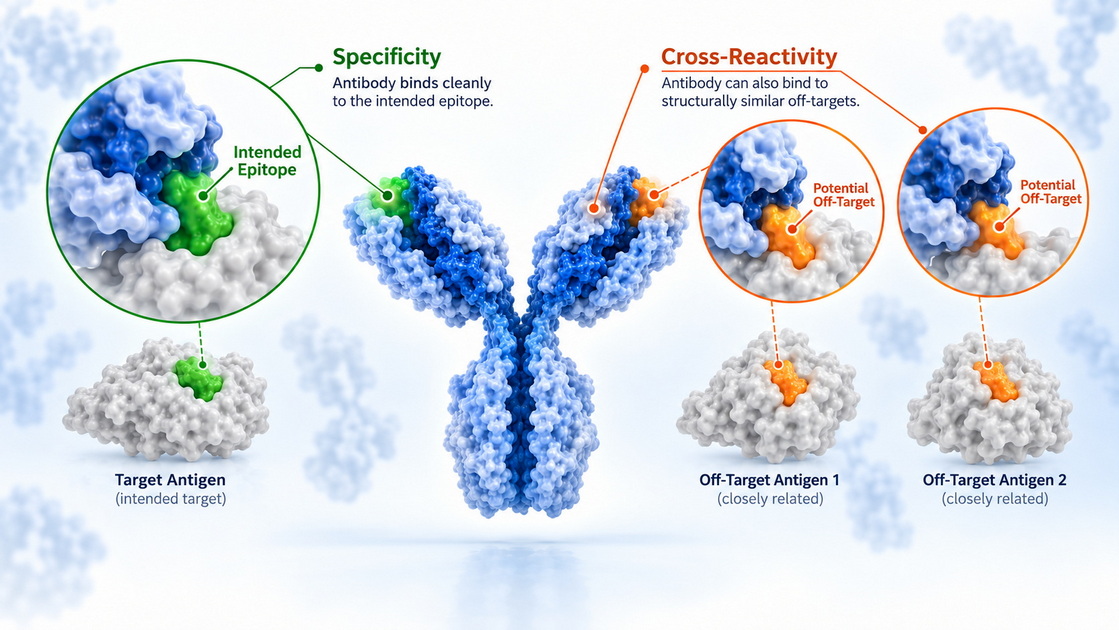
What Does Antibody Specificity Mean?
An antibody binds through its variable domains. Six complementarity-determining regions form most of the antigen-contacting surface, or paratope. Shape, charge, hydrogen bonding, and hydrophobic contacts influence how that paratope recognizes an epitope.
Specificity describes discrimination: how well an antibody distinguishes its intended target from plausible alternatives under relevant conditions.
This is why specificity should always be expressed in context. Important variables include:
- Antigen state: Native, denatured, reduced, fixed, soluble, or membrane-bound.
- Biological matrix: Purified buffer, serum, plasma, cell lysate, tissue, or culture supernatant.
- Target abundance: Low-level endogenous expression versus recombinant overexpression.
- Related molecules: Isoforms, paralogs, orthologs, post-translational variants, and homologous family members.
- Assay conditions: Antibody concentration, incubation time, temperature, pH, detergent, fixation, blocking reagent, and wash stringency.
A useful conclusion is therefore narrow and testable: "This antibody is specific enough for this application in this sample under these conditions."
Specificity, Affinity, and Selectivity
These terms answer different experimental questions and should not be used interchangeably.
| Property | Practical question | Typical evidence | Common misinterpretation |
|---|---|---|---|
| Specificity | Does the antibody distinguish the intended epitope from off-target epitopes? | Knockout controls, related-antigen panels, peptide competition, or mass spectrometry | Strong binding is assumed to mean exclusive binding |
| Affinity | How strongly does one binding site interact with its antigen? | Surface plasmon resonance, biolayer interferometry, or equilibrium binding assays | A low dissociation constant is treated as proof of specificity |
| Avidity | How strong is the combined multivalent interaction? | Format-aware binding measurements using multivalent antigen | Format-driven signal is mistaken for better intrinsic affinity |
| Selectivity | Can the antibody find its target in a complex mixture? | Endogenous samples, proteome arrays, immunoprecipitation, or matrix-spike studies | Binding to purified antigen is assumed to transfer to lysate or tissue |
| Sensitivity | What is the lowest target level that can be detected reliably? | Titration, limit-of-detection studies, and signal-to-background analysis | High sensitivity is accepted despite off-target signal |
A high-affinity antibody can still be cross-reactive. Conversely, a moderately affine antibody may offer cleaner discrimination in a specific assay. Affinity must be optimized together with specificity, stability, solubility, and assay performance, rather than pursued as an isolated maximum.
Why Cross-Reactivity Occurs
Cross-reactivity occurs when an antibody binds a non-target molecule strongly enough to affect interpretation. The off-target may share a linear sequence, a three-dimensional surface, a chemical motif, or a distribution of charge and hydrophobicity with the intended epitope.
Homologous Proteins and Isoforms
Closely related proteins often contain conserved domains. An antibody raised against a conserved peptide may recognize several family members. Isoform-specific development becomes especially difficult when the unique region is short, poorly exposed, disordered, or removed by sample preparation.
Conformational Changes
A conformational epitope depends on native three-dimensional structure. Denaturation, reduction, fixation, or adsorption to plastic can alter that structure and reveal surfaces that are normally buried. This explains why success in an enzyme-linked immunosorbent assay does not guarantee success in Western blotting, flow cytometry, or immunohistochemistry.
Polyspecificity and Heterospecificity
Polyspecificity is the capacity of one antibody to recognize structurally distinct epitopes. Limited polyspecificity contributes to immune repertoire breadth, but excessive nonspecific interaction can complicate research assays and developability-oriented assessment.
Heterospecificity describes a case in which an antibody reacts more strongly with another antigen than with the immunizing antigen. Both concepts show why the immunogen alone cannot define the final binding profile. Experimental challenge against relevant alternatives is essential.
Why Specificity Is Application-Specific
An antibody should be validated where it will be used. The same clone may encounter a linearized protein in Western blotting, a native extracellular domain in flow cytometry, and a chemically fixed antigen in immunohistochemistry. Each format presents a different molecular target.
| Application | Target presentation | Strong specificity controls | Important risk |
|---|---|---|---|
| Western blot | Usually denatured and often reduced | Wild-type versus knockout lysate, expected-size assessment, independent antibody | A single band can still represent an off-target protein |
| Flow cytometry | Native proteins on intact cells | Target-positive and target-negative cells, fluorescence-minus-one controls, titration | Fc-receptor binding and altered epitope accessibility |
| Immunofluorescence | Fixed or permeabilized cellular structures | Knockout cells, tagged target, expected localization, second antibody | Fixation-dependent staining and compartment background |
| Immunohistochemistry | Fixed tissue with complex architecture | Positive and negative tissues, genetic controls, peptide competition where appropriate | Autofluorescence, endogenous enzymes, and tissue-specific background |
| Immunoprecipitation | Native target in a complex lysate | Immunocapture followed by mass spectrometry, knockout lysate | Co-complex proteins may be confused with direct off-targets |
| ELISA | Purified or captured antigen on a surface | Related-antigen panel, blank matrix, spike recovery, competition | Surface adsorption may create non-native epitopes |
A clean result in one column does not validate the antibody for every other column. Changes in species, cell type, tissue, fixation, or detection chemistry can justify renewed testing.
A Five-Pillar Validation Strategy
No single experiment proves universal specificity. A stronger assessment combines independent lines of evidence. A widely used framework organizes validation into five conceptual pillars.
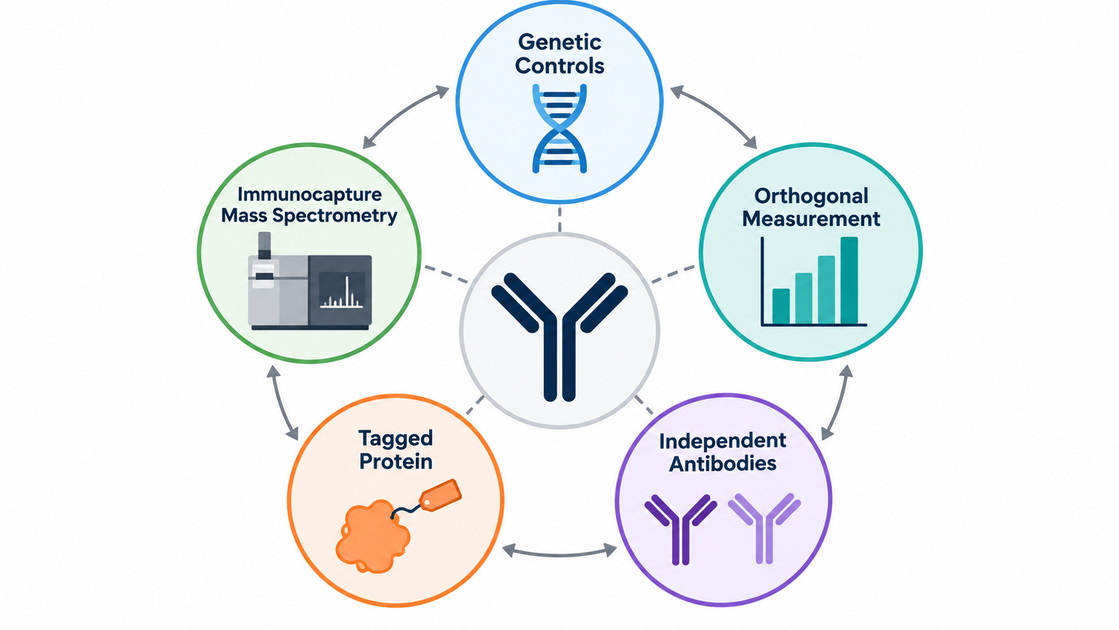
Genetic Controls
Compare signal in a target-positive sample with signal in a knockout or knockdown sample. Loss or substantial reduction of the expected signal supports specificity. Persistent signal indicates off-target binding, incomplete target depletion, or an assay artifact that requires investigation.
Orthogonal Measurement
Compare antibody-dependent results with an antibody-independent method across multiple samples. For example, protein signal may be compared with targeted mass spectrometry or with expression patterns supported by another quantitative method. Agreement across a biologically varied sample set is more informative than agreement in one overexpression model.
Independent Antibodies
Use two antibodies that recognize different epitopes on the same target. Concordant results strengthen confidence, particularly when the antibodies have distinct sequences and were generated independently. However, two antibodies can share an off-target, so this approach is strongest when combined with another pillar.
Tagged-Protein Strategies
Compare staining from the test antibody with a genetically encoded tag attached to the target. Spatial agreement is useful for imaging applications. Tag placement and expression level must be controlled because either can change localization or accessibility.
Immunocapture and Mass Spectrometry
Capture proteins from a relevant lysate and identify enriched species by mass spectrometry. This approach can show whether the intended target is recovered and reveal unexpected binding partners. Known members of the target's native complex should be interpreted differently from direct off-target proteins.
Step-by-Step Specificity Workflow
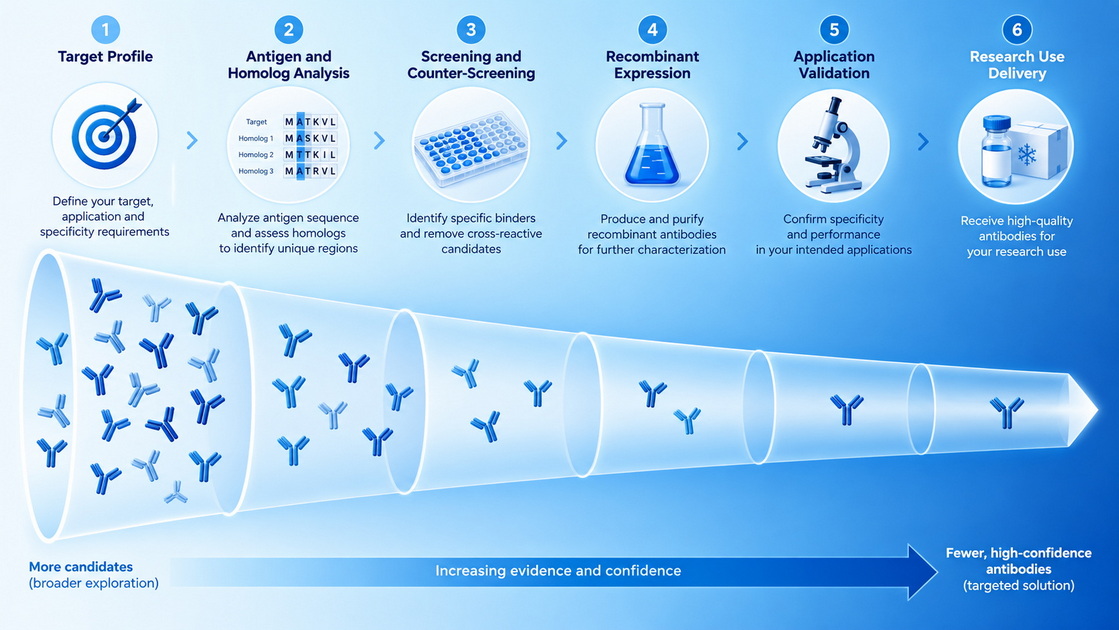
A practical workflow begins before immunization or library screening.
1. Define the research profile. Specify the target, epitope, species reactivity, applications, matrices, format, and unacceptable cross-reactivity.
2. Analyze related molecules. Align isoforms, paralogs, orthologs, and conserved domains; identify unique, exposed regions and relevant modifications.
3. Build a screening funnel. Begin with target binding, then add homologs, irrelevant proteins, blank matrices, and target-negative cells. Increase biological complexity as candidates narrow.
4. Rank by discrimination. Compare on-target signal, off-target signal, background, concentration dependence, and variability—not target signal alone.
5. Confirm and validate. Express sequence-defined clones recombinantly, then use appropriate controls and at least one strong validation pillar in the intended application.
6. Test and document robustness. Repeat critical measurements across days, operators, or reagent lots. Record the usable concentration window, tested conditions, and known limitations.
Engineering for Better Specificity
When a candidate binds the target but fails a counter-screen, engineering may improve discrimination. The strategy should reflect the failure mechanism.
Antigen and Library Design
Specificity can be shaped upstream by selecting an immunogen or screening antigen that emphasizes a unique, accessible region. During display-based discovery, negative selection against homologs can remove cross-reactive clones. Alternating antigen presentations may also help identify binders that recognize the desired biological form rather than a platform artifact.
Targeted Sequence Optimization
Mutations within or near the complementarity-determining regions can change the balance of shape, charge, and hydrophobic contacts. Focused libraries allow teams to preserve productive interactions while weakening contacts associated with off-target binding. Broad random mutation may improve affinity but also introduce new nonspecific interactions.
Avoiding the Affinity Trap
More affinity is not always better. If affinity maturation rewards target binding without parallel counter-selection, variants may gain interactions that also recognize unrelated surfaces. A better campaign monitors target affinity, related-antigen discrimination, nonspecific binding, expression, stability, and aggregation together.
A Practical Family-Selectivity Example
Consider a research program seeking an antibody against one member of a highly conserved receptor family. A purified-target screen may identify several strong binders, but it does not establish family-member selectivity.
A better funnel would include the intended receptor, the closest homologs, target-negative cells, and cells expressing each family member at controlled levels. Candidates would then be ranked by discrimination window, not target signal alone. Finalists would be expressed recombinantly and tested in the intended assay with endogenous positive and negative samples.
If every high-affinity clone cross-reacts, the team should revisit antigen design or apply negative selection rather than merely lowering antibody concentration. This decision prevents late-stage repetition and creates a clearer route to fit-for-purpose research-grade materials.
Monoclonal, Polyclonal, and Recombinant Options
Polyclonal antibodies recognize multiple epitopes and can provide robust signal, but their mixed composition can increase background and lot variation. Antigen-affinity purification enriches relevant antibodies without making the mixture sequence-defined.
Monoclonal antibodies come from one clone and recognize one principal epitope, yet they can still cross-react. Recombinant antibodies connect function to known sequences, enabling reproducible expression, format conversion, and mutation. In vitro production is generally preferred when practical. Every format still requires context-specific validation.
Custom Antibody Development at Gene Universal
Gene Universal supports global research teams with integrated services spanning DNA/RNA, protein, and custom antibody development and engineering. For specificity-focused projects, the most productive starting point is a precise brief covering target biology, desired species reactivity, intended assay, required exclusions, sample context, and preferred antibody format.
This information helps align antigen design, discovery strategy, recombinant expression, screening, and early characterization around the same scientific question. The objective is not simply to produce a binder. It is to develop research-use candidates supported by evidence that matches their intended purpose.
Ready to discuss a difficult target, homolog-selectivity challenge, or antibody optimization plan? Contact Gene Universal with the target sequence, intended application, desired cross-reactivity profile, and available controls to receive a fit-for-purpose project assessment.
Service scope: Gene Universal provides research-focused life science services and does not offer GMP services, CDMO programs, or IND submission support.
Frequently Asked Questions
1. Is antibody specificity the same as affinity?
No. Affinity measures binding strength, whereas specificity measures discrimination between the intended antigen and alternative molecules. A high-affinity antibody may still bind an off-target. Both properties should be measured during candidate selection.
2. Can one antibody be specific in Western blot but not in flow cytometry?
Yes. Western blotting usually presents denatured protein, while flow cytometry presents native proteins on cells. Epitope structure, accessibility, target density, and background mechanisms differ, so each application requires its own validation.
3. Does a single band prove antibody specificity?
No. A band at the expected molecular weight is encouraging but not definitive. A cross-reactive protein can migrate at a similar size. Knockout or knockdown material, an independent antibody, or orthogonal identification provides stronger evidence.
4. What is the best negative control for antibody specificity?
A genetically matched knockout sample is often one of the strongest controls because it removes the intended target while preserving much of the sample context. When it is unavailable, knockdown samples, known negative cells or tissues, related-antigen panels, and no-primary controls can provide complementary evidence.
5. How can cross-reactivity be reduced during antibody discovery?
Use a unique antigen region where possible, screen against close homologs, include target-negative biological material, and apply negative selection early. Rank candidates by the difference between on-target and off-target binding rather than by target signal alone.
6. Are monoclonal antibodies always more specific than polyclonal antibodies?
No. Monoclonal antibodies offer a defined clone and epitope preference, but an individual clone can still cross-react. Polyclonal preparations contain multiple specificities and may produce broader background, although affinity purification can improve their useful signal profile.
References
1. Uhlén, M., et al. (2016). [A Proposal for Validation of Antibodies]. *Nature Methods*, 13, 823–827.
2. Bordeaux, J., et al. (2010). [Antibody Validation]. *BioTechniques*, 48, 197–209.
3. Pillai-Kastoori, L., et al. (2020). [Antibody Validation for Western Blot: By the User, for the User]. *Journal of Biological Chemistry*, 295, 926–939.
4. Saper, C. B. (2024). [Antibody Characterization Is Critical to Enhance Reproducibility in Biomedical Research]. *eLife*, 13, e100211.
5. Lund-Johansen, F., et al. (2020). [The Antibody Society's Antibody Validation Webinar Series]. *mAbs*, 12.
6. Kalyuzhny, A. E. (2016). [Antibody Validation by Immunoprecipitation Followed by Mass Spectrometry Analysis]. *Methods in Molecular Biology*.
7. Rabia, L. A., et al. (2018). [Understanding and Overcoming Trade-Offs Between Antibody Affinity, Specificity, Stability and Solubility]. *Biochemical Engineering Journal*, 137, 365–374.
8. Sela-Culang, I., et al. (2014). [Specificity, Polyspecificity, and Heterospecificity of Antibody–Antigen Recognition]. *Frontiers in Immunology*, 5, 452.
9. National Research Council. (1999). [In Vitro Production of Monoclonal Antibody]. *Monoclonal Antibody Production*, NCBI Bookshelf.