 +1 302-235-9792
 SIGN IN
 CONTACT US


- News
- Would You Edit Your DNA? The Science, Risks, Ethics, and Future of Human Genome Editing
share


Would You Edit Your DNA? The Science, Risks, Ethics, and Future of Human Genome Editing
Content Menu
● What Does It Mean to Edit Your DNA?
>> Somatic Versus Heritable Genome Editing
● How CRISPR Gene Editing Works
>> CRISPR-Cas9: Target, Cut, Repair
>> Base Editing and Prime Editing
● Why Would Someone Edit Their DNA?
>> Disease Treatment Versus Enhancement
● What Are the Main Risks?
>> Unintended and Unexpected Edits
>> Mosaicism and Cell-to-Cell Variation
>> Delivery and Tissue Specificity
>> Immune Response and Durability
>> Interpretation Beyond DNA
● Landmark Evidence Changed the Question
● A Practical Decision Framework
>> 1. What Is the Purpose?
>> 2. Which Cells Will Be Edited?
>> 3. How Strong Is the Gene-Disease Relationship?
>> 4. What Alternatives Exist?
>> 5. How Will Risks Be Measured?
>> 6. Who Has Reviewed the Work?
● From Sequence Design to Research Evidence
>> 1: Define the Biological Hypothesis
>> 2: Design Editing Components and Controls
>> 3: Verify Sequence Identity and Material Quality
>> 4: Measure Multiple Editing Outcomes
>> 5: Connect Genotype to Function
>> 6: Document Limitations
● Supporting Genome-Editing Research
● Would You Edit Your DNA?
● Take the Next Research Step
● Frequently Asked Questions
>> 1. Is Genome Editing the Same as Gene Therapy?
>> 2. Can CRISPR Edit Every Cell in the Body?
>> 3. Are CRISPR Edits Always Permanent?
>> 4. What Is the Difference Between Somatic and Germline Editing?
>> 5. What Are Off-Target Effects?
>> 6. Has a CRISPR-Based Treatment Been Approved?
>> 7. Can Gene Universal Support Genome-Editing Research?
● References
Would you edit your DNA if a single change could address a serious inherited disease? Human genome editing has moved from a provocative thought experiment to a practical question for researchers, physicians, patients, and families. CRISPR gene editing can alter selected DNA sequences, but the phrase "edit your DNA" covers very different interventions, risk profiles, and ethical consequences.
From a molecular biology specialist's perspective, the first question should not be whether DNA editing is exciting. It should be: What is being edited, why, in which cells, with what evidence, and who carries the uncertainty?
Those distinctions separate responsible biomedical research from oversimplified promises.

What Does It Mean to Edit Your DNA?
Genome editing is the targeted addition, removal, replacement, or alteration of DNA in a cell. Researchers use it to study gene function, build disease models, test biological hypotheses, and explore ways to correct or compensate for harmful genetic variants.
DNA editing is often confused with traditional gene therapy. Some gene therapies add a functional gene without changing the original sequence. Genome editing, by contrast, is designed to make a change at a chosen genomic location.
The practical result depends on several connected factors:
- The editing system
- The target sequence
- The cell type
- The delivery method
- The cell's repair pathways
- The biological effect of the resulting edit
For this reason, DNA editing should not be understood as simply correcting a typographical error. A genomic sequence exists within a complex system of regulatory elements, chromatin structures, interacting genes, proteins, cells, and tissues.
A technically successful edit may therefore produce an unexpected biological outcome.
Somatic Versus Heritable Genome Editing
The most important distinction is where the edit occurs.
| Question | Somatic Genome Editing | Heritable Genome Editing |
|---|---|---|
| Which cells are changed? | Non-reproductive body cells | Eggs, sperm, embryos, or precursor cells |
| Who may be affected? | The treated individual | The resulting individual and potentially descendants |
| Can the change be inherited? | Generally no | Potentially yes |
| Typical current focus | Disease research and therapeutic investigation | Basic research and ethical-policy debate |
| Central concern | Safety, delivery, specificity, and durability | Somatic concerns plus consent across generations and societal consequences |
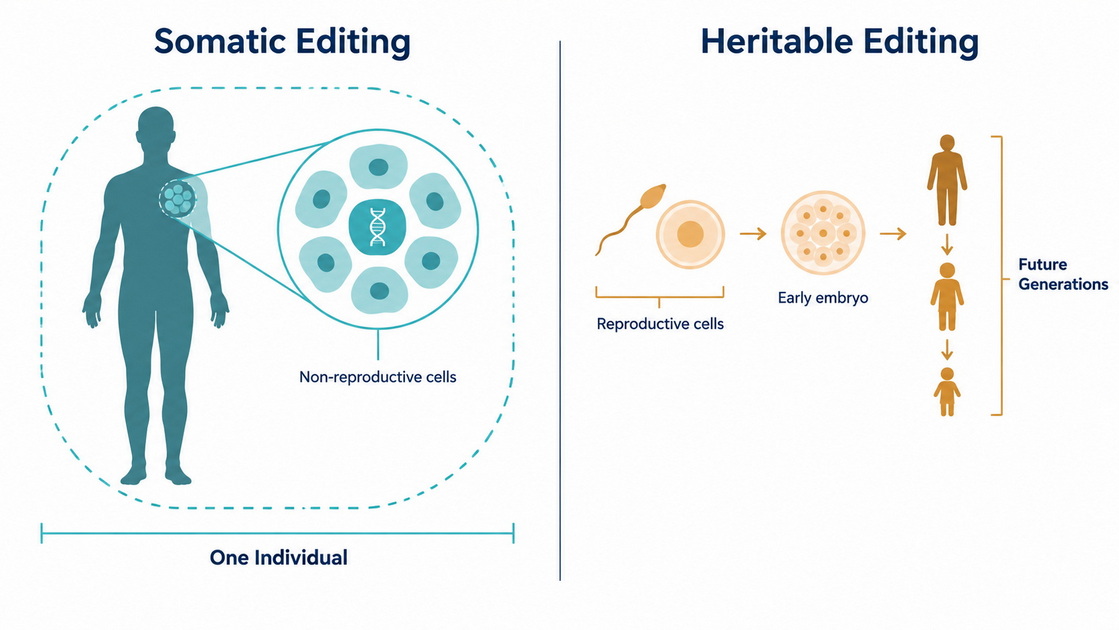
This distinction changes the ethical calculation.
A somatic edit can be evaluated primarily around one person's potential benefits and harms. A heritable edit may propagate beyond the original intervention, while future individuals cannot consent to the change.
Heritable editing also creates difficult social questions. If a technology becomes associated with selecting or enhancing traits, it may reinforce inequality, stigmatize disability, or create pressure for families to conform to changing ideas of what counts as a desirable characteristic.
How CRISPR Gene Editing Works
CRISPR-Cas9: Target, Cut, Repair
CRISPR-Cas9 uses a guide RNA to direct the Cas9 enzyme toward a selected DNA sequence. When the system locates a sufficiently matching target, Cas9 cuts the DNA.
The cell then attempts to repair the break.
Researchers can use these repair processes to:
- Disrupt the activity of a selected gene
- Remove part of a DNA sequence
- Insert a designed sequence
- Reconstruct a disease-associated variant
- Explore how a particular gene influences cellular behavior
The familiar "molecular scissors" analogy is useful, but incomplete.
Finding and cutting the intended site does not guarantee the intended biological outcome. Cellular repair can produce multiple sequence outcomes. A successful edit at the DNA level may also fail to generate the expected RNA, protein, cellular, or tissue-level effect.
Editing efficiency alone is therefore not enough to establish experimental success.
Base Editing and Prime Editing
Newer editing systems aim to expand precision and reduce reliance on double-strand DNA breaks.
Base editors can convert certain DNA letters into others within a defined editing window. They are particularly useful when a research objective involves a compatible single-nucleotide change.
Prime editors combine a Cas-derived nickase, reverse transcriptase, and a specialized guide RNA. This system can install selected substitutions, insertions, or deletions without requiring a conventional double-strand break or an independent donor DNA template.
These platforms broaden the experimental toolbox. However, more precise does not mean risk-free.
Researchers must still evaluate:
- Unintended edits
- Editing byproducts
- Activity at similar genomic sequences
- Variable performance across cell types
- Delivery efficiency
- Cellular stress
- Functional consequences
- Long-term stability
Selecting an editing system should therefore begin with the biological question—not with the popularity of a particular technology.
Why Would Someone Edit Their DNA?
The strongest case for editing human DNA involves serious disease, especially when a well-understood genetic mechanism offers a clear target and existing options are limited.
Potential objectives include:
- Correcting a disease-associated variant
- Disabling a harmful gene
- Restoring the expression of a needed protein
- Changing gene regulation
- Compensating for a disrupted biological pathway
- Modifying cells outside the body before returning them
- Targeting selected cells directly within the body
For researchers, genome editing also has value before any therapeutic application is considered.
It can help create patient-relevant cell models, reproduce disease-associated mutations, validate potential targets, compare variant functions, and investigate relationships among DNA, RNA, proteins, and cellular phenotypes.
Disease Treatment Versus Enhancement
Purpose matters.
Survey research generally indicates stronger public support for gene editing intended to treat or prevent serious disease than for enhancement. Somatic applications also tend to receive more support than changes that could be passed to future generations.
Common reasons someone might consider DNA editing include:
- Addressing a severe monogenic disorder with a defined causal variant
- Modifying blood-forming or immune cells outside the body
- Targeting cells within the body when removal and reinfusion are impractical
- Creating patient-relevant disease models
- Testing a target hypothesis during early discovery and characterization
By contrast, editing for height, appearance, athletic performance, or generalized intelligence introduces greater scientific and social uncertainty.
Complex traits usually involve many genes, developmental processes, and environmental influences. The idea that one edit could reliably produce one desirable human trait is therefore often biologically misleading.
Enhancement also raises questions about:
- Fair access
- Social coercion
- Disability rights
- Cultural diversity
- Parental authority
- Commercial exploitation
- Long-term effects on future generations
The ability to perform an edit does not automatically justify its use.
What Are the Main Risks?
A responsible answer to "Would you edit your DNA?" requires more than an estimate of editing efficiency. It requires a multilayer assessment of sequence, cell, tissue, and whole-person effects.
Unintended and Unexpected Edits
An editing system may modify sequences that resemble the intended target. These are commonly described as off-target effects.
An unintended edit may be rare but still important, especially if it affects:
- Gene regulation
- Tumor-suppressor pathways
- Oncogenes
- Essential cellular functions
- Chromosome stability
- Developmentally important sequences
Researchers must also examine the intended target itself.
Editing at the correct location can produce unexpected insertions, deletions, rearrangements, or mixed repair products. A result should not be classified as successful solely because the editor reached the planned genomic site.
Mosaicism and Cell-to-Cell Variation
Not every cell necessarily receives the editing components. Even among exposed cells, not every cell executes the edit in the same way.
A sample may contain:
- Unedited cells
- Correctly edited cells
- Cells with partial edits
- Cells with unintended repair outcomes
- Cells carrying different combinations of changes
This mosaic pattern can complicate data interpretation.
Mosaicism is particularly significant in embryo editing because different developing tissues may contain different edits. A sample taken from one group of cells may not accurately represent the rest of the developing organism.
Delivery and Tissue Specificity
The editor must reach the correct cells in sufficient quantity while limiting exposure elsewhere.
Delivery remains one of the defining challenges in genome editing, especially for tissues that are difficult to access.
Common delivery approaches include:
- Viral vectors
- Lipid nanoparticles
- Electroporation
- Ribonucleoprotein complexes
- Messenger RNA delivery
- Engineered particles
- Cell-type-specific targeting systems
Each approach has different trade-offs involving payload capacity, tissue targeting, duration of expression, cellular toxicity, immune recognition, and manufacturing complexity.
A highly accurate editor has limited value if it cannot reach the intended tissue. Conversely, an efficient delivery system may create additional risk if it distributes editing components to unintended cells.
Immune Response and Durability
Editor proteins, delivery vehicles, or edited cells may trigger immune responses.
Researchers must determine whether:
- The delivery material activates innate immunity
- Preexisting immunity affects the editor
- Edited cells remain viable
- Edited cells retain their normal functions
- The desired effect persists
- The targeted cell population turns over
- Biological compensation changes the outcome
Durability depends heavily on the target tissue. Editing a long-lived stem cell population may have a different time horizon from editing mature cells with limited lifespans.
Interpretation Beyond DNA
Sequence confirmation is necessary, but it is not enough.
A strong study connects the edit to:
- RNA expression
- Protein abundance
- Protein activity
- Cellular phenotype
- Pathway response
- Appropriate positive and negative controls
The most persuasive evidence is a chain of causality, not a single percentage.
For example, detecting the intended DNA change does not establish that a functional protein has been restored. Protein expression also does not automatically demonstrate correction of the relevant cellular phenotype.
Each stage requires appropriate measurement.
Landmark Evidence Changed the Question
The discussion is no longer entirely hypothetical.
In December 2023, the FDA approved Casgevy for certain patients aged 12 years and older with sickle cell disease. It became the first FDA-approved treatment to use CRISPR-Cas9.
The approach modifies a patient's blood-forming stem cells outside the body. Editing disrupts an erythroid regulatory region of BCL11A, increasing the production of fetal hemoglobin.
In the FDA's original review, 29 of 31 evaluable patients—93.5%—achieved freedom from severe vaso-occlusive crises for at least 12 consecutive months during the specified evaluation period.
This evidence demonstrates the potential of carefully controlled somatic editing. It does not establish that every target, tissue, editing system, or delivery platform has the same benefit-risk profile.
Several features distinguish this application:
- The cells can be collected outside the body
- Editing can occur under controlled conditions
- The cells can be characterized before administration
- The underlying disease biology is well studied
- The biological endpoint can be monitored
- The intervention is directed toward somatic cells
A second landmark arrived in 2025, when an NIH-supported team reported a personalized CRISPR-based intervention for an infant with severe CPS1 deficiency.
The program targeted non-reproductive liver cells and was developed rapidly for a single patient. The case illustrates how reusable editing platforms may support highly individualized approaches.
At the same time, it reinforces the need for careful evidence, oversight, transparent reporting, and long-term follow-up. A successful individual case should be treated as an important scientific milestone rather than universal proof that every rare variant can be approached in the same way.
A Practical Decision Framework
A meaningful personal decision should involve qualified medical and genetics professionals, not a technology headline.
The following six questions provide a practical framework.
1. What Is the Purpose?
Treating a severe disease is ethically and scientifically different from changing appearance or enhancing a complex trait.
The intended purpose determines the acceptable level of uncertainty and influences whether the expected benefit could justify the risk.
2. Which Cells Will Be Edited?
Determine whether the intervention targets somatic cells or reproductive cells.
This question affects who carries the consequences and whether the resulting change could be inherited.
3. How Strong Is the Gene-Disease Relationship?
A clear causal mechanism supports a more testable hypothesis.
Researchers should examine whether the selected variant is genuinely pathogenic, how it affects gene or protein function, and whether modifying the target is likely to improve the relevant phenotype.
4. What Alternatives Exist?
Genome editing should be evaluated alongside other available options, which may include:
- Medicines
- Cell transplantation
- Enzyme replacement
- Dietary management
- Reproductive options
- Supportive care
- Participation in other research
- No intervention
The existence of alternatives can change the acceptable risk threshold.
5. How Will Risks Be Measured?
A credible assessment should examine:
- Intended-site editing
- Off-target activity
- Unintended on-target outcomes
- Cellular viability
- Delivery specificity
- Functional protein changes
- Phenotypic effects
- Immune responses
- Long-term persistence
A single assay rarely answers all of these questions.
6. Who Has Reviewed the Work?
Independent ethics review, appropriate institutional oversight, transparent research registration, and meaningful informed consent are essential.
Participants should understand not only potential benefits but also uncertainty, alternatives, follow-up expectations, and limitations in predicting long-term outcomes.
A useful rule is simple:
The more permanent, heritable, or uncertain an intervention is, the stronger the evidence and oversight should be.
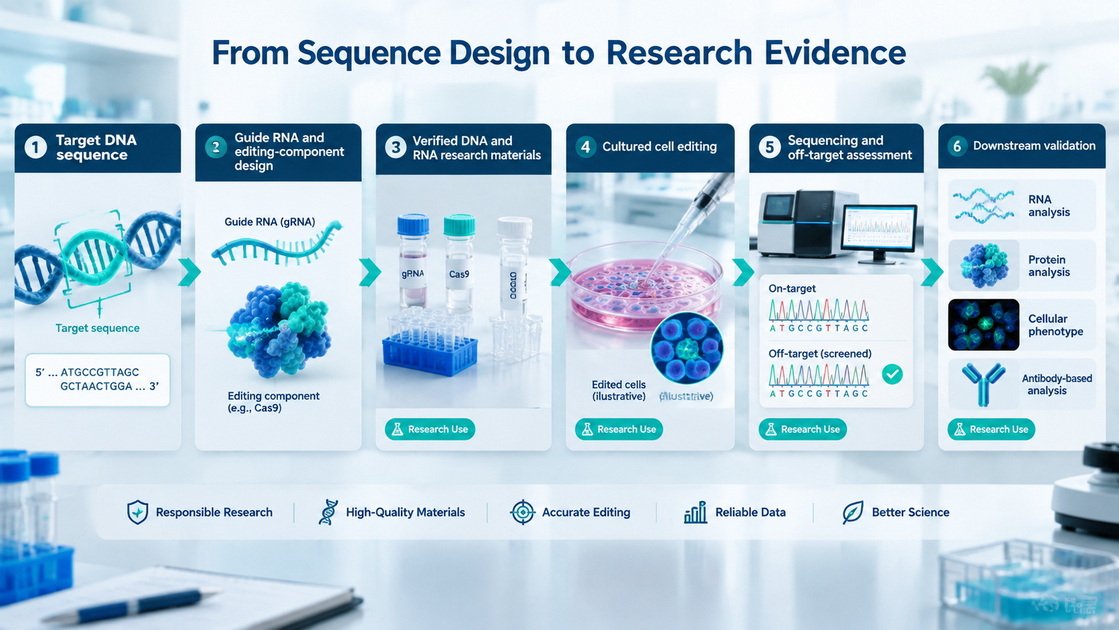
From Sequence Design to Research Evidence
For research teams, reliable conclusions begin long before an edit is introduced into a cell.
A disciplined workflow connects design decisions to measurable biological outcomes.
1: Define the Biological Hypothesis
Specify:
- The target gene or variant
- The genomic locus
- The biological pathway
- The intended cell type
- The expected molecular effect
- The expected cellular phenotype
A precise hypothesis makes it easier to select the appropriate editor, controls, and analytical methods.
2: Design Editing Components and Controls
Researchers should design the editing reagents and establish appropriate controls.
Depending on the experiment, these may include:
- Non-targeting controls
- Mock-treated controls
- Untreated cells
- Positive controls
- Editing-process controls
- Rescue experiments
- Independent guide sequences
- Biological replicates
Controls help distinguish true target effects from delivery effects, editing stress, batch variation, and assay noise.
3: Verify Sequence Identity and Material Quality
DNA or RNA reagents should match the intended design.
Errors introduced at this stage can affect every downstream result. Sequence verification, material documentation, concentration measurements, and fit-for-purpose quality assessment can reduce avoidable uncertainty.
4: Measure Multiple Editing Outcomes
Researchers should avoid reporting only the preferred sequence result.
A comprehensive analysis may examine:
- Unedited sequence
- Intended edit
- Insertions and deletions
- Mixed sequence outcomes
- Potential off-target sites
- Large structural changes
- Editing frequency across replicates
The analytical method should match the expected type and frequency of the edit.
5: Connect Genotype to Function
A useful experiment should connect the DNA result to downstream biology.
Depending on the project, this may involve:
- RNA expression analysis
- Protein production
- Protein binding
- Enzyme activity
- Cell viability
- Signaling changes
- Morphological changes
- Disease-relevant cellular phenotypes
This step is especially important when the edited sequence is expected to affect protein structure or expression.
6: Document Limitations
Every experimental system has constraints.
Researchers should document:
- Detection thresholds
- Model limitations
- Batch effects
- Cell-line characteristics
- Delivery efficiency
- Assay variability
- Unresolved sequence outcomes
- Differences between model systems and human biology
Transparent limitations improve reproducibility and help other teams interpret the findings correctly.
Supporting Genome-Editing Research
Gene Universal supports global life-science research with end-to-end services spanning DNA/RNA, proteins, and antibodies.
These capabilities can help researchers move from sequence concepts toward:
- Early discovery and characterization
- Gene-function studies
- Disease-model development
- Editing-component preparation
- Protein expression and analysis
- Antibody-related research
- Developability-oriented assessment
- Fit-for-purpose research-grade materials
Connecting these service categories can help research teams examine the full biological chain—from the original sequence design to downstream protein and antibody-related validation.
Scope matters: Gene Universal does not provide GMP manufacturing, CDMO services, or IND submission support. Researchers pursuing regulated development should engage appropriately qualified organizations for those activities.
Clear project scoping protects both scientific quality and buyer expectations. It also allows the research workflow to focus on the areas where Gene Universal can provide the most relevant support.
Would You Edit Your DNA?
For a serious disease with a compelling molecular mechanism, no adequate alternative, strong somatic-editing evidence, and rigorous oversight, the answer could reasonably be yes.
For cosmetic enhancement, poorly understood traits, or heritable editing under unresolved safety and governance conditions, the responsible answer is not now.
That position is not anti-innovation. It is how durable innovation is built.
The field advances when researchers:
- State clearly what is known
- Identify what remains uncertain
- Measure what could go wrong
- Use appropriate experimental controls
- Include affected communities in the discussion
- Avoid overstating early findings
- Resist treating technical possibility as automatic permission
The most important question is therefore not simply, "Can DNA be edited?"
It is:
Can a specific edit be justified by its purpose, supported by reliable evidence, delivered to the right cells, evaluated across multiple biological levels, and governed in a way that respects both present and future consequences?
Take the Next Research Step
Planning a genome-editing, gene-function, or disease-modeling study?
Discuss your research objective, target sequence, material requirements, experimental controls, and downstream validation needs with Gene Universal.
Gene Universal can help define a fit-for-purpose research workflow across DNA/RNA, protein, and antibody services—while keeping project scope, material use, and service boundaries transparent.
Frequently Asked Questions
1. Is Genome Editing the Same as Gene Therapy?
No. Gene therapy is a broad category that may add, replace, regulate, or otherwise influence genetic function.
Genome editing specifically changes DNA at selected genomic locations, although the two categories can overlap in practice.
2. Can CRISPR Edit Every Cell in the Body?
No. Delivery depends on the tissue, cell type, editor, and carrier.
Reaching enough target cells while limiting exposure elsewhere remains a major research challenge. Different organs may require different delivery approaches.
3. Are CRISPR Edits Always Permanent?
DNA sequence edits can be permanent in the edited cell and its daughter cells. However, the practical effect depends on cell lifespan, editing distribution, tissue turnover, and biological context.
RNA editing and some epigenetic approaches may produce more transient effects.
4. What Is the Difference Between Somatic and Germline Editing?
Somatic editing targets non-reproductive cells and generally affects one individual.
Germline or embryo editing can create changes that may be inherited by future generations. That possibility introduces additional scientific, ethical, and societal concerns.
5. What Are Off-Target Effects?
Off-target effects are unintended changes at genomic sites other than the intended target.
Assessment may combine computational prediction, targeted sequencing, genome-wide methods, and biological interpretation. No single method necessarily detects every type of unintended change.
6. Has a CRISPR-Based Treatment Been Approved?
Yes. Casgevy became the first FDA-approved treatment using CRISPR-Cas9 in December 2023. Its original approval covered certain patients aged 12 years and older with sickle cell disease.
7. Can Gene Universal Support Genome-Editing Research?
Gene Universal provides research services spanning DNA/RNA, proteins, and antibodies for molecular biology workflows.
Projects should be scoped as research-use support. Gene Universal does not offer GMP manufacturing, CDMO services, or IND submission support.
References
1. [World Health Organization — Human Genome Editing: Recommendations]
2. [World Health Organization — Human Genome Editing: Position Paper]
3. [National Human Genome Research Institute — Ethical Concerns of Genome Editing]
4. [National Institutes of Health — Gene Editing Digital Media Kit]
5. [NIH Common Fund — Somatic Cell Genome Editing Program]
6. [U.S. Food and Drug Administration — FDA Approves First Gene Therapies for Sickle Cell Disease]
7. [U.S. Food and Drug Administration — Human Gene Therapy Products Incorporating Human Genome Editing]
8. [National Institutes of Health — Infant Receives Personalized Gene-Editing Therapy]
9. [PubMed — What Do People Think About Genetic Engineering? A Systematic Review of Survey Studies]
10. [PubMed — Prime Editing: A Gene Precision Editing Tool From Inception to Present]
11. [PubMed — Ethics of Human Genome Editing]
12. [PubMed — Public Acceptability of Gene Therapy and Gene Editing for Human Use]